


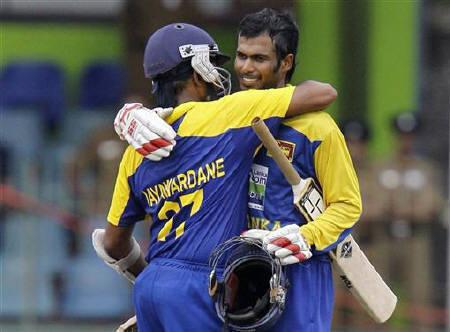
Sri Lanka decimate India by 161 runs

July 3, 2013

Upul_TharangaKingston, Jul 3: Upul Tharanga scored a career-best unbeaten 174 as Sri Lanka produced a clinical display to thrash India by 161 runs in the third match of the ODI tri-series here.

Sent into bat, Sri Lanka first rode on Tharanga's 174 and Mahela Jayawardene's 107 to pile up a mammoth 348 for one yesterday and then shot out the Indians for a paltry 187 in 44.5 overs.

Apart from Tharanga and Jayawardene, skipper Angelo Mathews made a quickfire 44.

The Indians looked a pale shadow of themselves with Ravindra Jadeja top-scoring with an unbeaten 49 followed by Suresh Raina (33), Murali Vijay (30), Shikhar Dhawan (24) and Dinesh Karthik (22).

Rohit Shamra was the first to depart, caught by Mathews at short mideicket off Nuwan Kulasekara's bowling. With a mountain to chase, the Indians found boundaries hard to come by as they dealt mostly in singles and twos.

The ever-climbing asking rate took a tool on the Indians as they lost Dhawan and skipper Virat Kohli in successive overs.

While trying to break the shakles Dhawan found out Tharanga at deep midwicket off Rangana Herath (3/37), Kohli hooked a Mathews delivery straight to Lasith Malinga at fine-leg in the next over.

Maling then went through Vijay's defence two overs later as India slumped to 70 for four after the end of 19 overs.

Wicket-keeper Karthik and Raina added 53 runs off 63 balls for the fitth wicket before the former perished, stumped by Kumar Sangakkara off Herath in the 29th over.

Raina tried hard to get India back on track with a run-a-ball 33 but fell victim of a run out.

Thereafter, the Indian innings fell apart as none other batsmen managed doubled digit scores with only Jadeja showing some teeth before the discipleined Sri Lankan bowling attack.

This is India's second defeat in the tournament after having lost to West Indies by one wicket in their tournament opener.

Earlier, Tharanga smashed a career-best unbeaten 174, while Jayawardene made 107 as Sri Lanka produced a dominant batting display to post an imposing 348 for one. Tharanga scored his runs off just 159 deliveries with the help of 19 boundaries and three hits over the fence.

Jayawardene, on the other hand, faced 112 balls during his century knock. He hit nine fours and two sixes during his innings.

Towards the end, captain Mathews played a 29-ball 49-run cameo to help help Sri Lanka get near the 350-run mark. He struck fours boundaries and one six in the process.

Sent into bat, Sri Lanka made a quiet start to their innings before Jayawadene and Tharanga opened up. Jayawardene and Tharanga mixed caution with aggression to pile up 47 runs in the first 10 overs.

Shami Ahmed, who replaced Bhuveneshwar Kumar, and Umesh Yavad failed to derive any assistance from the low and slow Sabina Park wicket as the Sri Lankan opening duo milked the Indian attack to surge ahead.

Jayawardene, who was dropped by Vijay off Jadeja at the personal score of 25, cashed in on the chance and played sensibly thereafter to reach his fifty in 60 balls with the help of four boundaries and one six.

Tharanga, on the other hand, played second fiddle initially and reached his fifty in 76 balls balls during which he struck five hits to the fence.

Nothing seemed to have worked in favour India captain Virat Kohli, who is leading the side in place of injured Mahendra Singh Dhoni, as his bowling changes came a cropper against the Sri Lankans today.

Kohli, who will captain India in the remainder of the tournament after Dhoni has been ruled out due to a hamstring injury, found the going tough as none of his bowlers managed to produce result till the 39th over of the innings.

Off-spinner Ravichandran Ashwin finally managed to break the deadlock when he dismissed the dangerous-looking Jayawardene but not before the batsman had scored 107 off 112 balls with the help of nine boundaries and two sixes.

Jayawardene was caught by a diving Yadav at short third man after the batsman went for reverse sweep.

Tharanga, however, went about his business in a quiet fashion and notched up his century in 124 balls during which he hit 11 boundaries. After Jayawardene's dismissal, Tharanga took the lead and in skipper Mathews' company he blossomed to take Sri Lanka forward.

The duo of Tharanga and Mathews pressed on the gas and registered their 50-run stand in just 27 balls.

Jadeja, who was the bowler of the tournament in the ICC Champions Trophy, came in for some harsh treatment as Tharanga and Mathews hit the left-arm spinner for a six each to pile up 15 runs in the 44th over.

Tharanga and Mathews took the ordinary-looking Indian attack for a task and struck boundaries and sixes at will to pile a whopping 124 runs off the last 10 overs.

Score Board

Sri Lanka:

Upul Tharanga not out 174

Mahela Jayawardene c Yadav b Ashwin 107

Angelo Mathews not out 44

Extras: (B-1, LB-6, W-16) 23

Total: (1 wicket in 50 overs) 348

Fall of wickets: 1-213

Bowling: Ahmed 10-0-68-0, Yadav 8-0-64-0, Sharma 9-0-68-0, Jadeja 9-0-55-0, Ashwin 10-0-67-1, Kohli 2-0-9-0, Raina 2-0 -10-0.

India innings:

Rohit Sharma c Mathews b Kulasekara 5

Shikhar Dhawan c Tharanga b Herath 24

Murali Vijay b Malinga 30

Virat Kohli c Malinga b Mathews 2

Dinesh Karthik st Sangakkara b Herath 22

Suresh Raina run out 33

Ravindra Jadeja not out 49

Ravichandran Ashwin c Malinga b Senanayake 4

Shami Ahmed b Senanayake 0

Ishant Sharma c Sangakkara b Herath 2

Umesh Yadav b Malinga 0

Extras: (LB-4, W-12) 16

Total: (all out in 44.5 overs) 187

Fall of wickets: 1-12, 2-52, 3-57, 4-65, 5-118, 6-142, 7-153, 8-153, 9-166, 10-187.

Bowling: Kulasekara 9-0-37-1, Mathews 8-2-23-1, Senanayake 10-0-46-2, Herath 10-0-37-3, Malinga 7.5-0-40-2.

Comments

Add new comment

  • Coastaldigest.com reserves the right to delete or block any comments.
  • Coastaldigset.com is not responsible for its readers’ comments.
  • Comments that are abusive, incendiary or irrelevant are strictly prohibited.
  • Please use a genuine email ID and provide your name to avoid reject.
News Network
January 22,2020

New Delhi, Jan 22: The pitches in New Zealand have become a lot more batting-friendly over the years, says iconic former batsman Sachin Tendulkar, insisting that India have the “ammunition” to trouble the sprightly hosts during the upcoming series.

Tendulkar, who has been on a record five New Zealand tours since 1990, feels that from seaming tracks during his early trips years, the tracks became high-scoring hard ones during his last tour back in 2009.

“Of late, the Tests in New Zealand have been high scoring and surfaces have changed,” Tendulkar told PTI during an exclusive interview.

India will play five T20 Internationals, three ODIs and two Tests during the tour starting with the shortest format on January 24.

From 2002, when India played ODIs and Tests on green tops, to 2009, when India won only their second Test series in 32 years, Tendulkar has seen it all in New Zealand.

“I remember when we played in 2009, the Hamilton pitch was different compared to other pitches. Other pitches got harder (Wellington and Napier) but not Hamilton. It remained soft.

“But Napier became hard with passage of time (where Gautam Gambhir scored an epic match-saving 12-hour hundred in 2009). So, from my first tour (in 1990 till 2009), I realised pitches got harder with passage of time,” Tendulkar said.

Tendulkar is confident that the Indian bowling attack, spearheaded by Jasprit Bumrah, has the ammunition to put New Zealand in trouble.

“We have a good bowling attack with quality fast bowlers as well as spinners. I believe we have the ammunition to compete in New Zealand.”

However, in Wellington, Tendulkar wants the team to be well-prepared to counter the breeze factor.

“Wellington, I have played and it makes a huge difference if you are bowling with the wind or against the wind. The batsman needs to be judicious in the choice of which end he wants to attack, it is very important,” he said.

Tendulkar said he would prefer spinners to bowl against the breeze.

“...the seamers bowling against the strong breeze need to be smart. So I would prefer that if there is strong breeze, let the spinner bowl from that end and from the opposite end, the fast bowler bowls with the breeze behind him,” he said.

The maestro is confident that Rohit Sharma's white ball experience will hold him in good stead in the Tests as well, an assignment that has been kept for the last leg of the trip, which begins with five T20 Internationals from January 24.

“The challenge would be to go out and open in different conditions. I think Rohit had opened in New Zealand in ODIs and has been there quite a few times, he knows the conditions well. Eventually, Test cricket is Test cricket,” he said.

“But all depends on surfaces that they provide. If they provide green tops, then it's a challenge.”

There is no Bhuvneshwar Kumar or Deepak Chahar in limited-overs series but Tendulkar is not ready to press the panic button.

“Injuries are part and parcel of the game when you play and push your body to the limits.

“When you play for your country you need to give your best and while you give your best, you can get injured. That's okay,” he concluded.

Comments

Add new comment

  • Coastaldigest.com reserves the right to delete or block any comments.
  • Coastaldigset.com is not responsible for its readers’ comments.
  • Comments that are abusive, incendiary or irrelevant are strictly prohibited.
  • Please use a genuine email ID and provide your name to avoid reject.
Agencies
April 2,2020

Lausanne, Apr 2: The postponement of the Tokyo Olympics and the shutdown of the sporting calendar because of the coronavirus pandemic are going to hit international sports federations hard financially.

Many sports that are part of the Games depend heavily on the payouts every four years from the International Olympic Committee (IOC).

"The situation is tense and very gloomy. An assessment will be made, but clearly some posts are under threat," said an official of a major international federation.

The 28 international federations (IF) of the sports that were due to be present at the Tokyo Olympics, would have received substantial sums from the IOC.

However, the postponement of the Games until 2021 could lead to a freeze of their payment.

"We have a lot of IF with substantial reserves, but others work on a different business model, they have income from major events which are suspended, which can be a problem for the cashflow if they don't have enough reserves," said Andrew Ryan, director general of the Association of International Olympic Summer Sports Federations (ASOIF), which is responsible for distributing this money.

The five additions to the Tokyo Games programme - karate, surfing, skateboarding, climbing and baseball/softball - are not eligible.

The Olympic payout totalled 520 million after the Rio Games, four years ago.

"The Olympic money could be less than for Rio 2016," Ryan warned before adding: "My advice is to budget the same as in Rio".

The federations receive money on a sliding scale determined by their audience and size.

The three largest (athletics, swimming and gymnastics) can expect approximately 40 million.

For the second tier, made up of cycling, basketball, volleyball, football and tennis, the sum is 25 million.

For group three, which contains eight sports, including boxing, rowing, judo and table tennis, it is 17 million.

The nine sports in the next level (including sailing, canoing and fencing) receive 12 million.

For the three in the last category (rugby, golf, modern pentathlon) the payout is 7 million.

For the largest associations, such as football's FIFA which has a 1.5 billion nest egg, or basketball body FIBA which has CHF 44.4 million (42 million euros) in reserves, IOC aid represents a small proportion of their income.

For others, it is vital.

"Some IF probably don't have the cashflow to survive one year," said Ryan.

For most federations, the postponement of the Olympic Games has a domino effect, forcing them to reschedule their own money-earning competitions.

"The revenues from these events will eventually come in," said Ryan. "But this impacts the cashflow." World Athletics has already postponed the 2021 World Championships in Eugene, Oregon to 2022.

The International Swimming Federation (FINA) will have to do the same for its World Championships scheduled for next summer in Fukuoka, Japan, when they would probably clash with the Tokyo Games.

"One edition of the World Championships means for us 10 million in revenues," said one sports federation official, speaking on condition of anonymity.

"If this income is postponed, totally or partially, for a year, we will face major problems, especially if the IOC money, originally expected in September, is not paid out."

The Singapore-based International Table Tennis Federation has already taken steps, with "the Executive Committee agreeing to reduce their expenses and senior staff offering to take a salary reduction," said marketing director Matt Pound, but, he added,"further cuts will take place if needed."

- 'Significant loss of revenue' -

The ITTF has suspended all its competitions until June and that is costly.

Kim Andersen, the Danish president of London-based World Sailing, said commercial revenues are not immune.

"The IOC will eventually pay out its aid, but what weighs most heavily is the uncertainty about whether our competitions will be held and whether our sponsors will be maintained," he said.

The IOC is not prepared to go into details of what it plans.

"It is not possible at this stage to assess the overall impact" of the postponement of the Tokyo Olympics, an official told AFP.

"It depends on a number of variables that are currently being studied." According to an official of one federation: "the IOC will discuss on a case-by-case basis, sport by sport".

Another option is for the federations to ask for a share of the public aid set up to deal with the coronavirus crisis, in Switzerland, where 22 ASOIF members are based and also in the United Kingdom, home of World Sailing.

"Can sports federations benefit from federal aid? The answer is yes, in principle," Philippe Leuba, State Councillor of the canton of Vaud, in charge of the economy and sport, told.

Comments

Add new comment

  • Coastaldigest.com reserves the right to delete or block any comments.
  • Coastaldigset.com is not responsible for its readers’ comments.
  • Comments that are abusive, incendiary or irrelevant are strictly prohibited.
  • Please use a genuine email ID and provide your name to avoid reject.
News Network
June 22,2020

New Delhi, Jun 22: Claiming to be saddled with faulty equipment from China, the Indian Weightlifting Federation (IWLF) on Monday called for a boycott of sports apparatus made in that country after the violent face-off in eastern Ladakh killed 20 Army personnel last week.

The IWLF ordered four weightlifting sets, comprising barbells and weight plates, from Chinese company 'ZKC' last year. The body said that the equipment turned out to be faulty and the weightlifters are no longer using them.

"We should boycott all Chinese equipment. The Indian Weightlifting Federation has taken the decision that it will not use any equipment made in China," IWLF secretary general Sahdev Yadav said.

The IWLF, in a letter, has informed the Sports Authority of India (SAI) about its decision to stop using any equipment made in China.

"In a letter to SAI we have written that IWLF won't be using the Chinese equipment," he said.

"In future also we will not use made in china sets. We will use sets made by Indian origin companies or any other company but not from China," Yadav added.

National coach Vijay Sharma revealed that the plates were found to be sub-standard when the lifters started training again earlier this month following the easing of the COVID-19 lockdown restrictions.

"The sets were spoilt. We can't use them now," Sharma said.

"All the weightlifters in the camp are against China. They have stopped using Chinese apps like Tik Tok. Even while ordering things online, they check where the product has been manufactured," he added.

Asked why the sets were even ordered, Sharma said they had no option as the equipment from China is to be used in the Tokyo Olympics and lifters needed to be familiar with it.

"We had ordered four sets from China for Olympic training a year ago. Now, since we have resumed training post the lockdown we haven't used them. All the lifters are against the use of Chinese equipment," he said.

He said equipment was ordered from China for the first time.

"We don't order equipment from China as the quality is very bad. This was the first time we got it."

The weightlifters are currently training with equipment made in Sweden.

"Post the lockdown we started training on sets from Swedish company 'ELICKO'. SAI has issued 10 sets for us. The main training takes place with those. Maximum international competitions have sets from ELICKO," Sharma said.

Yadav also said that there are ready alternatives to Chinese equipment.

"We have a lot of alternatives. We already have good Indian sets and we also have equipment from Sweden. We will use that, why should we use Chinese?" Yadav said.

Calls to boycott China-made goods erupted across India after the Galwan valley clash last Monday. It was the most violent face-off between the troops from the two countries in more than four decades.

The Indian Olympic Association (IOA) has said it is open to boycotting Chinese products in the wake of the incident.

The BCCI will also review IPL's sponsorship deals, including the title deal with Chinese mobile manufacturing company Vivo later this week.

Comments

Add new comment

  • Coastaldigest.com reserves the right to delete or block any comments.
  • Coastaldigset.com is not responsible for its readers’ comments.
  • Comments that are abusive, incendiary or irrelevant are strictly prohibited.
  • Please use a genuine email ID and provide your name to avoid reject.