


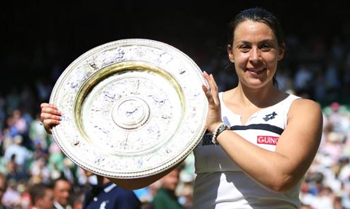
Bartoli routs Lisicki to win first Wimbledon title

July 7, 2013

Wimbledon_titleLondon, Jul 7: Marion Bartoli romped to her first Grand Slam title as the French 15th seed thrashed Germany's Sabine Lisicki 6-1, 6-4 in the Wimbledon final today.

Bartoli, 28, is the fifth oldest woman to become a first-time Grand Slam winner in the Open Era.

Six years after losing to Venus Williams in the Wimbledon final, Bartoli returned to Centre Court and finally ended her long wait for a major crown with a supreme display of power hitting.

She took just 81 minutes to rout 23rd seed Lisicki, who broke down in tears as the match slipped away in the second set.

By finally winning her maiden major title in the 47th Grand Slam appearance of her career, Bartoli surpassed the previous record set by Jana Novotna, who won Wimbledon in 1998 after 45 appearances at the majors.

Bartoli, who will climb to seventh when the latest world rankings are released on Monday, didn't drop a single set in her seven matches and is the first Frenchwoman to win a Grand Slam singles title since Amelie Mauresmo at Wimbledon in 2006.

Ironically, Mauresmo has played a key role in Bartoli's remarkable renaissance over the last two weeks.

Bartoli's career had been on a downward spiral in recent years and she hit rock bottom in February when she struggled with the emotional decision to move on from her dad Walter, who had coached her since childhood.

She eventually turned to Mauresmo for help after failing to strike up a rapport with a series of coaches.

Her compatriot has brought a calmer approach to Bartoli's preparations, to the extent that the 28-year-old was even willing to sleep up to 30 minutes before her semi-final win over Kirsten Flipkens on

Thursday, and her influence was clear to see in the final as Bartoli recovered from a potentially disastrous start.

Bartoli was broken in the first game, but Lisicki then surrendered her own serve in error-strewn fashion.

Lisicki, 23, was a shadow of the bold stroke-maker who stunned defending champion Serena Williams in the fourth round.

But Bartoli had shaken off her early anxiety and took advantage of Lisicki's nerves to break again for a 3-1 lead.

Throughout her career Bartoli's game has been marked by bizarre routines as she jumps, skips, shuffles and twirls her racket before serving or returning.

And her quirky routine was on full display as she took the attack to Lisicki in the sixth game, breaking to seal the set thanks to a series of punishing forehands.

Lisicki had every reason to hang her head as she trudged off court to gather her thoughts during a bathroom break before the start of the second set.

The German finally held serve for the first time in the match when she returned to start the second set.

She then mounted her only serious threat to Bartoli's dominance, earning four break points in the second game, only to see the Frenchwoman come up with a series of blistering winners.

Bartoli had scented Lisicki's discomfort and landed the decisive blow with a break to move 2-1 ahead.

Liskci's beaming smile and all-action style had made her the darling of the Centre Court crowd this year, but this was a miserable end to her fairytale run and she was in tears when she served at 3-1 down.

Bartoli showed no mercy, breaking again as she took a 5-1 lead.

With the title within touching distance, tension crept into Bartoli's game and Lisicki was able to prolong the battle longer than expected.

But Bartoli eventually settled back down and sealed the biggest win of her life with an ace before climbing into stands to share a joyous embrace with Mauresmo and her father.

Comments

Add new comment

  • Coastaldigest.com reserves the right to delete or block any comments.
  • Coastaldigset.com is not responsible for its readers’ comments.
  • Comments that are abusive, incendiary or irrelevant are strictly prohibited.
  • Please use a genuine email ID and provide your name to avoid reject.
Agencies
April 2,2020

Lausanne, Apr 2: The postponement of the Tokyo Olympics and the shutdown of the sporting calendar because of the coronavirus pandemic are going to hit international sports federations hard financially.

Many sports that are part of the Games depend heavily on the payouts every four years from the International Olympic Committee (IOC).

"The situation is tense and very gloomy. An assessment will be made, but clearly some posts are under threat," said an official of a major international federation.

The 28 international federations (IF) of the sports that were due to be present at the Tokyo Olympics, would have received substantial sums from the IOC.

However, the postponement of the Games until 2021 could lead to a freeze of their payment.

"We have a lot of IF with substantial reserves, but others work on a different business model, they have income from major events which are suspended, which can be a problem for the cashflow if they don't have enough reserves," said Andrew Ryan, director general of the Association of International Olympic Summer Sports Federations (ASOIF), which is responsible for distributing this money.

The five additions to the Tokyo Games programme - karate, surfing, skateboarding, climbing and baseball/softball - are not eligible.

The Olympic payout totalled 520 million after the Rio Games, four years ago.

"The Olympic money could be less than for Rio 2016," Ryan warned before adding: "My advice is to budget the same as in Rio".

The federations receive money on a sliding scale determined by their audience and size.

The three largest (athletics, swimming and gymnastics) can expect approximately 40 million.

For the second tier, made up of cycling, basketball, volleyball, football and tennis, the sum is 25 million.

For group three, which contains eight sports, including boxing, rowing, judo and table tennis, it is 17 million.

The nine sports in the next level (including sailing, canoing and fencing) receive 12 million.

For the three in the last category (rugby, golf, modern pentathlon) the payout is 7 million.

For the largest associations, such as football's FIFA which has a 1.5 billion nest egg, or basketball body FIBA which has CHF 44.4 million (42 million euros) in reserves, IOC aid represents a small proportion of their income.

For others, it is vital.

"Some IF probably don't have the cashflow to survive one year," said Ryan.

For most federations, the postponement of the Olympic Games has a domino effect, forcing them to reschedule their own money-earning competitions.

"The revenues from these events will eventually come in," said Ryan. "But this impacts the cashflow." World Athletics has already postponed the 2021 World Championships in Eugene, Oregon to 2022.

The International Swimming Federation (FINA) will have to do the same for its World Championships scheduled for next summer in Fukuoka, Japan, when they would probably clash with the Tokyo Games.

"One edition of the World Championships means for us 10 million in revenues," said one sports federation official, speaking on condition of anonymity.

"If this income is postponed, totally or partially, for a year, we will face major problems, especially if the IOC money, originally expected in September, is not paid out."

The Singapore-based International Table Tennis Federation has already taken steps, with "the Executive Committee agreeing to reduce their expenses and senior staff offering to take a salary reduction," said marketing director Matt Pound, but, he added,"further cuts will take place if needed."

- 'Significant loss of revenue' -

The ITTF has suspended all its competitions until June and that is costly.

Kim Andersen, the Danish president of London-based World Sailing, said commercial revenues are not immune.

"The IOC will eventually pay out its aid, but what weighs most heavily is the uncertainty about whether our competitions will be held and whether our sponsors will be maintained," he said.

The IOC is not prepared to go into details of what it plans.

"It is not possible at this stage to assess the overall impact" of the postponement of the Tokyo Olympics, an official told AFP.

"It depends on a number of variables that are currently being studied." According to an official of one federation: "the IOC will discuss on a case-by-case basis, sport by sport".

Another option is for the federations to ask for a share of the public aid set up to deal with the coronavirus crisis, in Switzerland, where 22 ASOIF members are based and also in the United Kingdom, home of World Sailing.

"Can sports federations benefit from federal aid? The answer is yes, in principle," Philippe Leuba, State Councillor of the canton of Vaud, in charge of the economy and sport, told.

Comments

Add new comment

  • Coastaldigest.com reserves the right to delete or block any comments.
  • Coastaldigset.com is not responsible for its readers’ comments.
  • Comments that are abusive, incendiary or irrelevant are strictly prohibited.
  • Please use a genuine email ID and provide your name to avoid reject.
News Network
March 29,2020

New Delhi, Mar 29: Former Indian batsman Wasim Jaffer on Sunday picked his all-time IPL team and appointed wicket-keeper batsman MS Dhoni as its captain.

Jaffer's team's feature opener Rohit Sharma, current Indian skipper Virat Kohli, all-rounder Hardik Pandya, spinner R Ashwin, and pacer Jasprit Bumrah as seven domestic players.
While the foreign players spot have been occupied by West Indies' swashbuckling batsman Chris Gayle, all-rounder Andre Russell, Afghanistan's spinner Rashid Khan, and Sri Lanka's veteran pacer Lasith Malinga.
Indian all-rounder Ravindra Jadeja has been picked as 12th man by Jaffer.

Earlier this month, the Board of Control for Cricket in India (BCCI) decided to postpone the IPL to April 15, 2020, as a precautionary measure against COVID-19 outbreak.
The board also assured that it will work in unison with the Sports Ministry and will adhere to the guidelines issued.

The 13th edition of IPL was scheduled to commence from March 29. 

Comments

Add new comment

  • Coastaldigest.com reserves the right to delete or block any comments.
  • Coastaldigset.com is not responsible for its readers’ comments.
  • Comments that are abusive, incendiary or irrelevant are strictly prohibited.
  • Please use a genuine email ID and provide your name to avoid reject.
Agencies
April 14,2020

Tokyo, Apr 14: Tokyo organizers said Tuesday they have no B Plan in the event the Olympics need to be postponed again because of the coronavirus pandemic.

Masa Takaya, the spokesman for the Tokyo Olympics, said organizers are proceeding under the assumption the Olympics will open on July 23, 2021. The Paralympics follow on Aug. 24.

Those dates were set last month by the International Olympic Committee and Japanese officials after the coronavirus pandemic made it clear the Olympics could not be held as scheduled this summer.

We are working toward the new goal, Takaya said, speaking in English on a teleconference call with journalists.

We don't have a B Plan. The severity of the pandemic and the death toll has raised questions if it will even be feasible to hold the Olympics in just over 15 months. Several Japanese journalists raised the question on the call.

All I can tell you today is that the new games' dates for both the Olympic and Paralympic Games have been just set up, Takaya said.

In that respect, Tokyo 2020 and all concerned parties now are doing their very best effort to deliver the games next year." IOC President Thomas Bach was asked about the possibility of a postponement in an interview published in the German newspaper Die Welt on Sunday.

He did not answer the question directly, but said later that Japanese organizers and Prime Minister Shinzo Abe indicated they could not manage a postponement beyond next summer at the lastest.

The Olympics draw 11,000 athletes and 4,400 Paralympic athletes and large support staffs from 206 national Olympic committees.

There are also questions about frozen travel, rebooking hotels, cramming fans into stadiums and arenas, securing venues, and the massive costs of rescheduling, which is estimated in Japan at 2 billion- 6 billion.

Tokyo 2020 CEO Toshiro Muto addressed the issue in a news conference on Friday. He is likely to be asked about it again on Thursday when local organizers and the IOC hold a teleconferene with media in Japan.

The other major question is the cost of the delay; how much will it be, and who pays? Bach said in the Sunday interview that the IOC would incur several hundred million dollars in added costs. Under the so-called Host City Agreement, Japan is liable for the vast majority of the expenses.

This is impossible to say for now, Takaya, the spokesman said.

It is not very easy to estimate the exact amount of the games' additional costs, which have been impacted by the postponement."

Tokyo says it's spending 12.6 billion to organize the Olympics. But a Japanese government audit published last year says the costs are twice that much. Of the total spending, 5.6 billion in private money. The rest is from Japanese governments.

Comments

Add new comment

  • Coastaldigest.com reserves the right to delete or block any comments.
  • Coastaldigset.com is not responsible for its readers’ comments.
  • Comments that are abusive, incendiary or irrelevant are strictly prohibited.
  • Please use a genuine email ID and provide your name to avoid reject.