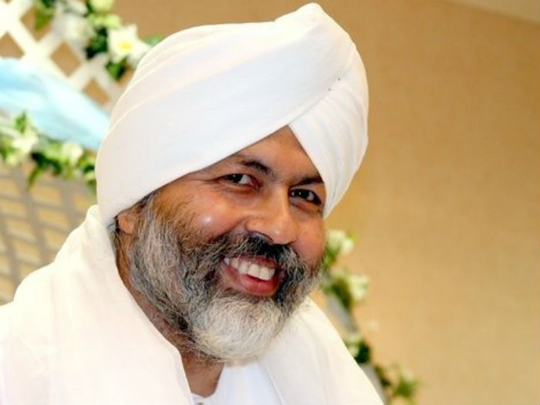
Nirankari sect head Baba Hardev Singh killed in Canada accident: reports

May 13, 2016

New Delhi, May 13: Indian spiritual leader and Nirankari sect head Baba Hardev Singh was reportedly killed in a car accident in Canada on Friday.

Narsingh copy

BJP leader Shahnawaz Hussain confirmed the development on Twitter.

Baba Hardev Singh was the chief priest of the spiritual organization Sant Nirankari Mission. He was born to the previous Satguru of Sant Nirankari Mission, Gurbachan Singh and his wife Kulwant Kaur.

The Sant Nirankari Movement or Universal Brotherhood Movement, which was started by Baba Buta Singh in early 19th century, believes in the importance of a living leader. Sikhism, on the other hand, believed in the Sikh scriptures as their final guru. It was this difference that caused the Sant Nirankari movement, which separated from mainstream Sikhism in 1929.

Satguru Gurbachan Singh was assassinated by fundamentalist Sikhs belonging to Akhand Kirtani Jatha who were wary of the growing power of the Nirankari Mission.

After the assassination, Baba Hardev Singh succeeded his father as the Satguru of the mission and continued to provide teachings to the believers.

The mission has grown to be a global entity with over 2000 centres around the world.

Comments

Sanjay kumar
 - 
Thursday, 19 Jul 2018

In reply to by Sadhu Maharaj

Interesting how the first leader was his grand father and then his father and then him, after his death, his wife and then his daughter. Is this the first ‘family’ of spirituality? Seems more like a family business. 

Sadhu Maharaj
 - 
Friday, 13 May 2016

Deeply saddened to learn the demise of Baba Hardev Singh ji. Baba Hardev Singh's demise is a huge loss to the Nirankari Mission.

Ram charan
 - 
Friday, 13 May 2016

Saddened to hear about the demise of #nirankari Baba. Hardev Singh. RIP

Priyanka Chopra
 - 
Friday, 13 May 2016

Deeply pained by the untimely death of the Nirankari Baba Hardev Singh Ji Maharaj

Umanath Kotian
 - 
Friday, 13 May 2016

Singh's demise is a huge loss to the Nirankari society. May God give his followers the strength to bear the pain of his death.

Add new comment

  • Coastaldigest.com reserves the right to delete or block any comments.
  • Coastaldigset.com is not responsible for its readers’ comments.
  • Comments that are abusive, incendiary or irrelevant are strictly prohibited.
  • Please use a genuine email ID and provide your name to avoid reject.
News Network
May 20,2020

London, May 20: The current physical distancing guidelines of 6 feet may be insufficient to prevent COVID-19 transmission, according to a study which says a mild cough in low wind speeds can propel saliva droplets by as much as 18 feet.

Researchers, including those from the University of Nicosia in Cyprus, said a good baseline for studying the airborne transmission of viruses, like the one behind the COVID-19 pandemic, is a deeper understanding of how particles travel through the air when people cough.

In the study, published in the journal Physics of Fluids, they said even with a slight breeze of about four kilometres per hour (kph), saliva travels 18 feet in 5 seconds.

"The droplet cloud will affect both adults and children of different heights," said study co-author Dimitris Drikakis from the University of Nicosia.

According to the scientists, shorter adults and children could be at higher risk if they are located within the trajectory of the saliva droplets.

They said saliva is a complex fluid, which travels suspended in a bulk of surrounding air released by a cough, adding that many factors affect how saliva droplets travel in the air.

These factors, the study noted, include the size and number of droplets, how they interact with one another and the surrounding air as they disperse and evaporate, how heat and mass are transferred, and the humidity and temperature of the surrounding air.

In the study, the scientists created a computer simulation to examine the state of every saliva droplet moving through the air in front of a coughing person.

The model considered the effects of humidity, dispersion force, interactions of molecules of saliva and air, and how the droplets change from liquid to vapour and evaporate, along with a grid representing the space in front of a coughing person.

Each grid, the scientists said, holds information about variables like pressure, fluid velocity, temperature, droplet mass, and droplet position.

The study analysed the fates of nearly 1,008 simulated saliva droplets, and solved as many as 3.7 million equations.

"The purpose of the mathematical modelling and simulation is to take into account all the real coupling or interaction mechanisms that may take place between the main bulk fluid flow and the saliva droplets, and between the saliva droplets themselves," explained Talib Dbouk, another co-author of the study.

However, the researchers added that further studies are needed to determine the effect of ground surface temperature on the behaviour of saliva in air.

They also believe that indoor environments, especially ones with air conditioning, may significantly affect the particle movement through air.

This work is important since it concerns safety distance guidelines, and advances the understanding of the transmission of airborne diseases, Drikakis said.

Comments

Add new comment

  • Coastaldigest.com reserves the right to delete or block any comments.
  • Coastaldigset.com is not responsible for its readers’ comments.
  • Comments that are abusive, incendiary or irrelevant are strictly prohibited.
  • Please use a genuine email ID and provide your name to avoid reject.
News Network
April 22,2020

London, Apr 22: The UK government on Tuesday announced a 20 million pounds funding for a University of Oxford project working on developing a vaccine against the novel coronavirus, which is now ready for acceleration as it begins human trials from Thursday.

UK Health Secretary Matt Hancock told the daily Downing Street briefing that the Department for Health was “throwing everything” at trying to find a vaccine because it is a critical aspect of the COVID-19 pandemic fight and lifting the strict lockdown measures in place to curb its spread.

Another 22.5 million pounds is being made available to Imperial College London to support its phase-two clinical trials for them to begin the work on a very large phase three trial.

"Normally it would take years to get to this point," said Hancock.

"The UK is at the forefront of the global effort – we've put in more money than any other into the global search for a vaccine. Nothing about this is inevitable. Vaccine production is a matter of trial and error. But the UK will throw everything it has at trying to find one,” he said.

The announcement came as Britain had another major daily leap in the hospital death toll from coronavirus, up by 823 to hit 17,337 on Tuesday.

But the Cabinet minister said the government's plan to control the rapid spread of the virus and prevent the state-funded National Health Service (NHS) from being overwhelmed is working as the number of hospitalisations with COVID-19 was showing a downward trajectory.

In reference to a major issue in the last few weeks of a critical shortage of personal protective equipment (PPE) for doctors and nurses on the frontlines of COVID-19 treatment, the minister said the supply problems are being addressed by actively engaging with thousands of companies, including 159 UK manufacturers.

“We are determined to get people the PPE they need. This is a 24/7 operation, one of the biggest cross-government operation I have ever seen," said Hancock.

Comments

Add new comment

  • Coastaldigest.com reserves the right to delete or block any comments.
  • Coastaldigset.com is not responsible for its readers’ comments.
  • Comments that are abusive, incendiary or irrelevant are strictly prohibited.
  • Please use a genuine email ID and provide your name to avoid reject.
Agencies
July 2,2020

Moscow, Jul 2: Russian voters approved changes to the constitution that will allow President Vladimir Putin to hold power until 2036, but the weeklong plebiscite that concluded Wednesday was tarnished by widespread reports of pressure on voters and other irregularities.

With most of the nation's polls closed and 20% of precincts counted, 72% voted for the constitutional amendments, according to election officials.

For the first time in Russia, polls were kept open for a week to bolster turnout without increasing crowds casting ballots amid the coronavirus pandemic a provision that Kremlin critics denounced as an extra tool to manipulate the outcome.

A massive propaganda campaign and the opposition's failure to mount a coordinated challenge helped Putin get the result he wanted, but the plebiscite could end up eroding his position because of the unconventional methods used to boost participation and the dubious legal basis for the balloting.

By the time polls closed in Moscow and most other parts of Western Russia, the overall turnout was at 65%, according to election officials. In some regions, almost 90% of eligible voters cast ballots.

On Russia's easternmost Chukchi Peninsula, nine hours ahead of Moscow, officials quickly announced full preliminary results showing 80% of voters supported the amendments, and in other parts of the Far East, they said over 70% of voters backed the changes.

Kremlin critics and independent election observers questioned the turnout figures.

We look at neighboring regions, and anomalies are obvious there are regions where the turnout is artificially (boosted), there are regions where it is more or less real, Grigory Melkonyants, co-chair of the independent election monitoring group Golos, told The Associated Press.

Putin voted at a Moscow polling station, dutifully showing his passport to the election worker. His face was uncovered, unlike most of the other voters who were offered free masks at the entrance.

The vote completes a convoluted saga that began in January, when Putin first proposed the constitutional changes.

He offered to broaden the powers of parliament and redistribute authority among the branches of government, stoking speculation he might seek to become parliamentary speaker or chairman of the State Council when his presidential term ends in 2024.

His intentions became clear only hours before a vote in parliament, when legislator Valentina Tereshkova, a Soviet-era cosmonaut who was the first woman in space in 1963, proposed letting him run two more times.

The amendments, which also emphasize the primacy of Russian law over international norms, outlaw same-sex marriages and mention a belief in God as a core value, were quickly passed by the Kremlin-controlled legislature.

Putin, who has been in power for more than two decades longer than any other Kremlin leader since Soviet dictator Josef Stalin said he would decide later whether to run again in 2024.

He argued that resetting the term count was necessary to keep his lieutenants focused on their work instead of darting their eyes in search for possible successors.

Analyst Gleb Pavlovsky, a former Kremlin political consultant, said Putin's push to hold the vote despite the fact that Russia has thousands of new coronavirus infections each day reflected his potential vulnerabilities.

Putin lacks confidence in his inner circle and he's worried about the future, Pavlovsky said.

He wants an irrefutable proof of public support.

Even though the parliament's approval was enough to make it law, the 67-year-old Russian president put his constitutional plan to voters to showcase his broad support and add a democratic veneer to the changes.

But then the coronavirus pandemic engulfed Russia, forcing him to postpone the April 22 plebiscite.

The delay made Putin's campaign blitz lose momentum and left his constitutional reform plan hanging as the damage from the virus mounted and public discontent grew.

Plummeting incomes and rising unemployment during the outbreak have dented his approval ratings, which sank to 59%, the lowest level since he came to power, according to the Levada Center, Russia's top independent pollster.

Moscow-based political analyst Ekaterina Schulmann said the Kremlin had faced a difficult dilemma: Holding the vote sooner would have brought accusations of jeopardizing public health for political ends, while delaying it raised the risks of defeat.

Holding it in the autumn would have been too risky, she said.

In Moscow, several activists briefly lay on Red Square, forming the number 2036 with their bodies in protest before police stopped them.

Some others in Moscow and St. Petersburg staged one-person pickets and police didn't intervene.

Several hundred opposition supporters rallied in central Moscow to protest the changes, defying a ban on public gatherings imposed for the coronavirus outbreak. Police didn't intervene and even handed masks to the participants.

Authorities mounted a sweeping effort to persuade teachers, doctors, workers at public sector enterprises and others who are paid by the state to cast ballots. Reports surfaced from across the vast country of managers coercing people to vote.

The Kremlin has used other tactics to boost turnout and support for the amendments.

Comments

Add new comment

  • Coastaldigest.com reserves the right to delete or block any comments.
  • Coastaldigset.com is not responsible for its readers’ comments.
  • Comments that are abusive, incendiary or irrelevant are strictly prohibited.
  • Please use a genuine email ID and provide your name to avoid reject.