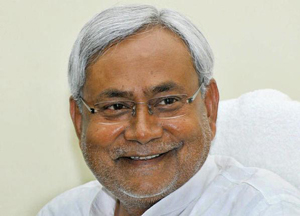
Nitish to skip opposition meet on VP pick

Agencies
July 10, 2017

Patna, Jul 10: Bihar Chief Minister Nitish Kumar cancelled today's public interface event and the subsequent press conference on health grounds, triggering speculation that he is intended to skip the big meet of opposition on Vice President pick. It is also speculated that he is avoiding the media in view of the recent CBI raids on the family of alliance partner Lalu Prasad.

nitishNeither Kumar, nor his party, the JD(U), has commented so far on Friday's CBI raids in four cities in connection with a corruption case, in which Lalu Prasad, his wife Rabri Devi and son Tejashwi are among the accused.

"The Lok Samvad programme, which was scheduled for tomorrow, stands cancelled due to an indisposition of Chief Minister Nitish Kumar," said an official release.

It said the JD(U) chief was down with fever.

Lok Samvad is a public interface programme of Kumar held every Monday. It is aimed at collecting the feedback of the people on the implementation of the development schemes and gather new ideas to strengthen 'sushasan' (good governance).

After the Lok Samvad programme, the chief minister holds a press conference.

While Kumar has maintained a studied silence on the issue of raids on Lalu's family, another ally Congress has expressed solidarity with the RJD chief and accused the central BJP government of "misusing" the official machinery.

Comments

Ahmed Ali K
 - 
Wednesday, 12 Jul 2017

Joke of the millennium
Prohibitory order in Dakshina Kannada??
Q- for whom?
A - Minorities only

Add new comment

  • Coastaldigest.com reserves the right to delete or block any comments.
  • Coastaldigset.com is not responsible for its readers’ comments.
  • Comments that are abusive, incendiary or irrelevant are strictly prohibited.
  • Please use a genuine email ID and provide your name to avoid reject.
News Network
June 4,2020

New Delhi, Jun 4: India on Thursday witnessed a record single-day spike of 9,304 coronavirus cases taking the country's tally to 2,16,919, according to the Union Ministry of Health and Family Welfare.

The ministry informed that 260 more deaths due to coronavirus were reported in the last 24 hours.

The total number of cases in the country now stands at 2,16,919 including 1,06,737 active cases, 1,04,107 cured/discharged/migrated and 6,075 deaths.

Maharashtra has so far reported 74,860 cases, more than any other state in the country.

In Tamil Nadu, 25,872 cases have been detected so far while Delhi has reported 23,645 coronavirus cases.

According to the Indian Council of Medical Research (ICMR), 1,39,485 samples were tested in the last 24 hours whereas 42,42,718 samples have been tested till date.

Comments

Add new comment

  • Coastaldigest.com reserves the right to delete or block any comments.
  • Coastaldigset.com is not responsible for its readers’ comments.
  • Comments that are abusive, incendiary or irrelevant are strictly prohibited.
  • Please use a genuine email ID and provide your name to avoid reject.
Agencies
May 22,2020

New Delhi, May 22: The number of COVID-19 cases averted due to the lockdown is in the range of 14-29 lakh, while the number of lives saved is between 37,000 and 78,000, the government said on Friday citing various studies, and asserted that the unprecedented shutdown has paid “rich dividends” in the fight against the pandemic.

The lockdown in India has been a timely, graded, proactive and pre-emptive public health measure to fight the COVID-19 pandemic and has been part and parcel of the government’s overall strategy, Dr V K Paul, Member (Health), NITI Aayog, and Chairman, Empowered Group 1, said at a media briefing on the COVID-19 situation.

The government imposed the nationwide lockdown from March 25 to prevent the spread of the novel coronavirus and it is currently in its fourth phase.

Like the number of cases, the growth rate of number of COVID-19 deaths too has fallen significantly due to the lockdown, marking a notable difference between pre-lockdown and post-lockdown situations, he said.

At the briefing, Pravin Srivastava, Secretary, Ministry of Statistics and Programme Implementation gave model-based estimates on COVID-19 cases and deaths which have been prevented due to the lockdown.

As per Boston Consulting Group's model, the lockdown saved between 1.2 lakh and 2.1 lakh lives, while the number of COVID-19 cases averted is between 36 lakh and 70 lakh, he said.

According to Public Health Foundation of India, nearly 78,000 lives have been saved due to the lockdown, Srivastava said.

Citing a model by two independent economists, he said that around 23 lakh COVID-19 cases and 68,000 deaths have been averted due to the lockdown.

Some independent experts, including retired scientists, have calculated that around 15.9 lakh cases and 51,000 deaths have been averted due to the lockdown, Srivastava said.

A joint study by the Ministry of Statistics and Programme Implementation and the Indian Statistical Institute found that around 20 lakh COVID-19 cases and 54,000 deaths were averted due to lockdown, he said.

The number of COVID-19 cases averted due to the lockdown is in the range of 14-29 lakh, while the number of lives saved is between 37,000 and 78,000, the official said.

“We are fully confident that the lockdown, with full public cooperation, has reaped rich dividends,” Srivastava said.

The strong defence of the lockdown, comes a day after the health ministry said the period of lockdown has been gainfully utilized to ramp up the health infrastructure, with around 3,027 dedicated COVID-19 hospitals and 7,013 care centres being readied across the country to fight the disease.

The announcement on Thursday came after some media reports questioned the country's preparedness to deal with the highly infectious disease.

"There are reports in a section of the media about some decisions of the government regarding the lockdown implementation and response to COVID-19 management. The period of the lockdown has been gainfully utilised to ramp up the health infrastructure in the country," the ministry had said.

Addressing the press briefing on Friday, joint secretary in the health ministry Lav Agarwal said 48,534 COVID-19 patients, which is about 41 per cent of the total cases, have recovered so far. As many as 3,234 patients have recovered in the last 24 hours, he said’

The COVID-19 mortality rate has dropped from 3.13 per cent on May 19 to 3.02 per cent as focus was on containment measures andclinical management of cases, Agarwal said.

An ICMR official said 27,55,714 tests for COVID-19 have been conducted till 1 pm Friday with 1,03,829 tests done in one day. Over 1 lakh tests for COVID-19 have been done each day for the last four days, the official said.

The growth rate of novel coronavirus cases witnessed a steep decline from Apr 4 when lockdown put a brake on the speed of increase of cases, V K Paul said.

The number of COVID-19 cases would have risen exponentially had the lockdown not been implemented, he said, adding that the doubling rate of cases was 3.4 days when the lockdown started and it is 13.3 days at present.

The COVID-19 outbreak in India has remained confined to limited areas with 80 per cent of active cases in just five states, Paul said

He said around 80 pc of COVID-19 deaths have been in Maharashtra, Gujarat, Madhya Pradesh, West Bengal and Delhi. 

Comments

Add new comment

  • Coastaldigest.com reserves the right to delete or block any comments.
  • Coastaldigset.com is not responsible for its readers’ comments.
  • Comments that are abusive, incendiary or irrelevant are strictly prohibited.
  • Please use a genuine email ID and provide your name to avoid reject.
Agencies
June 30,2020

United Nations, Jun 30: India accounts for 45.8 million of the world's 142.6 million "missing females" over the past 50 years, a report by the United Nations said on Tuesday, noting that the country along with China form the majority of such women globally.

The State of World Population 2020 report released on Tuesday by the United Nations Population Fund (UNFPA), the world organisation's sexual and reproductive health agency, said that the number of missing women has more than doubled over the past 50 years - from 61 million in 1970 to a cumulative 142.6 million in 2020.

Of this global figure, India accounted for 45.8 million missing females as of 2020 and China accounted for 72.3 million.

Missing females are women missing from the population at given dates due to the cumulative effect of postnatal and prenatal sex selection in the past, the agency said.

Between 2013 and 2017, about 460,000 girls in India were missing' at birth each year. According to one analysis, gender-biased sex selection accounts for about two-thirds of the total missing girls, and post-birth female mortality accounts for about one-third, the report said.

Citing data by experts, it said that China and India together account for about 90-95 per cent of the estimated 1.2 million to 1.5 million missing female births annually worldwide due to gender-biased (prenatal) sex selection.

The two countries also account for the largest number of births each year, it said.

The report cites data by Alkema, Leontine and others, 2014 National, Regional, and Global Sex Ratios of Infant, Child, and under-5 Mortality and Identification of Countries with Outlying Ratios: A Systematic Assessment' from The Lancet Global Health.

According to their analysis, India has the highest rate of excess female deaths, 13.5 per 1,000 female births, which suggests that an estimated one in nine deaths of females below the age of 5 may be attributed to postnatal sex selection.

The report notes that governments have also taken action to address the root causes of sex selection. India and Vietnam have included campaigns that target gender stereotypes to change attitudes and open the door to new norms and behaviours.

They spotlight the importance of daughters and highlight how girls and women have changed society for the better. Campaigns that celebrate women's progress and achievements may resonate more where daughter-only families can be shown to be prospering, it said.

The report said that successful education-related interventions include the provision of cash transfers conditional on school attendance; or support to cover the costs of school fees, books, uniforms and supplies, taking note of successful cash-transfer initiatives such as Apni Beti Apna Dhan' in India.

It said that preference for a male child manifested in sex selection has led to dramatic, long-term shifts in the proportions of women and men in the populations of some countries.

This demographic imbalance will have an inevitable impact on marriage systems. In countries where marriage is nearly universal, many men may need to delay or forego marriage because they will be unable to find a spouse, the report said.

This so-called "marriage squeeze", where prospective grooms outnumber prospective brides, has already been observed in some countries and affects mostly young men from lower economic strata.

"At the same time, the marriage squeeze could result in more child marriages, the report said citing experts.

Some studies suggest that the marriage squeeze will peak in India in 2055. The proportion of men who are still single at the age of 50 is forecast to rise after 2050 in India to 10 per cent, it said.

The UN report said that every year, millions of girls globally are subjected to practices that harm them physically and emotionally, with the full knowledge and consent of their families, friends and communities.

At least 19 harmful practices, ranging from breast ironing to virginity testing, are considered human rights violations, according to the UNFPA report, which focuses on the three most prevalent ones: female genital mutilation, child marriage, and extreme bias against daughters in favour of sons.

Harmful practices against girls cause profound and lasting trauma, robbing them of their right to reach their full potential, says UNFPA Executive Director Dr. Natalia Kanem.

This year, an estimated 4.1 million girls will be subjected to female genital mutilation. Today, 33,000 girls under age 18 will be forced into marriages, usually to much older men and an extreme preference for sons over daughters in some countries has fuelled gender-biased sex selection or extreme neglect that leads to their death as children, resulting in the 140 million missing females.

The report said that ending child marriage and female genital mutilation worldwide is possible within 10 years by scaling up efforts to keep girls in school longer and teach them life skills and to engage men and boys in social change.

Investments totalling USD 3.4 billion a year through 2030 would end these two harmful practices and end the suffering of an estimated 84 million girls, it said.

A recent analysis revealed that if services and programmes remain shuttered for six months due to the COVID-19 pandemic, an additional 13 million girls may be forced into marriage and 2 million more girls may be subjected to female genital mutilation between now and 2030.

The pandemic both makes our job harder and more urgent as so many more girls are now at risk, Kanem said.


Comments

Add new comment

  • Coastaldigest.com reserves the right to delete or block any comments.
  • Coastaldigset.com is not responsible for its readers’ comments.
  • Comments that are abusive, incendiary or irrelevant are strictly prohibited.
  • Please use a genuine email ID and provide your name to avoid reject.