No change in stand on Palestine: Govt.

July 22, 2014

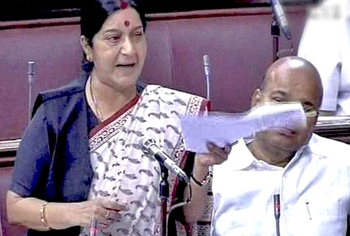
Palestine GovtNew Delhi, Jul 22: The Government on Monday asserted in the Rajya Sabha that India’s policy on the Palestine issue remains unchanged but stonewalled demands for a unanimous resolution on the Gaza conflict, triggering a walkout by the Opposition.

Replying to a short duration discussion in Rajya Sabha on Monday, External Affairs Minister Sushma Swaraj rebutted the Opposition’s call for suspension of all military purchases from Israel and raising the issue at the United Nations. “We fully support the Palestinian cause while maintaining good relations with Israel,” she said.

The Opposition’s demand for a resolution was turned down by Deputy Chairman P.J. Kurien who pointed out that Rule 176, under which the discussion took place, does not provide for a resolution or motion of any kind. Another reason was the Government’s disinclination for a resolution which meant there was no consensus.

With none of their demands met, almost the entire Opposition staged a walkout.

Stating the Government’s position on the conflict in Gaza, Ms. Swaraj said peace would have been restored by now had Hamas accepted the ceasefire proposal from Egypt.

An effort to form a Unity Government by Palestine also failed as Israel refused to recognise a government supported by Hamas, even from outside, leading to a breakdown of the peace talks, she said.

Mr Sitaram Yechury’s (CPI-M) call for suspending arms purchases from Israel was met by a riposte from the External Affairs Minister who wanted to know why his party, which was supporting the UPA-1, had not made such a demand in 2008 when 1,400 Palestinians were killed and then later in 2012 when there was another spurt of violence.

Comments

Add new comment

  • Coastaldigest.com reserves the right to delete or block any comments.
  • Coastaldigset.com is not responsible for its readers’ comments.
  • Comments that are abusive, incendiary or irrelevant are strictly prohibited.
  • Please use a genuine email ID and provide your name to avoid reject.
News Network
March 6,2020

New Delhi, Mar 6: As panicky depositors rushed to withdraw money from Yes Bank whose control was seized by the RBI in a dramatic late-night move, Finance Minister Nirmala Sitharaman on Friday assured depositors that their money is safe and said the central bank was working for an early resolution of the crisis.

The Reserve Bank of India (RBI) on Thursday evening capped withdrawals at Rs 50,000 for the next one month and imposed strict limits on operations at the country's fourth-largest private lender that faced "regular outflow of liquidity" after an effort to raise new capital failed.

"I am in continuous interaction with the RBI. The RBI is fully seized of the matter and has assured they will give a quick resolution," Sitharaman said here.

She said no depositor will lose his or her money and insisted that the immediate priority is to ensure Yes Bank customers are able to withdraw money within the stipulated cap.

"I want to assure every depositor that their money shall be safe. Their monies are safe," she said. "I am constantly in contact with the RBI and the steps that are taken are taken in the interest of depositors, banks and economy. We are fully seized of the development."

She was talking to reporters after meeting State Bank of India (SBI) Chairman Rajnish Kumar. On Thursday, the SBI board gave its "in-principle" approval to exploring investment opportunities in Yes Bank.

"So I repeat, the depositors can be assured that their money is safe," she said.

Soon after the RBI takeover, depositors thronged Yes Bank ATMs to withdraw money and police had to be deployed in some places to control the crowds.

Yes Bank has 1,000 branches across the country.

Refusing to elaborate on her meeting with the SBI chairman, the minister said that "was on a completely different matter".

"RBI governor has given me assurance that there will be an appropriate resolution soon. No depositor will lose (money)," she said. "Reserve Bank has taken cognizance of the problem."

The central bank, she said, has gone through the "process over and over again to find out an amicable solution".

"And that has been over the last couple of months. So it is not as if they have come in suddenly now. We have been monitoring the situation," she said adding the RBI has appointed an administrator who previously was with the SBI.

"Both the RBI and the government are looking at this with all the details before them, not just today. I have personally monitored the situation over the last couple of months with the RBI. Therefore we have taken a course which will be in everybody's interest," she added.

Yes Bank had been seeking new capital since last year to bolster its ratios and quell questions about its stability due to its exposure to the non-banking finance industry entangled in a prolonged crunch in the local credit market.

The SBI chairman said the resolution to the Yes Bank crisis will come "very shortly".

"This is not a sectoral problem. It is a bank-specific problem," he said. "The RBI will take all steps to ensure financial stability."

On SBI picking up a stake in Yes Bank, he said the lender already has an in-principle approval for doing so.

"If SBI has to pick up a stake in Yes Bank, we have an in-principle approval for that," he said.

Commenting on the crisis at Yes Bank, Alka Anbarasu, Vice President – Senior Credit Officer, Financial Institutions, Moody's Investors Service, said: "RBI's moratorium on Yes Bank is credit negative as it affects timely repayment of bank depositors and creditors."

"While Moody's expects Indian authorities will take steps to prevent the weakness in the bank's viability from significantly impacting its depositors and senior creditors, the lack of a coordinated and timely action highlights continued uncertainty around bank resolutions in India," she said.

Comments

Add new comment

  • Coastaldigest.com reserves the right to delete or block any comments.
  • Coastaldigset.com is not responsible for its readers’ comments.
  • Comments that are abusive, incendiary or irrelevant are strictly prohibited.
  • Please use a genuine email ID and provide your name to avoid reject.
News Network
July 16,2020

New Delhi, Jul 16: India's pharmaceutical industry will be able to produce Covid-19 vaccines not just for the country but also for the entire world, according to Microsoft co-founder and philanthropist Bill Gates.

A lot of "very important things have been done" in India and its pharma industry is doing work "to help make the coronavirus vaccine building on other great capacities that they have used for other diseases", said the Co-Chair and Trustee of Bill and Melinda Gates Foundation.

Speaking in a documentary -- Covid-19: India's War Against The Virus -- to be premiered on Discovery Plus this (Thursday) evening, Gates said India also faces a huge challenge due to the health crisis because of its gigantic size and urban centres with a lot of population density.

Commenting on the strength of India's pharma industry, he said, "India has a lot of capacity there -- with the drug and vaccine companies that are huge suppliers to the entire world. You know, more vaccines are made in India than anywhere-- starting with Serum Institute, that's the largest."

He further said, "But (there are) also Bio E, Bharat (Biotech), many others. They are doing work to help make the coronavirus vaccine, building on other great capacities that they have used for other diseases."

Stating that India joined Coalition for Epidemic Preparedness Innovations (CEPI), which is a group working on a global basis to build vaccines platforms, Gates said, "I am excited that the pharmaceutical industry there will be able to produce not just for India but also for the entire world. (This is) What we need to reduce the deaths and make sure we are immune, which is how we end the epidemic."

Gates said Bill and Melinda Gates Foundation is also a "partner with the government, particularly with the department of biotechnology, the Indian Council of Medical Research (ICMR) and the office of the principal scientific advisor provide advice and help about getting these tools going".

Commenting on the deadly virus breaching India's borders in the documentary which was shot extensively during the period of lockdown, he said, "India is still at the beginning of this, but there's a lot of very important things have been done.

“It's a huge challenge with India because you've got a gigantic country. You've got your urban centers with a lot of density-- and so that-- drives the spread. You have people moving around."

He, however, added: "Yet people are stepping up... Looking at how we reduce the spread while trying not to reduce food availability, equipment that people need."

Highlighting Gates foundation's role, he said it has "worked for the Indian government on health issues like introducing new vaccines over the last decade; and so when Covid-19 came along, we stepped in and said you know where are the gaps, we have been funding work on detection and isolation.

“We have been particularly active in UP and Bihar where we have done health delivery in the past."

The foundation is also working with the department of personnel and training to take their online training platforms and "are now using that guidance to help their frontline health workers", Gates said. 

Comments

Add new comment

  • Coastaldigest.com reserves the right to delete or block any comments.
  • Coastaldigset.com is not responsible for its readers’ comments.
  • Comments that are abusive, incendiary or irrelevant are strictly prohibited.
  • Please use a genuine email ID and provide your name to avoid reject.
News Network
March 2,2020

New Delhi, Mar 2: As communal violence spiked in north-east Delhi earlier this week, Hindu, Muslim and Sikh residents of a colony came together and stood guard against frenzied mobs which ran riot in nearby areas vandalising homes, shops and torching cars.

They have not let their guard down even as the situation is limping back to normalcy following four days of violence that has claimed at least 42 lives and left over 200 injured.

The B-Block colony in Yamuna Vihar has a Hindu-dominated Bahjanpura on one side and Muslim populated Ghonda on the other.

People from all faiths in the locality sit outside their homes at night and deal with any suspected outsider, Arib, a dentist in his 30s, said.

"It is the sloganeering by mobs that causes panic in the dead of night. Such slogans are from both sides and we hear groups of people moving forward towards our area.

"This is where we let the Muslim locals deal with Muslim groups and Hindu residents deal with Hindu groups coming from outside," he said.

Businessmen, doctors and people working at government offices stuck together as violence reached its crest on Monday and Tuesday, and have been guarding the locality round the clock.

Earlier, the locals had claimed inadequate police deployment in the area, but were satisfied as patrolling by security personnel increased in the last two days.

Charanjeet Singh, a Sikh who owns a transport firm, said residents have ensured that not too many people gather to guard the colony at night. It has been decided not use sticks or rods, an idea which seems to have worked in maintaining peace, he said.

"I was 10 years old when we came to this locality from Uttar Pradesh's Meerut in 1982. There were riots in 1984 and tension in 2002, but even then our area remained peaceful. We have always been united and that is the way we have helped each other," Singh, who is now in his 50s, told PTI.

Faisal, a businessman in his 30s, said after two days of major violence, there was palpable tension in the area. "Nobody could sleep in the neighbourhood even on Wednesday and Thursday when the situation was brought under control," he said.

Faisal said around 4 am on Wednesday, three to four miscreants had torched a car, but were chased away by vigilant residents. They raised an alarm and others gathered, saving other vehicles parked nearby from being damaged, he added.

On the idea of not keeping sticks while guarding B-Block, Singh said, "Violence begets violence, crowd begets crowd. We thought if somebody would see sticks or rods in our hands from a distance and large crowds standing guard, it is likely they would want to come prepared. This could fuel violence."

"Now, if there is some young man returning late in the night, we identify if he belongs to our area. If not, we normally inform him about the situation and guide him to his destination, if required," he added.

Seventy-year-old V K Sharma said people in his colony never had any trouble with each other, as he blamed "outside elements" for the violence in north-east Delhi.

"Some people have some problem with symbols. If they find a particular religion's symbol on a shop, home or a car, they vandalise it.

"This is on both sides, Hindus as well as Muslims. But not all people in all religion are like that. There are good people who outnumber these handful people involved in violence," he said.

The violence happened for two days but it would take months for fear to subside, Sharma said, as he took out his two granddaughters, aged nine and two, out for ice cream.

"I cannot reduce the tension outside my home, but at least I can make these kids feel good by reducing their craving for ice cream,” he added.

Colony resident Shiv Kumar, a property consultant, and Wasim, a government official, said they too were members of this voluntary guards' team of the colony which stays up at night to fend off miscreants.


Comments

Add new comment

  • Coastaldigest.com reserves the right to delete or block any comments.
  • Coastaldigset.com is not responsible for its readers’ comments.
  • Comments that are abusive, incendiary or irrelevant are strictly prohibited.
  • Please use a genuine email ID and provide your name to avoid reject.