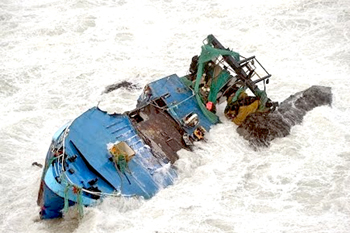
No sign of 52 missing from sunken trawler, empty lifeboats recovered

December 2, 2014

Fishing boatSeoul, Dec 2: South Korean officials say rescuers have found no trace of 52 people missing after a South Korean fishing boat sank off Russia's far-east coast.

Rescuers have recovered four empty lifeboats from the trawler, a Russian official said, as hope of finding the lost crew members fades.

"Four torn lifeboats were found," said Oleg Karev of the marine rescue centre in the port of Petropavlovsk-Kamchatsky which is participating in the rescue mission.

Rescuers also saw one dead body floating in the area but were not able to recover it due to storm conditions, he said.

The ferry, operated by South Korea's Sajo Industries, went down in the western Bering Sea on Monday.

The trawler was carrying 60 people, including one Russian inspector, 11 South Koreans, 35 Indonesians and 13 Philippine crew members.

One Korean sailor was confirmed dead, while the Russian and six foreign crew members had been rescued.

"Overnight rescue efforts produced no tangible results and 52 people are still missing," a Sajo Industries spokesman said.

Four ships, including two associated with Sajo, had been combing the site, the spokesman said, but the search was hampered by poor weather conditions and rough seas.

"We still don't really know how many may have managed to take to the life boats," he said.

The 36-year-old trawler was fishing for pollock when it sank in stormy weather.

Comments

Add new comment

  • Coastaldigest.com reserves the right to delete or block any comments.
  • Coastaldigset.com is not responsible for its readers’ comments.
  • Comments that are abusive, incendiary or irrelevant are strictly prohibited.
  • Please use a genuine email ID and provide your name to avoid reject.
News Network
February 3,2020

Beijing, Feb 3: The first batch of patients arrived on Monday at a specialised hospital built in just 10 days as part of China's intensive efforts to fight a new virus.

Huoshenshan Hospital and a second facility with 1,500 beds that's due to open this week were built by construction crews who are working around the clock in Wuhan, the city in central China where the outbreak was first detected in December.

The Wuhan treatment centres mark the second time Chinese leaders have responded to a new disease by building specialised hospitals almost overnight. As severe acute respiratory syndrome, or SARS, spread in 2003, a facility in Beijing for patients with that viral disease was constructed in a week.

The first batch of patients arrived at the Huoshenshan Hospital at 10 am on Monday, according to state media. The reports gave no details of the patients' identities or conditions.

The ruling Communist Party's military wing, the People's Liberation Army, sent 1,400 doctors, nurses and other personnel to staff the Wuhan hospital, the official Xinhua News Agency said. The government said earlier some have experience fighting SARS and other outbreaks.

Authorities have cut most road, rail and air access to Wuhan and surrounding cities, isolating some 50 million people, in efforts to contain the viral outbreak that has sickened more than 17,000 and killed more than 360 people.

The Huoshenshan Hospital was built by a 7,000-member crew of carpenters, plumbers, electricians and other specialists, according to the Xinhua News Agency.               Photos in state media showed workers in winter clothing, safety helmets and the surgical-style masks worn by millions of Chinese in an attempt to avoid contracting the virus.

About half of the two-storey, 600,000-square-foot building is isolation wards, according to the government newspaper Yangtze Daily. It has 30 intensive care units.

Doctors can talk with outside experts over a video system that links them to Beijing's PLA General Hospital, according to the Yangtze Daily. It said the system was installed in less than 12 hours by a 20-member "commando team" from Wuhan Telecom Ltd.

The building has specialised ventilation systems and double-sided cabinets that connect patient rooms to hallways and allow hospital staff to deliver supplies without entering the rooms.

The hospital received a donation of "medical robots" from a Chinese company for use in delivering medicines and carrying test samples, according to the Shanghai newspaper The Paper.

In other cities, the government has designated hospitals to handle cases of the new virus.

In Beijing, the Xiaotangshan Hospital built in 2003 for SARS is being renovated by construction workers. The government has yet to say whether it might be used for patients with the new disease.

Comments

Add new comment

  • Coastaldigest.com reserves the right to delete or block any comments.
  • Coastaldigset.com is not responsible for its readers’ comments.
  • Comments that are abusive, incendiary or irrelevant are strictly prohibited.
  • Please use a genuine email ID and provide your name to avoid reject.
June 25,2020

Islamabad, Jun 25: The coronavirus cases in Pakistan crossed the 192,000-mark after 4,044 new Covid-19 infections were detected in the last 24 hours, the health ministry said on Thursday.

According to the Ministry of National Health Services, 148 more people died due to the deadly virus in the country, taking the death toll to 3,903.

With the detection of 4,044 new cases in the last 24 hours, the coronavirus tally in the country now stands at 192,970, it said.

Sindh reported a maximum number of 74,070 infections, followed by 71,191 in Punjab, 23,887 in Khyber-Pakhtunkhwa, 11,710 in Islamabad, 9,817 in Balochistan, 1,365 in Gilgit-Baltistan and 930 in Pakistan-occupied Kashmir.

A total of 81,307 patients have recovered so far from the disease.

Health authorities have so far conducted 1,171,976 coronavirus tests, including 21,835 in the last 24 hours.

Comments

Add new comment

  • Coastaldigest.com reserves the right to delete or block any comments.
  • Coastaldigset.com is not responsible for its readers’ comments.
  • Comments that are abusive, incendiary or irrelevant are strictly prohibited.
  • Please use a genuine email ID and provide your name to avoid reject.
Agencies
July 2,2020

Moscow, Jul 2: Russian voters approved changes to the constitution that will allow President Vladimir Putin to hold power until 2036, but the weeklong plebiscite that concluded Wednesday was tarnished by widespread reports of pressure on voters and other irregularities.

With most of the nation's polls closed and 20% of precincts counted, 72% voted for the constitutional amendments, according to election officials.

For the first time in Russia, polls were kept open for a week to bolster turnout without increasing crowds casting ballots amid the coronavirus pandemic a provision that Kremlin critics denounced as an extra tool to manipulate the outcome.

A massive propaganda campaign and the opposition's failure to mount a coordinated challenge helped Putin get the result he wanted, but the plebiscite could end up eroding his position because of the unconventional methods used to boost participation and the dubious legal basis for the balloting.

By the time polls closed in Moscow and most other parts of Western Russia, the overall turnout was at 65%, according to election officials. In some regions, almost 90% of eligible voters cast ballots.

On Russia's easternmost Chukchi Peninsula, nine hours ahead of Moscow, officials quickly announced full preliminary results showing 80% of voters supported the amendments, and in other parts of the Far East, they said over 70% of voters backed the changes.

Kremlin critics and independent election observers questioned the turnout figures.

We look at neighboring regions, and anomalies are obvious there are regions where the turnout is artificially (boosted), there are regions where it is more or less real, Grigory Melkonyants, co-chair of the independent election monitoring group Golos, told The Associated Press.

Putin voted at a Moscow polling station, dutifully showing his passport to the election worker. His face was uncovered, unlike most of the other voters who were offered free masks at the entrance.

The vote completes a convoluted saga that began in January, when Putin first proposed the constitutional changes.

He offered to broaden the powers of parliament and redistribute authority among the branches of government, stoking speculation he might seek to become parliamentary speaker or chairman of the State Council when his presidential term ends in 2024.

His intentions became clear only hours before a vote in parliament, when legislator Valentina Tereshkova, a Soviet-era cosmonaut who was the first woman in space in 1963, proposed letting him run two more times.

The amendments, which also emphasize the primacy of Russian law over international norms, outlaw same-sex marriages and mention a belief in God as a core value, were quickly passed by the Kremlin-controlled legislature.

Putin, who has been in power for more than two decades longer than any other Kremlin leader since Soviet dictator Josef Stalin said he would decide later whether to run again in 2024.

He argued that resetting the term count was necessary to keep his lieutenants focused on their work instead of darting their eyes in search for possible successors.

Analyst Gleb Pavlovsky, a former Kremlin political consultant, said Putin's push to hold the vote despite the fact that Russia has thousands of new coronavirus infections each day reflected his potential vulnerabilities.

Putin lacks confidence in his inner circle and he's worried about the future, Pavlovsky said.

He wants an irrefutable proof of public support.

Even though the parliament's approval was enough to make it law, the 67-year-old Russian president put his constitutional plan to voters to showcase his broad support and add a democratic veneer to the changes.

But then the coronavirus pandemic engulfed Russia, forcing him to postpone the April 22 plebiscite.

The delay made Putin's campaign blitz lose momentum and left his constitutional reform plan hanging as the damage from the virus mounted and public discontent grew.

Plummeting incomes and rising unemployment during the outbreak have dented his approval ratings, which sank to 59%, the lowest level since he came to power, according to the Levada Center, Russia's top independent pollster.

Moscow-based political analyst Ekaterina Schulmann said the Kremlin had faced a difficult dilemma: Holding the vote sooner would have brought accusations of jeopardizing public health for political ends, while delaying it raised the risks of defeat.

Holding it in the autumn would have been too risky, she said.

In Moscow, several activists briefly lay on Red Square, forming the number 2036 with their bodies in protest before police stopped them.

Some others in Moscow and St. Petersburg staged one-person pickets and police didn't intervene.

Several hundred opposition supporters rallied in central Moscow to protest the changes, defying a ban on public gatherings imposed for the coronavirus outbreak. Police didn't intervene and even handed masks to the participants.

Authorities mounted a sweeping effort to persuade teachers, doctors, workers at public sector enterprises and others who are paid by the state to cast ballots. Reports surfaced from across the vast country of managers coercing people to vote.

The Kremlin has used other tactics to boost turnout and support for the amendments.

Comments

Add new comment

  • Coastaldigest.com reserves the right to delete or block any comments.
  • Coastaldigset.com is not responsible for its readers’ comments.
  • Comments that are abusive, incendiary or irrelevant are strictly prohibited.
  • Please use a genuine email ID and provide your name to avoid reject.