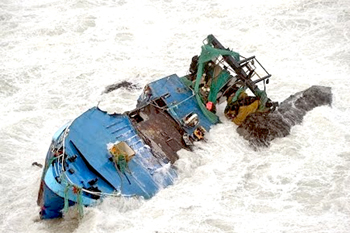
No sign of 52 missing from sunken trawler, empty lifeboats recovered

December 2, 2014

Fishing boatSeoul, Dec 2: South Korean officials say rescuers have found no trace of 52 people missing after a South Korean fishing boat sank off Russia's far-east coast.

Rescuers have recovered four empty lifeboats from the trawler, a Russian official said, as hope of finding the lost crew members fades.

"Four torn lifeboats were found," said Oleg Karev of the marine rescue centre in the port of Petropavlovsk-Kamchatsky which is participating in the rescue mission.

Rescuers also saw one dead body floating in the area but were not able to recover it due to storm conditions, he said.

The ferry, operated by South Korea's Sajo Industries, went down in the western Bering Sea on Monday.

The trawler was carrying 60 people, including one Russian inspector, 11 South Koreans, 35 Indonesians and 13 Philippine crew members.

One Korean sailor was confirmed dead, while the Russian and six foreign crew members had been rescued.

"Overnight rescue efforts produced no tangible results and 52 people are still missing," a Sajo Industries spokesman said.

Four ships, including two associated with Sajo, had been combing the site, the spokesman said, but the search was hampered by poor weather conditions and rough seas.

"We still don't really know how many may have managed to take to the life boats," he said.

The 36-year-old trawler was fishing for pollock when it sank in stormy weather.

Comments

Add new comment

  • Coastaldigest.com reserves the right to delete or block any comments.
  • Coastaldigset.com is not responsible for its readers’ comments.
  • Comments that are abusive, incendiary or irrelevant are strictly prohibited.
  • Please use a genuine email ID and provide your name to avoid reject.
News Network
May 30,2020

Washington, May 30: President Donald Trump said Friday he would strip several of Hong Kong's special privileges with the United States and bar some Chinese students from US universities in anger over Beijing's bid to exert control in the financial hub.

In a day of concerted action, the United States and Britain also raised alarm at the UN Security Council over a controversial new security law for Hong Kong, angering Beijing which said the issue had no place at the world body.

In a White House appearance that Trump had teased for a day, the US president attacked China over its treatment of the former British colony, saying it was "diminishing the city's longstanding and proud status."

"This is a tragedy for the people of Hong Kong, the people of China and indeed the people of the world," Trump said.

Trump also said he was terminating the US relationship with the World Health Organization, which he has accused of pro-China bias in its management of the coronavirus crisis.

But Trump was light on specifics and notably avoided personal criticism of President Xi Jinping, with whom he has boasted of having a friendship even as the two powers feud over a rising range of issues.

"I am directing my administration to begin the process of eliminating policy that gives Hong Kong different and special treatment," Trump said.

"This will affect the full range of agreements, from our extradition treaty to our export controls on dual-use technologies and more, with few exceptions," he said.

Secretary of State Mike Pompeo on Wednesday informed Congress that the Trump administration would no longer consider Hong Kong to be separate under US law, but it was up to Trump to spell out the consequences.

China this week pressed ahead on a law that would ban subversion and other perceived offenses against its rule in Hong Kong, which was rocked by months of massive pro-democracy protests last year.

US restricts students

In one move that could have long-reaching consequences, Trump issued an order to ban graduate students from US universities who are connected to China's military.

"For years, the government of China has conducted elicit espionage to steal our industrial secrets, of which there are many," Trump said.

Hawkish Republicans have been clamoring to kick out Chinese students enrolled in sensitive fields. The FBI in February said it was investigating 1,000 cases of Chinese economic espionage and technological theft.

But any move to deter students is unwelcome for US universities, which rely increasingly on tuition from foreigners and have already been hit hard by the COVID-19 shutdown.

China has been the top source of foreign students to the United States for the past decade with nearly 370,000 Chinese at US universities, although Trump's order will not directly affect undergraduates.

Critics say Trump has been eager to fan outrage about China to deflect attention from his own handling of the coronavirus pandemic that has killed more than 100,000 people in the United States, the highest number of deaths of any country.

Chuck Schumer, the top Democrat in the Senate, called Trump's announcement "just pathetic."

Eliot Engel, a Democrat who heads the House Foreign Affairs Committee, noted that Trump treaded lightly on Hong Kong during last year's protests as he sought a trade deal with Xi.

"Now, the president wants to shift the blame for his failures onto China, so he's doing the right thing for the wrong reason," Engel said.

Trump's order could also trigger retaliation. China in March expelled US journalists after the Trump administration tightened visa rules for staff at Chinese state media.

Clash at UN

The United States and Britain earlier in the day urged China to reconsider the Hong Kong law during talks at the UN Security Council, where China wields a veto -- making any formal session, let alone action against Beijing, impossible.

The Western allies raised Hong Kong in an informal, closed-door videoconference where China cannot block the agenda.

They said China was violating an international commitment as the 1984 handover agreement with Britain, in which Beijing promised to maintain the financial hub's separate system until at least 2047, was registered with the United Nations.

"The United States is resolute, and calls upon all UN members states to join us in demanding that the PRC immediately reverse course and honor its international legal commitments to this institution and to the Hong Kong people," said US Ambassador Kelly Craft, referring to the People's Republic of China.  

China demanded that the United States and Britain "immediately stop interfering in Hong Kong affairs," saying the law did not fall under the Security Council's mandate.

"Any attempt to use Hong Kong to interfere in China's internal matters is doomed to fail," warned a statement from China's UN mission.

"There was no consensus, no formal discussion in the Security Council, and the US and the UK's move came to nothing," it said.


Comments

Add new comment

  • Coastaldigest.com reserves the right to delete or block any comments.
  • Coastaldigset.com is not responsible for its readers’ comments.
  • Comments that are abusive, incendiary or irrelevant are strictly prohibited.
  • Please use a genuine email ID and provide your name to avoid reject.
News Network
May 21,2020

Canberra, May 21: Australian Prime Minister Scott Morrison and his Indian counterpart, Narendra Modi, are looking forward to deepening the countries' strategic relationship, with both sides expected to sign a range of pacts from defence to trade in strategic sectors amid heightened tensions with China over Beijing's response to coronavirus pandemic.

During a virtual summit, scheduled to take place on June 4, both leaders are expected to ramp up efforts to diversify Australia's export markets and find trusted suppliers of vital products and components, a local newspaper, The Australian reported on Tuesday.

The new agreements will focus on reliable supply chains in key strategic sectors, including medical goods, technology and critical minerals, amid heightened tensions with China over Beijing's response to coronavirus pandemic.

The leaders will seal a new defence agreement allowing reciprocal access to bases and co-operation on military technology projects, while a new education partnership will be on the table to help overcome Australian university reliance on Chinese students.

The talks in terms of strategic convergence, now have greater significance as COVID-19 exacerbates the strategic contest between the US and China, and forces like-minded countries to seek out reliable partners.

Australian farmers could also benefit, with talks underway on expanding agricultural exports to India, including barley, as China throws up new trade barriers, media reports stated.

The virtual summit follows the cancellation of Morrison's planned state visit to India in January due to the bushfires.

Morrison said last year, ahead of his planned visit, that India was "a natural partner for Australia", referring to the countries' "shared values" -- a point of differentiation with China.

Former Department of Foreign Affairs and Trade secretary Peter Varghese, who wrote a landmark report on the bilateral relationship in 2018, was quoted by the newspaper as saying that India would be even more important to Australia in the post-COVID world. "If one of the lessons from COVID is that countries need to spread their risk, then finding new markets or building up existing markets is a crucial part of that," he added.

Varghese noted that India, a member of the Quadrilateral Security Dialogue along with Australia, Japan and the US, was a vital strategic partner to Australia in helping "constrain China's ambitions to be the predominant power".

"That shared objective between Australia and India of not wanting to see the region dominated by China is a key component of building up our geopolitical relationship," he told The Australian.

The summit also follows recent talks between Australian Foreign Minister Marise Payne and Indian counterpart Subrahmanyam Jaishankar on the pandemic response and Australia's call for an independent inquiry, which was overwhelmingly backed at the World Health Assembly on Tuesday.

Australia wants to support India to develop a domestic critical minerals processing industry, which would provide Western nations with an alternative to sourcing the materials from China.

Meanwhile, India has strong expertise as a manufacturer of drugs and medical equipment, while Australia is a centre of biomedical research, opening the possibility for closer co-operation in the key sector, the media reported further.

Comments

Add new comment

  • Coastaldigest.com reserves the right to delete or block any comments.
  • Coastaldigset.com is not responsible for its readers’ comments.
  • Comments that are abusive, incendiary or irrelevant are strictly prohibited.
  • Please use a genuine email ID and provide your name to avoid reject.
News Network
February 4,2020

Kuala Lumpur, Feb 4: Malaysia said on Tuesday that India's move to cut back on palm oil purchases is "temporary" and will be resolved amicably between the two nations.

Last month, India restricted imports of refined palm oil and asked importers to avoid purchases from Malaysia after its criticism of actions in Kashmir and a new citizenship law.

"Having long-standing bilateral ties, the two nations will overcome the current challenges, and prevail towards mutual and beneficial outcomes," the Malaysian Palm Oil Council said in a statement, citing Primary Industries Minister Teresa Kok.

Malaysia's push to implement B20 biodiesel starting this month will also help sustain high crude palm oil prices, the statement read.

Comments

Add new comment

  • Coastaldigest.com reserves the right to delete or block any comments.
  • Coastaldigset.com is not responsible for its readers’ comments.
  • Comments that are abusive, incendiary or irrelevant are strictly prohibited.
  • Please use a genuine email ID and provide your name to avoid reject.