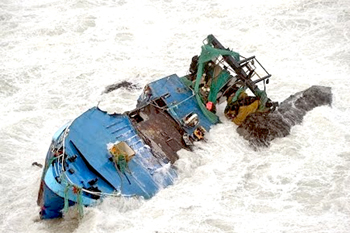
No sign of 52 missing from sunken trawler, empty lifeboats recovered

December 2, 2014

Fishing boatSeoul, Dec 2: South Korean officials say rescuers have found no trace of 52 people missing after a South Korean fishing boat sank off Russia's far-east coast.

Rescuers have recovered four empty lifeboats from the trawler, a Russian official said, as hope of finding the lost crew members fades.

"Four torn lifeboats were found," said Oleg Karev of the marine rescue centre in the port of Petropavlovsk-Kamchatsky which is participating in the rescue mission.

Rescuers also saw one dead body floating in the area but were not able to recover it due to storm conditions, he said.

The ferry, operated by South Korea's Sajo Industries, went down in the western Bering Sea on Monday.

The trawler was carrying 60 people, including one Russian inspector, 11 South Koreans, 35 Indonesians and 13 Philippine crew members.

One Korean sailor was confirmed dead, while the Russian and six foreign crew members had been rescued.

"Overnight rescue efforts produced no tangible results and 52 people are still missing," a Sajo Industries spokesman said.

Four ships, including two associated with Sajo, had been combing the site, the spokesman said, but the search was hampered by poor weather conditions and rough seas.

"We still don't really know how many may have managed to take to the life boats," he said.

The 36-year-old trawler was fishing for pollock when it sank in stormy weather.

Comments

Add new comment

  • Coastaldigest.com reserves the right to delete or block any comments.
  • Coastaldigset.com is not responsible for its readers’ comments.
  • Comments that are abusive, incendiary or irrelevant are strictly prohibited.
  • Please use a genuine email ID and provide your name to avoid reject.
News Network
June 26,2020

Washington, Jun 26: The United States reported more than 39,000 new coronavirus cases on Thursday, its highest-ever single-day count as the government relaxed restrictions and is downplaying the threat of the deadly virus.

According to the Washington Post, experts believe there is a troubling lack of consistent, unified messaging from President Donald Trump and Vice President Mike Pence. They have downplayed the danger and denigrated effective disease defences such as mask-wearing, testing, and social distancing.

Churches, beaches, and bars are filling up with people and so are hospital beds, the report said.

The counties home to Dallas, Phoenix, and Tampa all reported record-high averages on at least 15 straight days in June.

The hardest-hit states are California, Texas, Florida and those that thought they had the virus under control, like Utah and Oregon.

"I think the politicians are in denial," said Kami Kim, director of the Division of Infectious Disease and International Medicine at the University of South Florida.

The chief of the Division of Pediatric Infectious Diseases at the University of Utah Health, Andrew T. Pavia, is of the view that the push to reopen quickly even as cases climb sends a dangerous and inaccurate message.

"On the one hand, you get messages from politicians and the business community that we have to go, go, go and open up," he said. "On the other hand, you're seeing epidemiological indicators that we still have to be very careful."

"It's cognitive dissonance," he added.

The Trump administration has tried to downplay the rising number. Pence called concerns about another surge of infections "overblown," the product of media "fearmongering."

Some governors have followed the administration's lead, blaming rising caseloads on more testing.

Testifying before a congressional committee this week, Anthony S. Fauci, the nation's top infectious-diseases expert, said the new cases were "a disturbing surge" spurred by community transmission rather than testing.

"That's something I'm really quite concerned about," Fauci said. "A couple of days ago, there were 30,000 new infections. That's very disturbing to me."

Several states like Arizona, Arkansas, the Carolinas, Mississippi, Tennessee, Texas and Utah have recently reported new highs in the number of coronavirus patients hospitalized.

"We're seeing a 40 per cent increase in the last two weeks in hospitalizations," said Dallas County Judge Clay Jenkins (D), the jurisdiction's top elected official. "We're by far at our record numbers, and we're at record numbers in north Texas. Houston is at a record, the state is at a record." The Texas Medical Center in Houston, a massive medical complex, reported Thursday that 100 per cent of the beds in its intensive care unit are occupied.

Comments

Add new comment

  • Coastaldigest.com reserves the right to delete or block any comments.
  • Coastaldigset.com is not responsible for its readers’ comments.
  • Comments that are abusive, incendiary or irrelevant are strictly prohibited.
  • Please use a genuine email ID and provide your name to avoid reject.
News Network
April 28,2020

Washington, Apr 28: After nearly three weeks in an intensive care unit in Los Angeles, doctors treating 41-year-old Broadway actor Nick Cordero for COVID-19 were forced to amputate his right leg.

The flow of blood had been impeded by a blood clot: yet another dangerous complication of the disease that has been bubbling up in frontline reports from China, Europe and the United States.

To be sure, so-called "thrombotic events" occur for a variety of reasons among intensive care patients, but the rates among COVID-19 patients are far higher than would be otherwise expected.

"I have had 40-year-olds in my ICU who have clots in their fingers that look like they'll lose the finger, but there's no other reason to lose the finger than the virus," Shari Brosnahan, a critical care doctor at NYU Langone said.

One of these patients is suffering from a lack of blood flow to both feet and both hands, and she predicts an amputation may be necessary, or the blood vessels may get so damaged that an extremity could drop off by itself.

Blood clots aren't just dangerous for our limbs, but can make their way to the lungs, heart or brain, where they may cause lethal pulmonary embolisms, heart attacks, and strokes.

A recent paper from the Netherlands in the journal Thrombosis Research found that 31 percent of 184 patients suffered thrombotic complications, a figure that the researchers called "remarkably high" -- even if extreme consequences like amputation are rare.

Behnood Bikdeli, a doctor at New York-Presbyterian Hospital, assembled an international consortium of experts to study the issue. Their findings were published in the Journal of The American College of Cardiology.

The experts found the risks were so great that COVID-19 patients "may need to receive blood thinners, preventively, prophylactically," even before imaging tests are ordered, said Bikdeli.

What exactly is causing it? The reasons aren't fully understood, but he offered several possible explanations.

People with severe forms of COVID-19 often have underlying medical conditions like heart or lung disease -- which are themselves linked to higher rates of clotting.

Next, being in intensive care makes a person likelier to develop a clot because they are staying still for so long. That's why for example people are encouraged to stretch and move around on long haul flights.

It's also now clear the COVID-19 illness is associated with an abnormal immune reaction called "cytokine storm" -- and some research has indicated this too is linked to higher rates of clotting.

There could also be something about the virus itself that is causing coagulation, which has some precedent in other viral illnesses.

A paper in the journal The Lancet last week showed that the virus can infect the inner cell layer of organs and of blood vessels, called the endothelium. This, in theory, could interfere with the clotting process.

According to Brosnahan, while thinners like Heparin are effective in some patients, they don't work for all patients because the clots are at times too small.

"There are too many microclots," she said. "We're not sure exactly where they are."

Autopsies have in fact shown some people's lungs filled with hundreds of microclots.

The arrival of a new mystery however helps solve a slightly older one.

Cecilia Mirant-Borde, an intensive care doctor at a military veterans hospital in Manhattan, told AFP that lungs filled with microclots helped explain why ventilators work poorly for patients with low blood oxygen.

Earlier in the pandemic doctors were treating these patients according to protocols developed for acute respiratory distress syndrome, sometimes known as "wet lung."

But in some cases, "it's not because the lungs are occupied with water" -- rather, it's that the microclotting is blocking circulation and blood is leaving the lungs with less oxygen than it should.

It has just been a little under five months since the virus emerged in Wuhan, China, and researchers are learning more about its impact every day.

"While we react surprised, we shouldn't be as surprised as we were. Viruses tend to do weird things," said Brosnahan.

While the dizzying array of complications may seem daunting, "it's possible there'll be one or a couple of unifying mechanisms that describe how this damage happens," she said.

"It's possible it's all the same thing, and that there'll be the same solution."

Comments

Add new comment

  • Coastaldigest.com reserves the right to delete or block any comments.
  • Coastaldigset.com is not responsible for its readers’ comments.
  • Comments that are abusive, incendiary or irrelevant are strictly prohibited.
  • Please use a genuine email ID and provide your name to avoid reject.
News Network
July 2,2020

Naypyitaw, Jul 2: A landslide at a jade mine in northern Myanmar has killed at least 113 people, officials say, warning the death toll is likely to rise further.

The incident took place early on Thursday in the jade-rich Hpakant area of Kachin state after a bout of heavy rainfall, the Myanmar Fire Services Department said on Facebook.

"The jade miners were smothered by a wave of mud," the statement said. "A total of 113 bodies have been found so far," it added, raising the death toll from at least 50.

Photos posted on the Facebook page showed a search and rescue team wading through a valley apparently flooded by the mudslide.

'No one could help them'

Maung Khaing, a 38-year-old miner from the area, said he saw a towering pile of waste that looked on the verge of collapse and was about to take a picture when people began shouting "run, run!"

"Within a minute, all the people at the bottom [of the hill] just disappeared," he told Reuters news agency by phone.

"I feel empty in my heart. I still have goosebumps ... There were people stuck in the mud shouting for help, but no one could help them."

Tar Lin Maung, a local official with the information ministry, said authorities had recovered more than 100 bodies.

"Other bodies are in the mud. The numbers are going to rise," he told Reuters.

Fatal landslides are common in the poorly regulated mines of Hpakant, the victims often from impoverished communities who risk their lives hunting the translucent green gemstone.

The government of Myanmar leader Aung San Suu Kyi pledged to clean up the industry when it took power in 2016, but activists say little has changed.

Official sales of jade in Myanmar were worth $750.4m in 2016-2017, according to data published by the government as part of the Extractive Industries Transparency Initiative.

But experts believe the true value of the industry, which mainly exports to China, is much larger.

Northern Myanmar's abundant natural resources - including jade, timber, gold and amber - have also helped finance both sides of a decades-long conflict between ethnic Kachin and the military.

The fight to control the mines and the revenues they bring frequently traps local civilians in the middle.

Comments

Add new comment

  • Coastaldigest.com reserves the right to delete or block any comments.
  • Coastaldigset.com is not responsible for its readers’ comments.
  • Comments that are abusive, incendiary or irrelevant are strictly prohibited.
  • Please use a genuine email ID and provide your name to avoid reject.