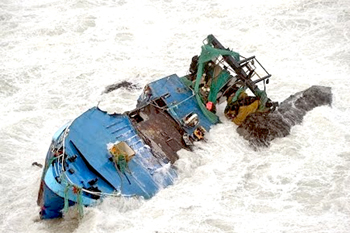
No sign of 52 missing from sunken trawler, empty lifeboats recovered

December 2, 2014

Fishing boatSeoul, Dec 2: South Korean officials say rescuers have found no trace of 52 people missing after a South Korean fishing boat sank off Russia's far-east coast.

Rescuers have recovered four empty lifeboats from the trawler, a Russian official said, as hope of finding the lost crew members fades.

"Four torn lifeboats were found," said Oleg Karev of the marine rescue centre in the port of Petropavlovsk-Kamchatsky which is participating in the rescue mission.

Rescuers also saw one dead body floating in the area but were not able to recover it due to storm conditions, he said.

The ferry, operated by South Korea's Sajo Industries, went down in the western Bering Sea on Monday.

The trawler was carrying 60 people, including one Russian inspector, 11 South Koreans, 35 Indonesians and 13 Philippine crew members.

One Korean sailor was confirmed dead, while the Russian and six foreign crew members had been rescued.

"Overnight rescue efforts produced no tangible results and 52 people are still missing," a Sajo Industries spokesman said.

Four ships, including two associated with Sajo, had been combing the site, the spokesman said, but the search was hampered by poor weather conditions and rough seas.

"We still don't really know how many may have managed to take to the life boats," he said.

The 36-year-old trawler was fishing for pollock when it sank in stormy weather.

Comments

Add new comment

  • Coastaldigest.com reserves the right to delete or block any comments.
  • Coastaldigset.com is not responsible for its readers’ comments.
  • Comments that are abusive, incendiary or irrelevant are strictly prohibited.
  • Please use a genuine email ID and provide your name to avoid reject.
News Network
May 12,2020

London, May 12: British Prime Minister Boris Johnson has warned that a mass vaccine for the novel coronavirus may be over a year away and, in the worst-case scenario, may in fact never be found.

In his foreword to the government’s new 50-page guidance on a step by step easing of the lockdown measures in place to control the spread of the deadly virus, the UK prime minister lays out plans for businesses to gradually start reopening with “COVID-19 Secure” measures of social distancing and for the public to use “good solid British common sense” as the economy is unlocked.

“A mass vaccine or treatment may be more than a year away,” said Johnson, highlighting the work being done in the UK by scientists at Oxford University and Imperial College London towards this mission.

“Indeed, in a worst-case scenario, we may never find a vaccine. So our plan must countenance a situation where we are in this, together, for the long haul, even while doing all we can to avoid that outcome,” he said.

Admitting that a vaccine or drug-based treatment is the only “feasible long-term solution”, he said the UK has accelerated this with “promising” vaccine development programmes and a collaboration between Oxford University and pharma major AstraZeneca was a vital step that could help rapidly advance the manufacture of a Covid-19 vaccine when it is ready.

As part of global efforts, he flagged the GBP 388 million in aid funding for research into vaccines, tests and treatment, including GBP 250m to the Coalition for Epidemic Preparedness Innovations.

“But while we hope for a breakthrough, hope is not a plan,” he said, as he unveiled his plan for starting to lift lockdown restrictions from this week in phases.

Following a televised address to the nation on Sunday night and a statement in Parliament on Monday, the guidance comes into effect in public life across England from Wednesday when people will be allowed one-to-one contact with people other than those they live with, as long as they remain outside and two metres apart.

They are allowed to play sport with a friend or family member from outside their household or socialise with them in the open air for the first time in more than six weeks since the lockdown was imposed.

People are still advised to work from home where possible but start heading into work where necessary, in sectors such as construction and manufacturing, keeping the social distancing norms in place.

Under the step by step plan, by the start of next month non-essential shops will also reopen, with some hairdressers, pubs and cinemas to follow from July. However, as part of a Covid-19 Alert System, if infection rates are seen to be rising again, restrictions would be tightened “possibly at short notice”.

Fines for breaching the new rules will also be increased to GBP 100 and will double for each repeat offence, up to a maximum of GBP 3,200.

Johnson said: "I must ask the country to be patient with a continued disruption to our normal way of life, but to be relentless in pursuing our mission to build the systems we need. The worst possible outcome would be a return to the virus being out of control – with the cost to human life, and – through the inevitable re-imposition of severe restrictions – the cost to the economy. We must stay alert, control the virus, and in doing so, save lives.

“Then, as vaccines and treatment become available, we will move to another new phase, where we will learn to live with Covid-19 for the longer term without it dominating our lives.”

The devolved administrations of Scotland and Wales are putting their own measures in place and keeping the “stay at home” message in place, rather than switch to the new “stay alert” message.

The UK government’s latest messaging has come under attack from the Opposition and other sections of society over a feared lack of clarity for the general public.


Comments

Add new comment

  • Coastaldigest.com reserves the right to delete or block any comments.
  • Coastaldigset.com is not responsible for its readers’ comments.
  • Comments that are abusive, incendiary or irrelevant are strictly prohibited.
  • Please use a genuine email ID and provide your name to avoid reject.
News Network
July 1,2020

As Peru begins to ease its strict coronavirus lockdown, the country's biggest LGBTQ nightclub opened its doors on Tuesday, but there will be no nighttime revellers; its dance floor will instead be filled with shelves stocked with groceries.

Instead of slinging cocktails at the bar or dancing on stage, ValeTodo Downtown's famed staff of drag queens will sell customers daily household products as the space reopens as a market while nightclubs are ordered to remain closed.

The Peruvian government will lift the lockdown in most regions of the country at the beginning of July but will keep borders closed, as well as nightclubs and bars.

The lockdown has been a struggle for the club's 120 employees like drag queen Belaluh McQueen. Her life completely changed when the government announced the quarantine. Her nights were spent at home, rather than performing as a dancer at the club in vivid-coloured costumes.

"I was very depressed because I have been doing this art for years, but you have to adapt to new challenges for the future," said McQueen, who is identified by her stage name.

Now McQueen is back to work as a grocery store employee, wearing a sequined suit, high heels and a mask. A DJ will play club music as patrons shop. "We have a new job opportunity," McQueen added.

Renamed as Downtown Market, the club, which has been a mainstay hallmark of the local LGBTQ community, ushered in its reopening with an inauguration ceremony.

"Before, I used to come here to dance and have a good time, but now we come to buy," said Alexandra Herrera, a regular attendee of the club. "The thing is to reinvent yourself."

The club's general manager, Claudia Achuy, said that the pandemic impacted the heart of Lima nightlife, but she chose to reopen as a market rather than risk cutting staff. "If we had just stayed as a nightclub we did not have a close horizon or a way of working," Achuy said.

Peru's confirmed coronavirus cases rose to 282,364 with 9,504 associated deaths on Monday, according to government data. It has the second-highest outbreak in Latin America after Brazil, according to a Reuters tally.

Comments

Add new comment

  • Coastaldigest.com reserves the right to delete or block any comments.
  • Coastaldigset.com is not responsible for its readers’ comments.
  • Comments that are abusive, incendiary or irrelevant are strictly prohibited.
  • Please use a genuine email ID and provide your name to avoid reject.
News Network
February 5,2020

Feb 5: Pakistan will buy more palm oil from Malaysia, Prime Minister Imran Khan said on Tuesday, aiming to help offset lost sales after top buyer India put curbs on Malaysian imports last month amid a diplomatic row.

India imposed restrictions on refined palm oil imports and informally asked traders to stop buying from Malaysia, the world's biggest producer of the edible oil. Sources said the move was in retaliation for Malaysia's criticism of India's policy on Kashmir.

Malaysian Prime Minister Mahathir Mohamad said on Tuesday that he discussed palm oil with Khan who was on a visit to Malaysia and that Pakistan had indicated it would import more from Malaysia.

"That's right, especially since we noticed India threatened Malaysia for supporting the Kashmir cause, threatened to cut palm oil imports," Khan told a joint news conference, referring to India's Muslim-majority region of Kashmir.

"Pakistan will do its best to compensate for that."

India is a Hindu-majority country while Malaysia and Pakistan are mainly Muslim. India and Pakistan have been mostly hostile to each other since the partition of British India in 1947, and have fought two of their three wars over competing territorial claims in Kashmir.

Pakistan may have bought around 135,000 tonnes of Malaysian palm oil last month, a record high, India-based dealers who track such shipments told Reuters on condition of anonymity.

The figure is close to estimates of 141,500 tonnes from Refinitiv, which show sales to India in January may have plunged 80% from a year earlier to 40,400 tonnes.

Malaysia will release official export data on Monday.

Pakistan bought 1.1 million tonnes of palm oil from Malaysia last year, while India bought 4.4 million tonnes, according to the Malaysian Palm Oil Council.

Malaysian palm oil futures rose on Tuesday after Khan's comments and on expectations of a steep drop in production in January.

STRONG TIES

India has repeatedly objected to Mahathir speaking out against its move last year to strip Kashmir's autonomy and make it easier for non-Muslims from neighbouring Muslim-majority Bangladesh, Pakistan and Afghanistan to gain citizenship.

At the news conference, Mahathir did not refer to Kashmir but Khan did.

"The way you, PM, have stood with us and spoken about this injustice going on, on behalf of Pakistan I really want to thank you," Khan said.

He also said he was sad he had been unable to attend a summit of Muslim leaders in Malaysia in December. Saudi Arabia did not attend the summit, saying it was the wrong forum to discuss matters affecting the world's Muslims and Khan belatedly pulled out.

Some Pakistani officials, unnamed because they were not authorised to speak to the media, said at the time that Khan pulled out under pressure from Saudi Arabia, a close ally, although local media reported his officials denied that was the reason for his absence.

"Unfortunately our friends, who are very close to Pakistan as well, felt that somehow the conference was going to divide the ummah," Khan said, using the Arabic word for the Muslim community but not mentioning Saudi Arabia by name.

"It is clearly a misconception, as that was not the purpose of the conference."

Comments

Add new comment

  • Coastaldigest.com reserves the right to delete or block any comments.
  • Coastaldigset.com is not responsible for its readers’ comments.
  • Comments that are abusive, incendiary or irrelevant are strictly prohibited.
  • Please use a genuine email ID and provide your name to avoid reject.