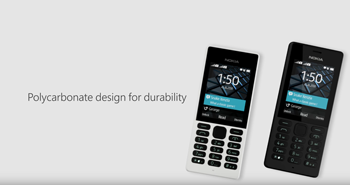
Nokia is back! New phones cost just Dh95

December 14, 2016

Dec 14: HMD Global, the Finnish company that owns the rights to use the Nokia brand on mobile phones, announced its first new products on Tuesday -- two basic handsets without internet access priced at $26 before local taxes and subsidies.

Nokia-150-01HMD said the Nokia 150 and Nokia 150 Dual SIM would go on sale in selected markets early next year.

The company, led by former Nokia executives, earlier this month took over the Nokia basic phone business from Microsoft and has struck a licensing deal with Nokia Oyj to bring the brand back to the smartphone market next year.

The basic phone business currently makes most of its sales in India, elsewhere in Asia and eastern Europe.

Nokia was once the world's dominant cellphone maker but missed the shift to smartphones. It sold all the handset activities to Microsoft in 2014 and is now focused on telecom network equipment.

Microsoft struggled to compete with the likes of Apple and Samsung in smartphones and has largely quit the phones business.

Comments

Add new comment

  • Coastaldigest.com reserves the right to delete or block any comments.
  • Coastaldigset.com is not responsible for its readers’ comments.
  • Comments that are abusive, incendiary or irrelevant are strictly prohibited.
  • Please use a genuine email ID and provide your name to avoid reject.
News Network
February 5,2020

Feb 5: Tesla is making Elon Musk a lot richer without paying him a dime.

A blistering stock rally has bolstered the value of CEO Musk's 19% stake in the electric car maker by $16 billion since the start of 2020, to $30 billion.

Tuesday's steep climb in the share price could sweeten Musk's payday under his record-breaking compensation package, which is built on stock options that rely on market value targets. Two milestones have now been achieved that could see Musk unlock options worth $1.8 billion.

The controversial chief executive, who is also the majority owner and CEO of rocket maker SpaceX, recently testified that he did not have a lot of cash as he successfully defended himself in a defamation lawsuit. He previously has taken loans using his Tesla shares as collateral.

Musk does not take a salary, choosing instead a risky options package that envisions the stock market value of Tesla rising to $650 billion over 10 years, a prospect that was derided by some investors when the deal was announced in 2018.

That target now looks less crazy. Shares of Tesla have rallied over 50% since the company posted its second consecutive quarterly profit last Wednesday, which was viewed as a major accomplishment for a company competing against established automotive heavyweights including General Motors Co  and BMW.

Tesla shares have climbed about 400% since early June, helped by the company's better-than-expected financial results and ramped-up production at its new car factory in Shanghai.

On Tuesday, Tesla surged as much as 24% before falling back in the final minutes of the trading session to end the day up 13.7%. That put its market capitalization at $160 billion, almost twice the combined value of Ford Motor and General Motors.

The shares had also rallied on Monday, partly fueled by Panasonic Corp's 6752.T saying its automotive battery venture with Tesla was profitable for the first time.

The options Musk was awarded in 2018 vest incrementally based on targets for Tesla's stock market value and its financial performance. The market capitalization would have to sustainably rise by $50 billion increments over the agreement's 10-year period, with the full package payout reached if the market cap reaches $650 billion, as well as the company's meeting revenue and profit targets.

Musk is on his way to seeing his first two tranches of options vest. He achieved operational targets on revenue and adjusted earnings last year.

The rise in Tesla's market capitalization last month to a target of $100 billion opened the way for Musk's first tranche of options to vest. With Tuesday's surging share price, the market capitalization blew past the second target of $150 billion, opening the way for the second tranche to vest. Tesla's market capitalization must stay at or above each target level for one- and six-month averages for each set of options to vest.

Tesla was valued at about $52 billion when shareholders approved the pay package in March 2018, a time when the company faced a cash crunch, production delays and increasing competition from rivals.

A full payoff for Musk would surpass anything previously granted to U.S. executives, according to Institutional Shareholder Services, a proxy advisor that recommended investors reject the pay package deal at the time.

Musk currently owns about 34 million Tesla shares, and his compensation package would let him buy another 20.3 million shares if all his options tranches vest.

When Tesla unveiled Musk’s package, it said he could in theory reap as much as $55.8 billion if no new shares were issued. However, Tesla has since awarded stock to employees and last year sold $2.7 billion in shares and convertible bonds, diluting the value of the stock.

Musk has transformed Tesla from a niche car maker with production problems into the global leader in electric vehicles, with U.S. and Chinese factories. So far it has stayed ahead of more established rivals including BMW and Volkswagen.

Many investors remain skeptical that Tesla can consistently deliver profit, cash flow and growth. More Wall Street analysts rate Tesla "sell" than "buy," and the company's stock is the most shorted on Wall Street.


Comments

Add new comment

  • Coastaldigest.com reserves the right to delete or block any comments.
  • Coastaldigset.com is not responsible for its readers’ comments.
  • Comments that are abusive, incendiary or irrelevant are strictly prohibited.
  • Please use a genuine email ID and provide your name to avoid reject.
Agencies
January 16,2020

Claiming that e-commerce giants like Amazon import as much as 80 per cent of the items sold on their platforms, small manufacturers' body has said that their business models do not benefit local industry and are creating jobs of delivery boys only.

"Neither manufacturers nor traders are getting any benefit from the business models of Amazon and Flipkart because they largely import their products from China and Korea and sell here. Nearly 80 per cent of their products are imported," said Anil Bhardwaj, Secretary General, Federation of Indian Micro and Small & Medium Enterprises (FISME).

Bhardwaj said that the global e-commerce players generally source and sell products through their own preferred suppliers and as a result a large number of local manufacturers and traders get crowded out.

He listed out deep discounting and buying products from preferred companies as unfair practices.

"Even if they buy products from local suppliers the commission charged is very high," Bhardwaj said adding that the issues related to unfair practices have been raised with Commerce Ministry on multiple occasions.

FISME maintains that the technology-driven retail is way forward and one cannot be oblivious of the benefits it brings to consumers but at the same time the local industry can also not be ignored given its role in job creation.

"If both traders and local manufacturers are crowded out then how would the local industry survive and employment be generated?" asked Bhardwaj.

As Amazon Founder and CEO Jeff Bezos is currently on his three-day visit to India, the local traders are up in arms against the "unfair" trade practices of the tech giant. Delhi-based Confederation of All India Traders (CAIT) has launched a countrywide protest against the company and has organised protests across 300 cities.

In a setback to Amazon and Walmart-backed Flipkart, the fair market watchdog Competition Commission of India (CCI) has ordered probe into the business operations of both the companies on multiple counts including deep-discounts and exclusive tie-up with preferred sellers.

"For the first time some concrete step has been taken against Amazon and Flipkart who are continuously violating the FDI policy in indulging in a vicious racket of controlling and monopolising not only the e-commerce but even the retail trade as well," CAIT National Secretary General Praveen Khandelwal said after the CCI order.

Comments

Add new comment

  • Coastaldigest.com reserves the right to delete or block any comments.
  • Coastaldigset.com is not responsible for its readers’ comments.
  • Comments that are abusive, incendiary or irrelevant are strictly prohibited.
  • Please use a genuine email ID and provide your name to avoid reject.
Agencies
February 26,2020

New Delhi, Feb 26: With the government pushing for the disinvestment of Air India, industrial conglomerate Adani Group may emerge as one of the bidders for the debt-laden national carrier, sources said.

According to highly placed sources, the Group has held internal rounds of deliberations on whether or not to submit an Expression of Interest (EoI) and the discussions are still in the preliminary stage.

If the company actually submits an EoI, it would be a major move towards further diversification of the company which has business interests across sectors right from edible oil, food to mining and minerals. 

It also entered into airport operations and maintenance business and won bids for privatisation of six airports, Ahmedabad, Lucknow, Jaipur, Guwahati, Thiruvananthapuram and Mangaluru in 2019. 

On being contacted by IANS, the company did not comment on the matter.

Air India is one of the most important divestment proposals for the current fiscal to reach the huge Rs 2.1 lakh crore target.

The government in January restarted the divestment process of the airline and invited bids for selling 100 per cent of its equity in the state-owned airline, including Air India's 100 per cent shareholding in AI Express Ltd. and 50 per cent in Air India SATS Airport Services Private Ltd.

After its unsuccessful bid to sell Air India in 2018, the government this time has decided to offload its entire stake. In 2018, it had offered to sell its 76 per cent stake in the airline.

Of the total debt of Rs 60,074 crore as of March 31, 2019, the buyer would be required to absorb Rs 23,286 crore.

Air India, along with its subsidiary Air India Express, has a total operational fleet of 146 aeroplanes.

Further, the disinvestment department has extended the last date for submission of written queries on the Performance Information Memorandum and Share Purchase Agreement to March 6.

The last date for submission of written queries on PIM and SPA was originally set for February 11, following which the Department of Investment and Public Asset Management (DIPAM) on February 21 issued 20 clarifications on the queries raised and expected.

Any delay in the tentatively rolled out timeline would also delay DIPAM's plan to identify the pre-qualified bidders by March 31 and the financial bids invitation as well. It is expected to take more than two months after the selection of the pre-qualified bidders to complete Air India's sale.

Comments

Add new comment

  • Coastaldigest.com reserves the right to delete or block any comments.
  • Coastaldigset.com is not responsible for its readers’ comments.
  • Comments that are abusive, incendiary or irrelevant are strictly prohibited.
  • Please use a genuine email ID and provide your name to avoid reject.