


North Korea fires ballistic missile in challenge to Trump: Seoul

February 12, 2017

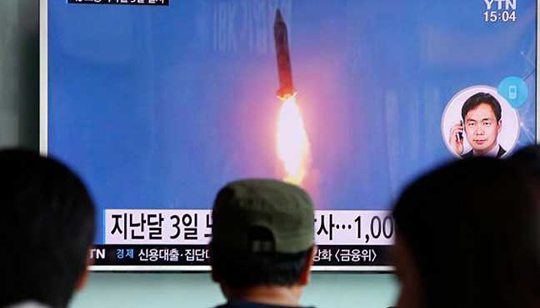
Seoul, Feb 12: North Korea fired a ballistic missile today in an apparent provocation to test the response from new US President Donald Trump, the South Korean defence ministry said.
missil

The missile, launched around 7:55 am (local time) from Banghyon air base in the western province of North Pyongan Province, flew east towards the Sea of Japan (East Sea), it said.

The missile flew about 500 kilometres before falling into the sea, a defence ministry spokesman said, adding the exact type of missile had yet to be identified. "It is believed that today's missile launch ... is aimed at drawing global attention to the North by boasting its nuclear and missile capabilities," the ministry said in a statement.

"It is also believed that it was an armed provocation to test the response from the new US administration under President Trump," it added. Yonhap news agency said the South Korean military suspected the North might have been testing a intermediate-range Musudan missile.

Last October North Korea test-fired Musudan missiles twice from the same airbase.On a visit to Seoul earlier this month, new US Defense Secretary James Mattis warned Pyongyang that any nuclear attack would be met with an "effective and overwhelming" response.

"Any attack on the United States or our allies will be defeated and any use of nuclear weapons would be met with a response that would be effective and overwhelming," Mattis said.

Pyongyang in 2016 conducted two nuclear tests and numerous missile launches in its quest to develop a nuclear weapons system capable of hitting the US mainland.

In January leader Kim Jong-Un boasted that Pyongyang was in the "final stages" of developing an intercontinental ballistic missile (ICBM) in an apparent attempt to pressure the incoming US president. Trump shot back on Twitter, saying "It won't happen."

The latest North Korean launch also comes after Trump assured visiting Japanese Prime Minister Shinzo Abe that Washington was committed to the security of its key Asian ally.

"We will work together to promote our shared interests, of which we have many, in the region, including freedom from navigation and defending against the North Korean missile and nuclear threat, both of which I consider a very, very high priority," Trump said Friday.

Washington has repeatedly vowed that it would never accept North Korea as a nuclear-armed nation. Analysts are divided over how close Pyongyang is to realising its full nuclear ambitions, especially as it has never successfully test-fired an ICBM. But all agree it has made enormous strides in that direction since Kim took over after the death of his father and longtime ruler, Kim Jong-Il, in December 2011.

Comments

Add new comment

  • Coastaldigest.com reserves the right to delete or block any comments.
  • Coastaldigset.com is not responsible for its readers’ comments.
  • Comments that are abusive, incendiary or irrelevant are strictly prohibited.
  • Please use a genuine email ID and provide your name to avoid reject.
News Network
January 19,2020

President Donald Trump gave a new justification for killing Qassim Suleimani, telling a gathering of Republican donors that the top Iranian general was "saying bad things about our country" before the strike, which led to his decision to authorise his killing. "How much are we going to listen to?" Trump said on Friday, according to remarks from a fundraiser obtained by CNN.

With his typical dramatic flourish, Trump recounted the scene as he monitored the strikes from the White House Situation Room when Suleimani was killed. The president spoke in a ballroom at his Mar-a-Lago club in Palm Beach, Florida, at a Republican event that raised $10 million for Trump's 2020 campaign.

The January 3 killing of Suleimani prompted Iran to retaliate with missile strikes against US forces in Iraq days later and almost triggered a broad war between the two countries. "They're together sir," Trump said military officials told him. "Sir, they have two minutes and 11 seconds. No emotion. Two minutes and 11 seconds to live, sir. They're in the car, they're in an armoured vehicle. Sir, they have approximately one minute to live, sir. Thirty seconds. Ten, 9, 8 ...'"

"Then all of a sudden, boom," he said. "They're gone, sir. Cutting off, I said, where is this guy?" Trump continued. "That was the last I heard from him". It was the most detailed account that Trump has given of the drone strike, which has drawn criticism from some US lawmakers because neither the president nor his advisers have provided public information to back up their statements that Suleimani presented an "imminent" threat to US.

Trump's comments came a day after he warned Iran's supreme leader Ayatollah Ali Khamenei to be "very careful with his words". According to Trump, Khamenei's speech on Friday, in which he attacked the "vicious" US and described UK, France and Germany as "America's lackeys", was a mistake.

Comments

Add new comment

  • Coastaldigest.com reserves the right to delete or block any comments.
  • Coastaldigset.com is not responsible for its readers’ comments.
  • Comments that are abusive, incendiary or irrelevant are strictly prohibited.
  • Please use a genuine email ID and provide your name to avoid reject.
News Network
May 24,2020

Islamabad, May 24: Pakistan recorded 32 coronavirus-related deaths during the last 24 hours, taking the total number of fatalities in the country to 1,133, the health ministry said on Sunday.

The total number of COVID-19 patients in Pakistan also jumped to 54,601, it said.

Read: Coronavirus India update: State-wise total number of confirmed cases, deaths

Sindh reported the maximum number of 21,645 coronavirus cases, followed by Punjab at 19,557, Khyber-Pakhtukhwa at 7,685, Balochistan at 3,306, Islamabad at 1,592, Gilgit-Baltistan at 619 and Pakistan-occupied Kashmir (PoK) at 197.

According to the health ministry, 17,198 coronavirus patients have recovered and 473,607 tests, including 12,915 in the last 24 hours, have been conducted so far.

The government also issued strict instructions to observe social distancing while offering Eid prayer and asked people to avoid visiting relatives and hosting parties.

Eid congregations were held at open places, mosques and Eidgahs in all major cities and towns while following strict standard operating procedures (SOPs) of social distancing and other precautionary measures.

Pakistan Prime Minister's Special Assistant on Health Zafar Mirza on Friday said the deadly infection would continue to multiply if precautions are not taken.

Earlier this month, the government had announced the lifting of the countrywide lockdown imposed to curb the spread of the virus in phases, even as infections continued to rise in the country.

Prime Minister Imran Khan had cited the economic havoc the virus restrictions had wreaked on citizens as the reason behind the decision.

The prime minister on Saturday urged Pakistanis to forgo traditional Eid festivity in view of the hundreds of fatalities caused by the coronavirus and the lives lost in Friday's plane crash in Karachi.

Ninety-seven people, including nine children, were killed and two passengers miraculously survived a fiery crash when a Pakistan International Airlines plane with 99 travellers on board plunged into a densely populated residential area near the Jinnah International Airport in Karachi. Most of the victims were travelling home to celebrate Eid.

Comments

Add new comment

  • Coastaldigest.com reserves the right to delete or block any comments.
  • Coastaldigset.com is not responsible for its readers’ comments.
  • Comments that are abusive, incendiary or irrelevant are strictly prohibited.
  • Please use a genuine email ID and provide your name to avoid reject.
News Network
April 28,2020

Washington, Apr 28: After nearly three weeks in an intensive care unit in Los Angeles, doctors treating 41-year-old Broadway actor Nick Cordero for COVID-19 were forced to amputate his right leg.

The flow of blood had been impeded by a blood clot: yet another dangerous complication of the disease that has been bubbling up in frontline reports from China, Europe and the United States.

To be sure, so-called "thrombotic events" occur for a variety of reasons among intensive care patients, but the rates among COVID-19 patients are far higher than would be otherwise expected.

"I have had 40-year-olds in my ICU who have clots in their fingers that look like they'll lose the finger, but there's no other reason to lose the finger than the virus," Shari Brosnahan, a critical care doctor at NYU Langone said.

One of these patients is suffering from a lack of blood flow to both feet and both hands, and she predicts an amputation may be necessary, or the blood vessels may get so damaged that an extremity could drop off by itself.

Blood clots aren't just dangerous for our limbs, but can make their way to the lungs, heart or brain, where they may cause lethal pulmonary embolisms, heart attacks, and strokes.

A recent paper from the Netherlands in the journal Thrombosis Research found that 31 percent of 184 patients suffered thrombotic complications, a figure that the researchers called "remarkably high" -- even if extreme consequences like amputation are rare.

Behnood Bikdeli, a doctor at New York-Presbyterian Hospital, assembled an international consortium of experts to study the issue. Their findings were published in the Journal of The American College of Cardiology.

The experts found the risks were so great that COVID-19 patients "may need to receive blood thinners, preventively, prophylactically," even before imaging tests are ordered, said Bikdeli.

What exactly is causing it? The reasons aren't fully understood, but he offered several possible explanations.

People with severe forms of COVID-19 often have underlying medical conditions like heart or lung disease -- which are themselves linked to higher rates of clotting.

Next, being in intensive care makes a person likelier to develop a clot because they are staying still for so long. That's why for example people are encouraged to stretch and move around on long haul flights.

It's also now clear the COVID-19 illness is associated with an abnormal immune reaction called "cytokine storm" -- and some research has indicated this too is linked to higher rates of clotting.

There could also be something about the virus itself that is causing coagulation, which has some precedent in other viral illnesses.

A paper in the journal The Lancet last week showed that the virus can infect the inner cell layer of organs and of blood vessels, called the endothelium. This, in theory, could interfere with the clotting process.

According to Brosnahan, while thinners like Heparin are effective in some patients, they don't work for all patients because the clots are at times too small.

"There are too many microclots," she said. "We're not sure exactly where they are."

Autopsies have in fact shown some people's lungs filled with hundreds of microclots.

The arrival of a new mystery however helps solve a slightly older one.

Cecilia Mirant-Borde, an intensive care doctor at a military veterans hospital in Manhattan, told AFP that lungs filled with microclots helped explain why ventilators work poorly for patients with low blood oxygen.

Earlier in the pandemic doctors were treating these patients according to protocols developed for acute respiratory distress syndrome, sometimes known as "wet lung."

But in some cases, "it's not because the lungs are occupied with water" -- rather, it's that the microclotting is blocking circulation and blood is leaving the lungs with less oxygen than it should.

It has just been a little under five months since the virus emerged in Wuhan, China, and researchers are learning more about its impact every day.

"While we react surprised, we shouldn't be as surprised as we were. Viruses tend to do weird things," said Brosnahan.

While the dizzying array of complications may seem daunting, "it's possible there'll be one or a couple of unifying mechanisms that describe how this damage happens," she said.

"It's possible it's all the same thing, and that there'll be the same solution."

Comments

Add new comment

  • Coastaldigest.com reserves the right to delete or block any comments.
  • Coastaldigset.com is not responsible for its readers’ comments.
  • Comments that are abusive, incendiary or irrelevant are strictly prohibited.
  • Please use a genuine email ID and provide your name to avoid reject.