



North Korea fires missiles, three reach Japan waters

March 6, 2017

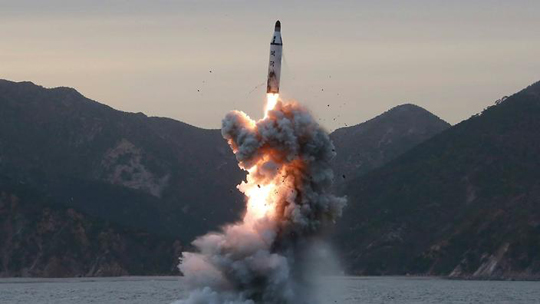
Seoul, Mar 6: Nuclear-armed North Korea fired four ballistic missiles east of the peninsula today, with Japan saying three of them landed in its waters.
koreas

Pyongyang fired a ballistic missile last month -- its first such launch since October -- which Seoul said was aimed at testing the response from the new US administration of President Donald Trump.

Seoul said several missiles were filed into the East Sea, also known as the Sea of Japan, and that South Korea and the US were "closely analysing" tracking data for further details.

"In terms of the range, it is around 1,000 kilometres," the South's defence ministry said in a statement.

Seoul said its armed forces were "closely monitoring the North's military for further provocations and maintaining military readiness".

Japanese Prime Minister Shinzo Abe said North Korea fired four missiles "almost simultaneously", three of which landed in Japan's Exclusive Economic Zone.

In response to the launch, South Korea's acting president Hwang Kyo-Ahn convened an emergency National Security Council (NSC) meeting, the presidential office said in a statement.

Seoul and Washington launched annual joint military exercises last week that infuriate Pyongyang, which condemns them as provocative rehearsals for invasion.

A day after the Foal Eagle drills kicked off, the North's military warned of "merciless nuclear counter-action" against enemy forces.

"Now that the US imperialists and the South Korean puppet forces again kicked off the dangerous nuclear war drills against the DPRK at its doorstep, our army will counter them with the toughest counteractions," a spokesman said in a statement carried by the KCNA news agency.

North Korea has regularly carried out actions in protest against the exercises, last year firing seven ballistic missiles during them.

That rocket -- said by the North to use solid fuel and to be capable of carrying a nuclear warhead -- flew east for about 500 kilometres before falling into the Sea of Japan, South Korea said at the time.

North Korea is under heavy international sanctions for its nuclear and missile programmes.

Last month, China -- the North's chief ally and diplomatic protector -- announced a suspension of all coal imports from the North until the end of the year, depriving Pyongyang of a crucial source of foreign currency.

China's foreign ministry said Beijing and Pyongyang were still "friendly neighbours" but added it remained opposed to the North's nuclear ambitions.

North Korea is barred under UN resolutions from any use of ballistic missile technology. But six sets of UN sanctions since Pyongyang's first nuclear test in 2006 have failed to halt its drive for what it insists are defensive weapons.

Last year the country conducted two nuclear tests and numerous missile launches in its quest to develop a nuclear weapons system capable of hitting the continental US.

Pyongyang has also been blamed by Seoul for the killing of Kim's half-brother Kim Jong-Nam by two women using VX nerve agent at Kuala Lumpur's international airport last month.

Comments

Add new comment

  • Coastaldigest.com reserves the right to delete or block any comments.
  • Coastaldigset.com is not responsible for its readers’ comments.
  • Comments that are abusive, incendiary or irrelevant are strictly prohibited.
  • Please use a genuine email ID and provide your name to avoid reject.
News Network
June 17,2020

Beijing, Jun 17: Beijing's airports cancelled more than 1,200 flights and schools in the Chinese capital were closed again on Wednesday as authorities rushed to contain a new coronavirus outbreak linked to a wholesale food market.

The city reported 31 new cases on Wednesday while officials urged residents not to leave Beijing, with fears growing about a second wave of infections in China, which had largely brought its outbreak under control.

Tens of thousands of people linked to the new Beijing virus cluster -- believed to have started in the sprawling Xinfadi wholesale food market -- are being tested, with almost 30 residential compounds in the city now under lockdown.

At least 1,255 scheduled flights were cancelled Wednesday morning, state-run People's Daily reported, nearly 70 percent of all trips to and from Beijing's main airports.

The outbreak had already forced authorities to announce a travel ban for residents of "medium- or high-risk" areas of the city, while requiring other residents to take nucleic acid tests in order to leave Beijing.

Meanwhile, several provinces were quarantining travellers from Beijing, where all schools -- which had mostly reopened -- have been ordered to close again and return to online classes.

"The epidemic situation in the capital is extremely severe," Beijing city spokesman Xu Hejian warned Tuesday.

Mass testing under way

Officials have closed 11 markets and disinfected thousands of food and beverage businesses in Beijing after the outbreak was detected.

The city has now reported 137 infections over the last six days, with six new asymptomatic cases and three suspected cases on Wednesday, according to the municipal health commission.

An additional two domestic cases, one in neighbouring Hebei province and another in Zhejiang, were reported by national authorities on Wednesday, while there were 11 imported cases.

Authorities have so far banned group sports, ordered people to wear masks in crowded enclosed spaces, and suspended inter-provincial group tours in response to the outbreak.

Officials said that since May 30, more than 200,000 people had visited Xinfadi market, which supplies more than 70 percent of Beijing's fruit and vegetables.

More than 8,000 workers there were tested and quarantined.

Until the new outbreak, most of China's recent cases were nationals returning from abroad as COVID-19 spread globally, and the government had all but declared victory against the disease.

China's Center for Disease Control and Prevention said Monday that the virus type found in the Beijing outbreak was a "major epidemic strain" in Europe.

Comments

Add new comment

  • Coastaldigest.com reserves the right to delete or block any comments.
  • Coastaldigset.com is not responsible for its readers’ comments.
  • Comments that are abusive, incendiary or irrelevant are strictly prohibited.
  • Please use a genuine email ID and provide your name to avoid reject.
News Network
April 26,2020

Apr 26: The remarkable story of an airman who overcame prejudice to become one of only a handful of Indian fighter pilots in the First World War has emerged in newly-released archive files by the UK's Commonwealth War Graves Commission (CWGC).

Lieutenant Shri Krishna Chanda Welinkar is one of the thousands of moving stories from the war preserved in family correspondence and being brought alive as part of a digitisation project.

The never-before-published files contain thousands of letters, pictures and other papers sent between the Commission and the next of the kin of First World War dead.

Among them is the story of Welinkar, who hailed from Bombay in colonial India. After much hardship and discrimination, he eventually became a pilot and went missing while on patrol over the skies above the Western Front in June 1918.

His family had to wait nearly three years before they finally knew for certain that he had died, and his grave was located.

“For everyone who died in the First World War, there was inevitably a partner, parent or child back home who had questions. The heartbreaking letters in CWGC's archive give us an insight into what it was like for those families trying to come to terms with their loss,” said Andrew Fetherston, chief archivist for CWGC.

“They are stories that show desperate searches for closure, former enemies uniting and, on many occasions, the sad realisation that a missing loved one would always remain so. We are pleased to be able to make this invaluable piece of World War history accessible to a new generation and help deepen our understanding of how the First World War impacted those who were left behind,” he said.

Welinkar was one of the 1.3 million Indians who answered the call to fight for the British Empire. Nearly 74,000 never saw their homeland again and are remembered today in cemeteries and memorials throughout the world, including France, Belgium, the Middle East and Africa.

Welinkar was a well-educated man studying at Cambridge University. He trained to become an aviator in Middlesex and wished to join the Royal Flying Corps, later known as the Royal Air Force.

Upon attempting to enlist, Welinkar encountered the same prejudices as his other fellow Indian airmen and was encouraged to become an air mechanic instead.

He was eventually given a commission in the Royal Flying Corps as an Officer. In 1918, he was posted to France and patrolled the skies above the Western Front.

In June 1918, Lieutenant Welinkar embarked on what would be his final patrol; he did not return and was reported missing. His fate remained unknown for many months afterwards.

The newly-released e-files chronicle the remarkable discovery of Welinkar and his final resting place long after the war had ended. Colonel Barton, who knew Welinkar, acted on behalf of his mother and helped find her missing son. They spoke to former enemies and honed their search to the grave of an unidentified man, buried by the Germans as “Oberleutnant S.C. Wumkar” in a grave in Rouvroy, Belgium.

The body was later moved and reinterred in Hangard Communal Cemetery Extension but it wasn't until the vital clue, found in the original German burial records in February 1921, that it was confirmed beyond doubt this grave was of Welinkar's.

In May 1921, Colonel Barton, on behalf of Welinkar's mother, requested that a Commission headstone be placed on the grave with the following personal inscription: “To the Honoured Memory of One of the Empire's Bravest Sons”.

This records – known as Enquiry Files – are part of a collection of nearly 3,000 files which have never been made available to the public before. Nearly half have been digitised so far, alongside a previously unreleased collection of more than 16,000 photographs held in negatives in the Commission's archive.

The files, internally referred to simply as E-Files, contain correspondence between the CWGC and the next of kin of the war dead. They often contain letters, typed memos between Commission staff and on occasion photos, maps and diagrams.

CWGC only holds an enquiry file for a small proportion of the 1.7 million people it commemorates from the Commonwealth. Today it is only possible to release those surviving records from the First World War because correspondence with families of Second World War casualties often involves people still alive today and cannot be made public for many years, due to the UK's data protection rules.

To date, more than 1,300 of the surviving 3,000 First World War enquiry files have been digitised.

The CWGC commemorates the 1.7 million Commonwealth servicemen and women who died during the two World Wars. It also holds and updates an extensive and accessible records archive, while operating over 23,000 locations in more than 150 countries and territories.

Comments

Add new comment

  • Coastaldigest.com reserves the right to delete or block any comments.
  • Coastaldigset.com is not responsible for its readers’ comments.
  • Comments that are abusive, incendiary or irrelevant are strictly prohibited.
  • Please use a genuine email ID and provide your name to avoid reject.
News Network
March 4,2020

Beijing/Zurich, Mar 4: China has approved the use of Swiss drugmaker Roche's anti-inflammation drug Actemra for patients who develop severe complications from the coronavirus as it urgently hunts for new ways to combat the deadly infection that is spreading worldwide.

China is hoping that some older drugs could stop severe cytokine release syndrome (CRS), or cytokine storms, an overreaction of the immune system which is considered a major factor behind catastrophic organ failure and death in some coronavirus patients.

Actemra, a biologic drug approved in 2010 in the United States for rheumatoid arthritis (RA), inhibits high Interleukin 6 (IL-6) protein levels that drive some inflammatory diseases.

China's National Health Commission said in treatment guidelines published online on Wednesday that Actemra can now be used to treat coronavirus patients with serious lung damage and high IL-6 levels.

Separately, researchers in the country are testing Actemra, known generically as tocilizumab, in a clinical trial expected to include 188 coronavirus patients and running until May 10.

Roche, which donated 14 million yuan ($2.02 million) worth of Actemra during February, said the trial was initiated independently by a third party with the aim of exploring the efficacy and safety of the drug in coronavirus patients with CRS.

It added that there was currently no published clinical trial data on the drug's safety or efficacy against the virus.

More than 3,000 people have died and 93,000 have been infected by the novel coronavirus thought to have originated in Wuhan, China, before spreading to around 90 countries including the United States, Italy, Switzerland, France and Germany.

The Swiss company, for which China is its No. 2 market behind the United States, also makes diagnostic gear to detect the coronavirus.

Since Actemra's approval a decade ago, it has become a go-to drug against other inflammatory conditions, including cytokine storms in cancer patients receiving cell therapies from Novartis and Gilead Sciences.

In 2012 it helped save the life of a young U.S. girl, the first child to be treated for leukaemia with Novatis' Kymriah, from a post-treatment rush of IL-6.

Priced at between $20-30,000 annually for RA according to SSR Health, Roche's medicine is also used for rare juvenile arthritis and giant cell arteritis, or inflammation of the blood vessels.

Comments

Add new comment

  • Coastaldigest.com reserves the right to delete or block any comments.
  • Coastaldigset.com is not responsible for its readers’ comments.
  • Comments that are abusive, incendiary or irrelevant are strictly prohibited.
  • Please use a genuine email ID and provide your name to avoid reject.