



North Korea fires missiles, three reach Japan waters

March 6, 2017

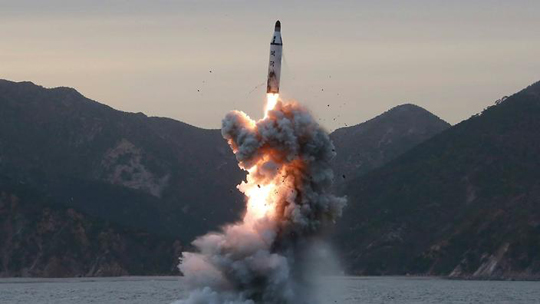
Seoul, Mar 6: Nuclear-armed North Korea fired four ballistic missiles east of the peninsula today, with Japan saying three of them landed in its waters.
koreas

Pyongyang fired a ballistic missile last month -- its first such launch since October -- which Seoul said was aimed at testing the response from the new US administration of President Donald Trump.

Seoul said several missiles were filed into the East Sea, also known as the Sea of Japan, and that South Korea and the US were "closely analysing" tracking data for further details.

"In terms of the range, it is around 1,000 kilometres," the South's defence ministry said in a statement.

Seoul said its armed forces were "closely monitoring the North's military for further provocations and maintaining military readiness".

Japanese Prime Minister Shinzo Abe said North Korea fired four missiles "almost simultaneously", three of which landed in Japan's Exclusive Economic Zone.

In response to the launch, South Korea's acting president Hwang Kyo-Ahn convened an emergency National Security Council (NSC) meeting, the presidential office said in a statement.

Seoul and Washington launched annual joint military exercises last week that infuriate Pyongyang, which condemns them as provocative rehearsals for invasion.

A day after the Foal Eagle drills kicked off, the North's military warned of "merciless nuclear counter-action" against enemy forces.

"Now that the US imperialists and the South Korean puppet forces again kicked off the dangerous nuclear war drills against the DPRK at its doorstep, our army will counter them with the toughest counteractions," a spokesman said in a statement carried by the KCNA news agency.

North Korea has regularly carried out actions in protest against the exercises, last year firing seven ballistic missiles during them.

That rocket -- said by the North to use solid fuel and to be capable of carrying a nuclear warhead -- flew east for about 500 kilometres before falling into the Sea of Japan, South Korea said at the time.

North Korea is under heavy international sanctions for its nuclear and missile programmes.

Last month, China -- the North's chief ally and diplomatic protector -- announced a suspension of all coal imports from the North until the end of the year, depriving Pyongyang of a crucial source of foreign currency.

China's foreign ministry said Beijing and Pyongyang were still "friendly neighbours" but added it remained opposed to the North's nuclear ambitions.

North Korea is barred under UN resolutions from any use of ballistic missile technology. But six sets of UN sanctions since Pyongyang's first nuclear test in 2006 have failed to halt its drive for what it insists are defensive weapons.

Last year the country conducted two nuclear tests and numerous missile launches in its quest to develop a nuclear weapons system capable of hitting the continental US.

Pyongyang has also been blamed by Seoul for the killing of Kim's half-brother Kim Jong-Nam by two women using VX nerve agent at Kuala Lumpur's international airport last month.

Comments

Add new comment

  • Coastaldigest.com reserves the right to delete or block any comments.
  • Coastaldigset.com is not responsible for its readers’ comments.
  • Comments that are abusive, incendiary or irrelevant are strictly prohibited.
  • Please use a genuine email ID and provide your name to avoid reject.
News Network
July 11,2020

Istanbul, Jul 11: Turkish President Recep Tayyip Erdogan announced Friday that the Hagia Sophia, one of the architectural wonders of the world, would be reopened for Muslim worship, sparking fury in the Christian community and neighbouring Greece.

His declaration came after a top Turkish court revoked the sixth-century Byzantine monument's status as a museum, clearing the way for it to be turned back into a mosque.

The UNESCO World Heritage site in historic Istanbul, a magnet for tourists worldwide, was first constructed as a cathedral in the Christian Byzantine Empire but was converted into a mosque after the Ottoman conquest of Constantinople in 1453.

The Council of State, Turkey's highest administrative court, unanimously cancelled a 1934 cabinet decision to turn it into a museum and said Hagia Sophia was registered as a mosque in its property deeds.

The landmark ruling could inflame tensions not just with the West and Turkey's historic foe Greece but also Russia, with which Erdogan has forged an increasingly close partnership in recent years.

'Millions of Christians not heard'

Greece swiftly branded the move by Muslim-majority Turkey an "open provocation to the civilised world".

"The nationalism displayed by Erdogan... takes his country back six centuries," Culture Minister Lina Mendoni said in a statement.

The Russian Orthodox Church was equally scathing.

"The concern of millions of Christians were not heard," Church spokesman Vladimir Legoida told Interfax news agency.

The decision "shows that all pleas regarding the need to handle the situation extremely delicately were ignored," he said.

UNESCO chief Audrey Azoulay said she "deeply regrets" the decision made without prior dialogue with the UN's cultural agency.

The move was also condemned by the US Commission on International Religious Freedom, which said it was an "unequivocal politicisation" of the monument.

Hagia Sophia, which stands opposite the impressive Sultanahmet Mosque -- often called the Blue Mosque, has been a museum since 1935 and open to believers of all faiths.

Transforming it from a mosque was a key reform under the new republic born out of the ashes of the Ottoman Empire.

Sharing a presidential decree which named Hagia Sophia as a "mosque", Erdogan announced its administration would be handed over to Turkey's religious affairs directorate known as Diyanet.

"May we be blessed," he commented. The decree was published on the official gazette.

Erdogan has in recent years placed great emphasis on the battles which resulted in the defeat of Byzantium by the Ottomans, with lavish celebrations held every year to mark the conquest.

Muslim clerics have occasionally recited prayers in the museum on key anniversaries or religious holidays.

"The decision is intended to score points with Erdogan's pious and nationalist constituents," said Anthony Skinner of the risk assessment firm Verisk Maplecroft.

"Hagia Sophia is arguably the most conspicuous symbol of Turkey's Ottoman past -- one which Erdogan is leveraging to strengthen his base while snubbing domestic and foreign rivals," he told AFP.

'Chains broken'

A few hundred Turks carrying Turkish flags gathered outside Hagia Sophia shouting "Chains broken, Hagia Sophia reopened".

Police heightened security measures around the building, according to AFP journalists.

"It's been a dream since we were kids," said Erdal Gencler, an Istanbul resident.

"(Hagia Sophia) finds its true purpose again. We are very excited, proud, and hopeful that there will be beautiful services here," he added.

Fatma, a woman with tearful eyes, said: "Of course I am crying. (Hagia Sophia) belongs to us."

Ahead of the court decision, Justice Minister Abdulhamit Gul shared a picture of Hagia Sophia on his official Twitter account, with a message: "Have a good Friday."

Finance Minister Berat Albayrak, Erdogan's son-in-law, tweeted that Hagia Sophia would be reopened to Muslim worship "sooner or later", referring to a quote from Turkish poet Necip Fazil Kisakurek.

The Council of State had on July 2 debated the case brought by a Turkish group -- the Association for the Protection of Historic Monuments and the Environment, which demanded Hagia Sophia be reopened for Muslim prayers.

Since 2005, there have been several attempts to change the building's status. In 2018, the Constitutional Court rejected one application.

Despite occasional protests outside the site by Islamic groups, Turkish authorities had until now kept the building as a museum.

Comments

Add new comment

  • Coastaldigest.com reserves the right to delete or block any comments.
  • Coastaldigset.com is not responsible for its readers’ comments.
  • Comments that are abusive, incendiary or irrelevant are strictly prohibited.
  • Please use a genuine email ID and provide your name to avoid reject.
Agencies
April 28,2020

United Nations, Apr 28: UN chief Antonio Guterres has warned that extremist groups are taking advantage of the COVID-19 lockdowns and intensifying efforts on social media to recruit youths online by exploiting their anger and despair, asserting that the world cannot afford a lost generation due to the unprecedented global health crisis.

The UN Secretary-General made the remarks on Monday during a video conference to review the five years since its adoption of a landmark resolution on youth, peace and security.

We can already see such groups taking advantage of the COVID-19 lockdowns, intensifying their efforts on social media to spread hatred and to recruit young people who may be spending more time at home and online, he said.

Guterres told the Security Council that even before the current crisis, young people were facing enormous challenges.

Listing startling numbers, he said one of every five young people was already not in education, training or employment and one of every four is affected by violence or conflict. Every year, 12 million girls become mothers while they themselves are still children.

These frustrations and, frankly, failures to address them by those in power today, fuel declining confidence in political establishments and institutions. And when such a cycle takes hold, it is all too easy for extremist groups to exploit the anger and despair, and the risk of radicalisation climbs, he said.

Issuing a call to action on youth, peace and security, Guterres said the world cannot afford a lost generation of youth, their lives set back by COVID-19 and their voices stifled by a lack of participation. Let us do far more to tap their talents as we tackle the pandemic and chart a recovery that leads to a more peaceful, sustainable and equitable future for all.

With over 1.54 billion children and youth out-of-school and young people acutely feeling the impact of the COVID-19 crisis, Guterres said countries must do more to harness the talents of young people to address the crisis and its aftermath.

In presenting his first report on the Security Council resolution, the UN chief said youth were already confronting numerous challenges even before the pandemic, including in accessing education, or through being affected by violence and conflict. Those pressing for peace or upholding human rights have been threatened.

Despite these obstacles, young people across the world have joined the common fight against the coronavirus disease, supporting both frontline workers and people in need. And they continue to push for change.

UN Youth Envoy Jayathma Wickramanayake spoke of the need for more meaningful partnerships between young people and the civil society organisations and government institutions that work on the youth, peace and security (YPS) agenda.

To date, there are no national action plans on YPS but I'm pleased to note that in some countries, these are in the process of development, she said.

For a national roadmap to be successful, a participatory, transparent and youth-led process with adequate resources are needed, she said.

Issuing his four-point call to action for the Council, Guterres urged members to do more to address the various challenges facing young people.

He also called for investment in youth participation, but also in their organisations and initiatives.

We must strengthen human rights protections and protect the civic space on which youth participation depends, he said. And fourth, we must emerge from the COVID-19 crisis with a determination to recover better - massively increasing our investment in young people's capacities as we deliver the Sustainable Development Goals.

Comments

Add new comment

  • Coastaldigest.com reserves the right to delete or block any comments.
  • Coastaldigset.com is not responsible for its readers’ comments.
  • Comments that are abusive, incendiary or irrelevant are strictly prohibited.
  • Please use a genuine email ID and provide your name to avoid reject.
Agencies
June 29,2020

Tehran, Jun 29: Iran has issued an arrest warrant and asked Interpol for help in detaining President Donald Trump and dozens of others it believes carried out the drone strike that killed a top Iranian general in Baghdad, a local prosecutor reportedly said Monday.

While Trump faces no danger of arrest, the charges underscore the heightened tensions between Iran and the United States since Trump unilaterally withdrew America from Tehran’s nuclear deal with world powers.

Tehran prosecutor Ali Alqasimehr said Trump and more than 30 others whom Iran accuses of involvement in the Jan. 3 strike that killed Gen. Qassem Soleimani in Baghdad face “murder and terrorism charges,” the semiofficial ISNA news agency reported.

Alqasimehr did not identify anyone else sought other than Trump, but stressed that Iran would continue to pursue his prosecution even after his presidency ends.

Interpol, based in Lyon, France, did not immediately respond to a request for comment.

Alqasimehr also was quoted as saying that Iran requested a “red notice” be put out for Trump and the others, which represents the highest level arrest request issued by Interpol. Local authorities end up making the arrests on behalf of the country that request it. The notices cannot force countries to arrest or extradite suspects, but can put government leaders on the spot and limit suspects’ travel.

After receiving a request, Interpol meets by committee and discusses whether or not to share the information with its member states. Interpol has no requirement for making any of the notices public, though some do get published on its website.

It is unlikely Interpol would grant Iran’s request as its guideline for notices forbids it from “undertaking any intervention or activities of a political” nature.

The U.S. killed Soleimani, who oversaw the Revolutionary Guard’s expeditionary Quds Force, and others in the January strike near Baghdad International Airport. It came after months of incidents raising tensions between the two countries and ultimately saw Iran retaliate with a ballistic missile strike targeting American troops in Iraq.

Comments

Add new comment

  • Coastaldigest.com reserves the right to delete or block any comments.
  • Coastaldigset.com is not responsible for its readers’ comments.
  • Comments that are abusive, incendiary or irrelevant are strictly prohibited.
  • Please use a genuine email ID and provide your name to avoid reject.