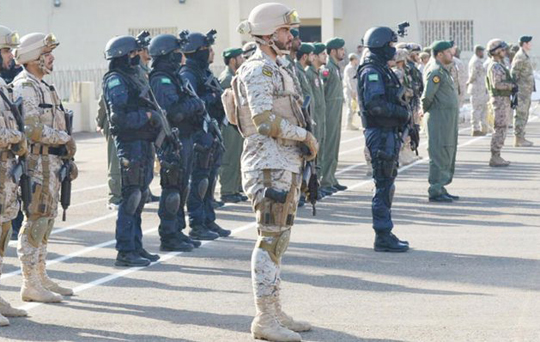
North Spear, Gulf Security-1 drills bolster Saudi defense capability

November 1, 2016

Jeddah, Nov 1: “North Spear” military exercises began Sunday in the northwestern region of Saudi Arabia in parallel with the Bahrain-hosted first Gulf joint exercises titled Arab Gulf Security-1.

spear

Participating in the North Spear exercises are units from the Royal Saudi Land Forces, the special forces of Malaysia and the United States and the Saudi Special Forces. The drill will continue until Nov. 14.

The opening ceremony was attended by the commander of the northwestern region, Maj. Gen. Zafer Ali Al-Shehri, and a number of US and Malaysian officers. The drill’s commander, Brig. Gen. Ali bin Sayer Al-Anzi, welcomed participants of the armed forces and pointed out the competence of the Saudi paratroopers and the special units at the Royal Saudi Land Forces and their efficiency in working in different environments such as mountains, deserts, coastal and urban areas.

He explained that the aim of the drill is to exchange experiences with friends and unify the concepts and measures in case of any threats to the national security.

Both the Malaysian and American sides have expressed their deep appreciation to the Saudi armed forces for hosting the drill and providing all capabilities to make it a success.

Meanwhile, Bahrain continues to host the Arab Gulf Security-1 exercises. The commander of the Saudi security forces taking part in this drill, Brig. Shayie bin Salem Al-Wad’ani, said that Saudi Arabia is keen to lead and participate in the security exercise as it is important to coordinate and integrate Gulf security forces to be able to better respond to different security situations, and managing operations and confronting terrorist plots targeting the security and stability of the GCC member states.

Videos were shared showing Saudi anti-terror security forces and others specializing in protecting land and sea borders, as well as the high levels of readiness reflected in the drill.

Comments

Add new comment

  • Coastaldigest.com reserves the right to delete or block any comments.
  • Coastaldigset.com is not responsible for its readers’ comments.
  • Comments that are abusive, incendiary or irrelevant are strictly prohibited.
  • Please use a genuine email ID and provide your name to avoid reject.
News Network
June 12,2020

Beirut, Jun 12: Angry Lebanese protesters blocked roads across the country with burning tyres, debris and their vehicles, incensed over the local currency's depreciation by more than 25 percent in just two days.

The demonstrations from northern Akkar and Tripoli to central Zouk, the eastern Bekaa Valley, Beirut and southern Tyre and Nabatieh on Thursday were some of the most widespread in months of upheaval over a calamitous economic and financial crisis.

Protesters set ablaze a branch of the Central Bank, vandalised several private banks and clashed with security forces in several areas. At least 41 people were injured in Tripoli alone, according to the Lebanese Red Cross.

"I'm really pissed off, that's all. If politicians think they can burn our hearts like this the fire is going to reach them too," unemployed computer engineer Ali Qassem, 26, told Al Jazeera after pouring fuel onto smouldering tyres on a main Beirut thoroughfare.

Tens of thousands of Lebanese have lost jobs in the past six months and hundreds of businesses have shuttered as a dollar shortage led the Lebanese pound to slide from 1,500 to $1 last summer - where it was pegged for 23 years - to roughly 4,000 for each US dollar last month.

But the slide turned into a freefall between Wednesday and Thursday when the pound plummeted to roughly 5,000 to $1 on black markets, which have become a main source of hard currency. There was widespread speculation the rate hit 6,000 or even 7,000 pounds to the dollar, though most markets stopped trading.

Protesters began amassing on streets across the country before sunset and increased into the thousands across the country as the night fell.

Prime Minister Hassan Diab cancelled all meetings scheduled for Friday to hold an emergency cabinet session at 9:30am and another at 3pm at the presidential palace to be headed by President Michel Aoun.

The pound's collapse is the perhaps the biggest challenge yet for Diab's young cabinet, which gained confidence in February after former prime minister Saad Hariri's government was toppled by an unprecedented October uprising that had the country's economic crisis at its core.

Economy Minister Raoul Nehme told Al Jazeera that there was "disinformation" being circulated about the exchange rate on social media and said he was investigating possible currency manipulation.

"I don't understand how the exchange rate increased by so much in two days," he said.

Many protesters have pitted blame on Central Bank governor Riad Salameh, nominally in charge of  keeping the currency stable. But they have also called on the government to resign.

"If people want reform between dawn and dusk, that's not going to work, and if someone thinks they can do a better job then please come forward," Nehme said.

"But what we can't have is a power vacuum - then the exchange rate won't be 5000, it'll be a catastrophe."

'Everyone paying the price'

When protesters set a large fire in Beirut's Riad al-Solh Square, which lies at the foot of a grand Ottoman-era building that serves as the seat of government, firefighters did not intervene to extinguish it.

It later became clear why: Civil Defence told local news channel LBCI they had run out of diesel to fuel their firetrucks.

Basic imports such as fuel have been hit hard by the currency crisis, making already-weak state services increasingly feeble.

A half-dozen or so police officers with Lebanon's Internal Security Forces observed the scene unfolding in front of them in the square.

"Why do you destroy shops and things and attack us security forces - do you think we're happy? Go and f****** break that wall or go to the politicians' houses," one police officer told Al Jazeera, referring to a large concrete barrier separating protesters from the seat of government.

"In the end we are with you and we want the country to change. Don't you dare think we're happy. My salary is now worth $130," the officer said.

The currency's spectacular fall seems to have pushed many Lebanese to put common interests above their differences.

Large convoys of men on motorbikes from Shia-majority areas of southern Beirut joined the demonstrations on Thursday, though they have clashed with protesters many times before - including at a protest on Saturday.

Some chanted sectarian insults, leading to brief clashes in areas that were formerly front lines during the country's devastating 15-year civil war.

Instead, the motorbike-riding demonstrators on Thursday chanted: "Shia, Sunni, F*ck sectarianism."

"We are Shia, and Sunnis and Christian are our brothers," Hisham Houri, 39, told Al Jazeera, perched on a moped with his fiancee behind him just a few metres from a pile of burning tyres.

The blaze sent thick black smoke into the sky towards an iconic blue-domed mosque and church in downtown Beirut.

"Politicians play on these sectarian issues and sometimes succeed, but in the end, they'll fail because all the people have been hurt," he said. "The dollar isn't just worth 6,000 for Shias or for Sunnis, everyone is paying that price."


Comments

Add new comment

  • Coastaldigest.com reserves the right to delete or block any comments.
  • Coastaldigset.com is not responsible for its readers’ comments.
  • Comments that are abusive, incendiary or irrelevant are strictly prohibited.
  • Please use a genuine email ID and provide your name to avoid reject.
News Network
July 20,2020

Abu Dhabi, Jul 20: The United Arab Emirates launched its first-ever interplanetary Hope Probe mission to Mars from Japan's Tanegashima Space Centre at 01:58 a.m. (local time) on Monday.

"United Arab Emirates (UAE) launches its first mission to Mars, the 'Hope Mars Mission' from Japan's Tanegashima Space Center," UAE Space Agency said on its Twitter page.

The spacecraft is expected to reach Mars orbit in about 200 days from now and then begin its mission to study the Red Planet's atmosphere, WAM news agency reported.

Once it enters Mars' orbit in the first quarter of 2021, the Hope probe will mark the UAE's 50th anniversary.

The probe will travel 493 million kilometres into space in a journey that will take seven months, and will orbit the Red Planet for one full Martian year of 687 days to provide the first truly global picture of the Martian atmosphere.

The Hope probe will be the first to study the Martian climate throughout daily and seasonal cycles. It will observe the weather phenomena on Mars such as the massive famous dust storms that have been known to engulf the Red Planet, as compared to the short and localised dust storms on Earth.

It will also examine the interaction between the upper and lower layers of the Martian atmosphere and causes of the Red Planet's surface corrosion, as well as study why Mars is losing its upper atmosphere.

Exploring connections between today's Martian weather and the ancient climate of the Red Planet will give deeper insights into the past and future of Earth as well as the potential of life on Mars and other distant planets.

The Hope Mars Mission is considered as the biggest strategic and scientific national initiative announced by UAE's President His Highness Sheikh Khalifa bin Zayed Al Nahyan and His Highness Sheikh Mohammed bin Rashid Al Maktoum in 2014. The UAE will be the first Arab nation to embark on a space mission to the Red Planet in a journey that contributes to the international science community as a service to human knowledge.

The interplanetary mission is the first by any West Asian, Arab or Muslim majority country.

Comments

Add new comment

  • Coastaldigest.com reserves the right to delete or block any comments.
  • Coastaldigset.com is not responsible for its readers’ comments.
  • Comments that are abusive, incendiary or irrelevant are strictly prohibited.
  • Please use a genuine email ID and provide your name to avoid reject.
Agencies
July 26,2020

Jeddah, Jul 26: The city of Makkah is opening its arms again to welcome pilgrims for the annual Hajj — although only a handful compared with previous years.

Because of the COVID-19 pandemic, this year’s event is limited to about 1,000 pilgrims, all from inside Saudi Arabia, about 700 of whom are expatriates.

Abdullah Al-Kathiri, an Emirati and a recovered COVID-19 patient, postponed his pilgrimage last year because it coincided with his wedding plans. “I’ve heard from many who’ve performed the pilgrimage in past years that it was always a smooth process, even with the massive numbers,” he said. “So you could imagine how it would be with the limited number of pilgrims this year. Surely it will be a great experience.”

Khadija, a Bulgarian expatriate, was overcome with tears when she heard she would be performing Hajj this year. “I didn’t expect they’d accept,” she said. “I’m sure this year’s Hajj will be an exceptional one in all respects.”

Dr. Haifa Yousef Hamdoon, a Tunisian physician in Qassim, is another who did not expect to be accepted because of the low numbers this year. “When I received confirmation of my request, I was overjoyed and couldn’t believe it,” she said.

Mu’taz Mohamed, a Sudanese pilgrim who also lives in Qassim region, praised the preventive and precautionary health measures taken in order to ensure his safety and that of other pilgrims, to enable them to perform the rituals safely.

After completing their arrival procedures, the pilgrims were taken to their accommodation in Makkah, supervised by the Ministry of Hajj and Umrah. They will stay there for four days before beginning their pilgrimage on July 30.

Comments

Add new comment

  • Coastaldigest.com reserves the right to delete or block any comments.
  • Coastaldigset.com is not responsible for its readers’ comments.
  • Comments that are abusive, incendiary or irrelevant are strictly prohibited.
  • Please use a genuine email ID and provide your name to avoid reject.