Kasaragod, Apr 19: Kasaragod, Kerala's COVID-19 hotspot, is the only district in the southern state lacking adequate health infrastructure.
In spite of treating the highest number of COVID-19 patients in the state with meagre infrastructural facilities and even without the support of a medical college in the north Kerala district, no deaths have been reported due to coronavirus.
The state health department views the performance of M Kunhiraman and his team, consisting of Janardhana Naik and Krishna Naik, at the General hospital in Kasaragod as a success story.
"Not only did they control the situation quickly with minimum infrastructure, they also started turning out a large number of negative cases within a few weeks and creditably ensured zero mortality.
This can be showcased as a best global model," Chairman of the Information Education and Communication (IEC) Committee and Project Director Kerala State Aids Control Society, R Ramesh said.
Recalling the ordeal, Janardhana Naik said his first major challenge was the physical examination of a patient with suspected COVID-19.
"Even with the PPE kit, nobody knew how effective they were and it took a whole 30 minutes to wear them properly.
But as time passed, we got accustomed to it," he said.
The traditional method of dealing with a patient involved knowing his or her history, observation and physical examination.
For hundreds of years, the hands-on body approach has been the soul of the doctor-patient relationship -- taking the pulse, tapping on and listening to the chest, feeling lumps.
With the onset of COVID-19 all that has changed.
"In fact, the whole exercise was fraught with grave risks because everything connected with COVID-19 was new.
Doctors have to keep a distance even though the physical examination wearing a Personal Protective Equipment (PPE) is difficult.
Sounds from the body are inaudible, vision is blurred through the smog-covered goggles and a stethoscope seldom has any use," Janardhana Naik said.
It was from March 15 that the hospital started receiving COVID-19 patients, primarily from Dubai.
By the time the first person came, the hospital was ready for him.
Soon, patient numbers began to swell and in a couple of weeks they reached about 91.
From then on, it was teamwork.
Committees were formed for each and every task, including the help desk, IT, treatment, medical board, training, food, waste disposal and data maintenance.
Initially, patients had many misgivings about the hospital.
"Some were disillusioned and even aggressive. Some were not happy with the facilities the hospital had to offer.
But gradually through good treatment and counselling by a psychiatrist, who visited the hospital on alternate days, the confidence and mood of the patients changed and they became friendly with the staff," Naik elaborated.
Counselling was also given to the concerned family members of the patients.
Besides treatment, the medical staff had to spend a considerable amount of time clearing the doubts of patients.
When they got discharged some patients insisted on seeing the faces of the medical staff, who till then were anonymous entities covered from head to toe.
Some even wanted to take selfies with them.
However, the medical team politely turned down their requests and preferred to remain hidden in their work attires.
The mood of the patients also rubbed off on the doctors and hospital staff.
All the physicians and hospital staff are now more confident of dealing with contagious diseases after treating COVID-19 patients.
"Our previous experience of treating H1N1, Chikungunya and Dengue cases helped us a lot.
Words of encouragement from the Health Minister K K Shailaja, Health Principal Secretary Dr Rajan N Khobragade and Health Services Director Dr Sarita R L gave us the impetus to build up confidence.
Moreover, the field health workers did a wonderful job in containing the viral spread," Naik added.
As the number of coronavirus cases rose, the state government on April 5 deputed a 26-member medical team from Thiruvananthapuram to set up a COVID-19 hospital in the district.
They turned a block of the under construction Government Medical College as a hospital-like facility, setting up a 200 bed facility to treat coronavirus patients.





Comments
All these because of lacking of knowledge of fundamentals of Islam.
Islam is perfectly taught with boundaries for what to be done and what not to be done.
What to be done are : Farz, or obligatory deeds
What may be done : N compulsion, but doing can lead for extra reward
Not to be done Prohibitions : These should not be done. Like Associating someone with the True God who created us who only deserves to be worshipped. This is a biggest crime in Islamic point of view. Other prohibitions are eating pork, liquors, adultery, gambling,
Now the things what happening mostly in Dargah are worshipping the graves, which is the biggest crime. This is forbidden to both men and women. People can visit the dargah and pray for the dead people in that grave. But begging the dead there is prohibited.
Really those dead bodies can not help us, in contrary those bodies need prayers, wishes of living people.
We can visit the dargah in the intention to pray for the dead in the grave and to say Salam. Doing like this properly is not sin.
Wrongly Visiting Dargah can mislead to sin,
And not visiting Dargah does not amount to sin.
Therefore people lack basic teaching of Islam.
A MUSLIMAH ( True Muslim Women) will never ask with any other creation EXCEPT ALLAH... Those who depend on other than ALLAH will get what they want but in the end they will fall for the trap of deceivers who are attracting the people who are WEAK in IMAN to their way of worshiping the graves or asking with the graves.
THOSE who have faith in ALLAH will never ask or depend on, other than ALLAH. They are Satisfied with what ALLAH gave and Say ALHAMDULLILLAH in whatever situation comes their way... Congrats to such MUSLIMS and MUSlIMAH who trust ALLAH and follow the teaching of Prophet Muhammad pbuh... who never showed us Such CULTURE of DARGAH ViSIT..
Prophet MUHAMMED pbuh said... Visit GRAVES to Pray for the one who is in the GRAVE & REMEMBER that one day our fate will be same. So dont live in this life in ARROGANT or do injustice to Others.
Dear Sahil, if they knows the meaning of Namaz or Salah they never visit Dargah. Here may be RSS behind such kind of demands.
These so called muslim women don't know Islam. so they are asking entry to Dargah/Grave yard. Who stop them to go there go and enjoy.CD Editor please remove Muslim woman tag because muslim women never ask such kind of demands.Better tag Ahle biddah women ask entry to darga.
They dont bother about namaz..but worried about entry to do shirq
Haha..funny..they dont bother about performing namaz..
But worried about entry to dargah to do shirq..
Dear CD team. Please be careful when you posting one sided opinion about practice of Islam. You have reader from all sections.
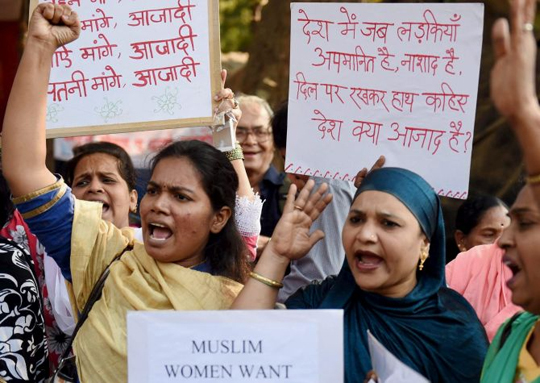
REALLY SURPRISED TO SEEE THESE MUSLIM LADIES IN ROAD PROTESTING FOR ENTERING THE DARGAH ,
FIRST THEY HAVE TO OFFER NAMAZ PERFECTLY I DONT KNOW WHAT THEY WILL GET IN DARGAH ....
THEY JUST VISIT TO ASK TO THEM.. THATS NOT GOOD WE HAVE TO ASK WITH ALLAH HE IS OUR ALL MIGHTY ..
Add new comment