


Obama nominates Richard Verma as new US envoy to India

September 19, 2014

Washington, Sep 19: President Barack Obama today nominated Indian-American, Richard Rahul Verma, as the next US Ambassador to India, ahead of Prime Minister Narendra Modi's visit to Washington later this month.
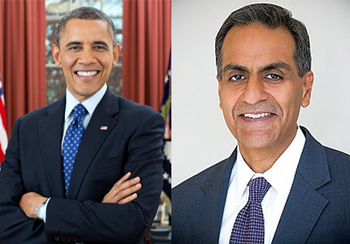
Richard VermaIf confirmed by the US Senate, Verma, who earlier served as the Assistant Secretary of State for Legislative Affairs and is now in the private sector, would be the first Indian-American to serve as the top US diplomatic position in New Delhi.

Obama announced his nomination along with several other key administration appointments.

"I am grateful that these impressive individuals have chosen to dedicate their talents to serving the American people at this important time for our country. I look forward to working with them in the months and years ahead," Obama said in a statement.

The US Embassy in New Delhi is currently headed by a Charge d'affaires, Kathleen Stephens.

Verma, 45, said to be a close confidant of the President and also former Secretary of State Hillary Clinton, currently serves as Senior Counselor at Steptoe & Johnson LLP and Albright Stonebridge Group. He is also a Senior National Security Fellow at the Center for American Progress.

Previously, he was Assistant Secretary for Legislative Affairs at the Department of State from 2009 to 2011 and Partner at Steptoe and Johnson LLP from 2007 to 2009.

He was Senior National Security Advisor, Counsel and Foreign Policy Advisor to the Senate Majority Leader Harry Reid from 2002 to 2007, and an Associate at Steptoe & Johnson from 1998 to 2002.

Verma served on active duty in the US Air Force from 1994 to 1998 and received, among other decorations, the Meritorious Service Medal and Air Force Commendation Medal.

Earlier in his career, Verma was a Field Representative for the National Democratic Institute in Eastern Europe and worked in the House of Representatives for Congressman John P Murtha.

He served on the Commission on the Prevention of Weapons of Mass Destruction, Proliferation and Terrorism in 2008 and has been a member of the Secretary of State's Foreign Affairs Policy Board.

Verma currently serves on the boards of Human Rights First, the Clinton Foundation, and the National Democratic Institute. He received a BS from Lehigh University, a JD from American University, and an LLM from Georgetown University Law Center.

Comments

Add new comment

  • Coastaldigest.com reserves the right to delete or block any comments.
  • Coastaldigset.com is not responsible for its readers’ comments.
  • Comments that are abusive, incendiary or irrelevant are strictly prohibited.
  • Please use a genuine email ID and provide your name to avoid reject.
Agencies
April 17,2020

Washington, Apr 17: A record number of 4,591 Americans have died in the last 24 hours due to the deadly novel coronavirus in the US, which has the highest number of COVID-19 casualties in the world.

According to the Johns Hopkins University data, by 8 pm on Thursday, as many as 4,591 Americans have died in the last 24 hours, The Wall Street Journal said.

The previous highest was 2,569 on Wednesday.

By Thursday, more than 662,000 Americans tested positive with the coronavirus.

The dreaded disease, which originated in Wuhan city in China in December last year, has so far claimed more than 144,000 lives and infected over 2.1 million people.

The virus has infected over 671,000 people and claimed more than 33,000 lives, the highest for any country in the world.

New York City and its adjoining areas, including New Jersey and Connecticut have emerged as the epicenter of the virus in the US.

New York alone accounts for 226,000 cases of infections and 16,106 deaths.

In New Jersey, as many as 3,518 people have died of the disease and 75,317 have tested positive.

According to the US Centers for Disease Control and Prevention, till April 14, four per cent of the Americans infected with COVID-19 were of Asian origin and nearly one-third (30 per cent) were African Americans.

US President Donald Trump told reporters at the White House that experts and scientists report that his strategy to slow the spread of the virus has saved hundreds of thousands of lives.

Models predicted between 1.5 million and 2.2 million US deaths. If there was no mitigation, it could have even been higher than that and between 100,000 and 240,000 deaths with mitigation. It is looking like we will come far under even these lowest numbers, he said.

Noting that experts say the curve of the virus has flattened, and the peak in the new cases has passed, Trump said that nationwide, more than 850 counties or nearly 30 per cent of the country have reported no new cases in the last seven days.

Because of our early and aggressive action, we have avoided the tragedy of health care rationing and deadly shortfalls that have befallen in many other nations, nations which wherever possible we are helping, he said.

According to Trump, at least 35 clinical trials are already underway, including antiviral therapies, immune therapies, and blood therapies in the form of convalescent plasma. So far, more than 3.5 million tests have been carried out.

Comments

Add new comment

  • Coastaldigest.com reserves the right to delete or block any comments.
  • Coastaldigset.com is not responsible for its readers’ comments.
  • Comments that are abusive, incendiary or irrelevant are strictly prohibited.
  • Please use a genuine email ID and provide your name to avoid reject.
News Network
May 27,2020

Washington, May 27: Most viruses and other germs do not spread easily on flights, the US Center for Disease Control and Prevention has said in its COVID-19 guidelines which do not recommend following social distancing between two passengers inside a plane or keeping the middle seat unoccupied.

As a result of coronavirus pandemic, air traffic inside the US has come to a near halt. Air traffic is said to be down to about 90 per cent. For all travellers coming from overseas, the Center for Disease Control and Prevention (CDC) has recommended 14 days quarantine.

"Most viruses and other germs do not spread easily on flights because of how air circulates and is filtered on aeroplanes," the CDC has said in its set of COVID-19 guidelines for air travellers.

However, it noted that the air travellers were not risk-free especially in the time of the coronavirus pandemic and recommended Americans to avoid travel as far as possible.

"Air travel requires spending time in security lines and airport terminals, which can bring you in close contact with other people and frequently touched surfaces," it said.

"Social distancing is difficult on crowded flights, and you may have to sit near others (within six feet), sometimes for hours. This may increase your risk for exposure to the virus that causes COVID-19," the CDC said.

But instead of recommended social distancing inside commercial planes, the CDC has advised a series of preventive and hygienic measures to be taken by the airlines pilot and crew to prevent the spread of coronavirus.

The US Department of Transportation and Federal Aviation Administration in its latest safety alerts for operators on May 11 said that air carriers and crews conducting flight operations having a nexus to the US, including both domestic and foreign air carriers, should follow CDC's occupational health and safety guidance.

The CDC issued its guidelines in first guidelines for the airlines and airline crew on March and again in May.

The CDC, which has issued an exhaustive social guideline measures in various sections, is silent on keeping the middle seat of a plane unoccupied so as to maintain the six feet distance between two passengers.

It calls for the plane crew to report to the CDC a traveller with specific COVID-19 symptoms like fever, persistent cough, difficulty in breathing and appearing unwell.

Asking the airlines and cabin crew to review infection control guidelines for cabin crew, the CDC recommends several measures for cabin crew to protect themselves and others, manage a sick traveller, clean contaminated areas, and take actions after a flight.

Prominent among them include washing hands often with soap and water for at least 20 seconds, particularly after assisting sick travellers or touching potentially contaminated body fluids or surfaces and use of alcohol-based hand sanitizer (containing at least 60 per cent alcohol) if soap and water are not available.

Airlines should consider providing alcohol-based hand sanitizer to cabin and flight crews for their personal use, it said.

The CDC guidelines do not recommend following social distancing inside a plane between two passengers or keeping the middle seat unoccupied. But it asks to minimise contact between passengers and cabin crew and the sick person.

"If possible, separate the sick person from others (by a distance of 2 meters or 6 feet, ideally) and designate one crew member to serve the sick person. Offer a facemask, if available and if the sick person can tolerate it. If a facemask is not available or cannot be tolerated, ask the sick person to cover their mouth and nose with tissues when coughing or sneezing," said the CDC guidelines.

If no symptomatic passengers were identified during or immediately after the flight, the CDC recommends airlines to follow routine operating procedures for cleaning aircraft, managing solid waste, and wearing PPE.

"If symptomatic passengers are identified during or immediately after the flight, routine cleaning procedures should be followed, and enhanced cleaning procedures should also be used," it said.

Clean porous (soft) surfaces (e.g, cloth seats, cloth seat belts) at the seat of the symptomatic passengers and within 6 feet of the symptomatic passengers in all directions, it added.

Comments

Add new comment

  • Coastaldigest.com reserves the right to delete or block any comments.
  • Coastaldigset.com is not responsible for its readers’ comments.
  • Comments that are abusive, incendiary or irrelevant are strictly prohibited.
  • Please use a genuine email ID and provide your name to avoid reject.
News Network
June 16,2020

Beijing, Jun 16: The coronavirus situation in China's capital is "extremely severe", a city official warned Tuesday, as 27 new infections were reported from Beijing where a new cluster has sparked a huge trace-and-test programme.

The COVID-19 resurgence -- believed to have started at the sprawling Xinfadi wholesale food market in the capital -- has sparked alarm as China had largely brought its outbreak under control through mass testing and lockdowns imposed earlier in the year.

The new cases took the number of confirmed infections in Beijing over the past five days to 106, as authorities locked down almost 30 communities in the city and tested tens of thousands of people.

"The epidemic situation in the capital is extremely severe," Beijing city spokesman Xu Hejian warned at a press conference.

The World Health Organization had already expressed concern about the cluster, pointing to Beijing's size and connectivity.

Officials in the capital have said they will test stall owners and managers at all of the city's food markets, restaurants and government canteens.

Beijing's coronavirus testing capacity has been expanded to 90,000 a day, according to China's official news agency Xinhua.

On Tuesday, the capital's transport commission banned taxi- and ride-hailing services from driving out of the city, Xinhua reported, in another move to try and contain the new outbreak.

All indoor sports and entertainment venues in Beijing were ordered to shut on Monday, and some other cities across China warned they would quarantine those arriving from the capital.

The National Health Commission also reported four new domestic infections in Hebei province, which surrounds Beijing, and a case reported in southwestern Sichuan province was linked to the Beijing cluster.

Authorities were also racing to track people from Beijing who had travelled to other parts of China, and those who visited the capital have been encouraged to get tested.

Beijing spokesman Xu said: "High-risk people who have left Beijing must inform local authorities immediately."

Market inspections

Authorities shut down another market on Tuesday -- Tiantaohonglian in the central Xicheng district -- after one employee there was diagnosed with COVID-19, state broadcaster CCTV reported.

Seven residential estates surrounding that market were also locked down.

In total, Beijing officials said Tuesday they have disinfected 276 agricultural markets, closed 11 markets, and disinfected more than 33,000 food and beverage businesses in a bid to stamp out the new cluster.

Officials had warned Sunday that since May 30, 200,000 people had visited the Xinfadi market -- the original site of the new outbreak.

More than 8,000 workers from Xinfadi have been tested and sent to centralised quarantine facilities.

Until this recent outbreak, most of China's cases in recent months were nationals returning home as the pandemic spread to other countries.

China's Center for Disease Control and Prevention said Monday that the virus strain found in the Beijing outbreak was a "major epidemic strain in the European countries".

While the virus was detected on chopping boards used to handle imported salmon at Xinfadi, "it does not clearly or definitely indicate it's from imported seafood", Wu Zunyou, the body's chief epidemiologist, said in an interview with state broadcaster CCTV.

"Ever since new cases suddenly emerged in Beijing, we have tried to figure out the reasons for the outbreak since there were no COVID-19 cases found over the past two months," Wu Zunyou said.

"We came up with several possibilities, and the most likely one is that the carrier of the novel coronavirus comes from outside China or other parts of China and brought it here."

On Tuesday, another eight imported cases were reported.

Comments

Add new comment

  • Coastaldigest.com reserves the right to delete or block any comments.
  • Coastaldigset.com is not responsible for its readers’ comments.
  • Comments that are abusive, incendiary or irrelevant are strictly prohibited.
  • Please use a genuine email ID and provide your name to avoid reject.