



Obama tells Latin America and World: Give Trump time, don't assume worst

November 20, 2016

Lima, Nov 20: US President Barack Obama did in Latin America what he tried to do in Europe: tell worried citizens not to draw negative conclusions about the man he once called unfit to serve in the White House, President-elect Donald Trump.
barack 2

In the last stop of an international farewell tour that included visits to Greece and Germany, Obama continued his efforts to calm anxieties since Republican businessman Trump beat Democratic rival and former Secretary of State Hillary Clinton in the US presidential race.

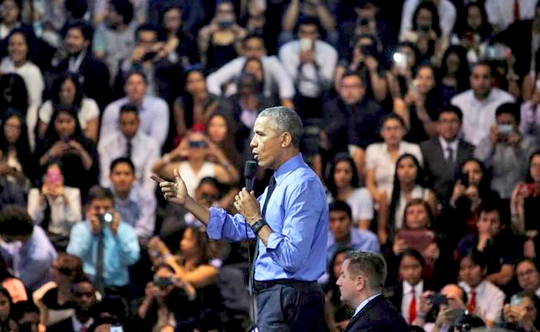
"My main message to you ... and the message I delivered in Europe is don't just assume the worst," Obama told a group of young people during a question-and-answer session in Peru on Saturday.

"Wait until the administration is in place, it's actually putting its policies together, and then you can make your judgments as to whether or not it's consistent with the international community's interest in living in peace and prosperity together."

Trump won the election after promising to build a wall on the US border with Mexico, rip up trade deals and ban Muslims temporarily from entering the United States.

Obama has sought to soothe fears by pledging to ensure a smooth transition of power and expressing optimism that the president-elect would shift away from inflammatory campaign rhetoric once he faced the realities of the job.

"It will be important for everybody around the world to not make immediate judgments but give this new president-elect a chance to put their team together, to examine the issues, to determine what their policies will be, because as I've always said, how you campaign isn't always the same as how you govern," Obama said.

But Obama has couched his assurances largely in hopeful language that Trump's team would see the merits of policies that Democrats championed despite Trump's pledged to dismantle them, from the Iran nuclear deal to an international pact to fight climate change.

And the president, who campaigned vigorously for Clinton and showed visible disdain for Trump before his victory, has offset his words of reassurance with subtle digs at his successor by emphasizing themes of democratic values in Europe and Peru that Trump has been criticized for ignoring.

"You're seeing some countries that are going backwards rather than forwards in terms of freedom of the press, in terms of freedom of the Internet, in terms of respecting political opposition and civil society," Obama said on Saturday.

Trump barred some news organizations from covering events during his campaign and threatened during a televised debate to jail Clinton for her use of a private email server while secretary of state.

Though Obama came on his trip able to assure European countries that Trump would respect US commitments to NATO, his other assurances, including for Latin American policy, seemed based more on optimism than knowledge of Trump's plans.

"With respect to Latin America, I don't anticipate major changes in policy from the new administration," he said, citing trade as a key exception.

Trump announced hawkish picks for attorney general, national security adviser, and CIA director on Friday that suggest he is setting up his administration to take a hard line confronting Islamist militancy and curbing illegal immigration.

Comments

Add new comment

  • Coastaldigest.com reserves the right to delete or block any comments.
  • Coastaldigset.com is not responsible for its readers’ comments.
  • Comments that are abusive, incendiary or irrelevant are strictly prohibited.
  • Please use a genuine email ID and provide your name to avoid reject.
Agencies
January 16,2020

Moscow, Jan 16: Russia's government resigned in a shock announcement on Wednesday after President Vladimir Putin proposed a series of constitutional reforms.

In a televised meeting with the Russian president, Prime Minister Dmitry Medvedev said the proposals would make significant changes to the country's balance of power and so "the government in its current form has resigned".

"We should provide the president of our country with the possibility to take all the necessary measures" to carry out the changes, Medvedev said.

"All further decisions will be taken by the president." Putin asked Medvedev, his longtime ally, to continue as head of government until a new government has been appointed.

"I want to thank you for everything that has been done, to express satisfaction with the results that have been achieved," Putin said.

"Not everything worked out, but everything never works out." He also proposed creating the post of deputy head of the Security Council, suggesting that Medvedev take on the position.

Earlier Wednesday Putin proposed a referendum on a package of reforms to Russia's constitution that would strengthen the role of parliament.

The changes would include giving parliament the power to choose the prime minister and senior cabinet members, instead of the president as in the current system.

Comments

Add new comment

  • Coastaldigest.com reserves the right to delete or block any comments.
  • Coastaldigset.com is not responsible for its readers’ comments.
  • Comments that are abusive, incendiary or irrelevant are strictly prohibited.
  • Please use a genuine email ID and provide your name to avoid reject.
News Network
April 26,2020

Apr 26: The remarkable story of an airman who overcame prejudice to become one of only a handful of Indian fighter pilots in the First World War has emerged in newly-released archive files by the UK's Commonwealth War Graves Commission (CWGC).

Lieutenant Shri Krishna Chanda Welinkar is one of the thousands of moving stories from the war preserved in family correspondence and being brought alive as part of a digitisation project.

The never-before-published files contain thousands of letters, pictures and other papers sent between the Commission and the next of the kin of First World War dead.

Among them is the story of Welinkar, who hailed from Bombay in colonial India. After much hardship and discrimination, he eventually became a pilot and went missing while on patrol over the skies above the Western Front in June 1918.

His family had to wait nearly three years before they finally knew for certain that he had died, and his grave was located.

“For everyone who died in the First World War, there was inevitably a partner, parent or child back home who had questions. The heartbreaking letters in CWGC's archive give us an insight into what it was like for those families trying to come to terms with their loss,” said Andrew Fetherston, chief archivist for CWGC.

“They are stories that show desperate searches for closure, former enemies uniting and, on many occasions, the sad realisation that a missing loved one would always remain so. We are pleased to be able to make this invaluable piece of World War history accessible to a new generation and help deepen our understanding of how the First World War impacted those who were left behind,” he said.

Welinkar was one of the 1.3 million Indians who answered the call to fight for the British Empire. Nearly 74,000 never saw their homeland again and are remembered today in cemeteries and memorials throughout the world, including France, Belgium, the Middle East and Africa.

Welinkar was a well-educated man studying at Cambridge University. He trained to become an aviator in Middlesex and wished to join the Royal Flying Corps, later known as the Royal Air Force.

Upon attempting to enlist, Welinkar encountered the same prejudices as his other fellow Indian airmen and was encouraged to become an air mechanic instead.

He was eventually given a commission in the Royal Flying Corps as an Officer. In 1918, he was posted to France and patrolled the skies above the Western Front.

In June 1918, Lieutenant Welinkar embarked on what would be his final patrol; he did not return and was reported missing. His fate remained unknown for many months afterwards.

The newly-released e-files chronicle the remarkable discovery of Welinkar and his final resting place long after the war had ended. Colonel Barton, who knew Welinkar, acted on behalf of his mother and helped find her missing son. They spoke to former enemies and honed their search to the grave of an unidentified man, buried by the Germans as “Oberleutnant S.C. Wumkar” in a grave in Rouvroy, Belgium.

The body was later moved and reinterred in Hangard Communal Cemetery Extension but it wasn't until the vital clue, found in the original German burial records in February 1921, that it was confirmed beyond doubt this grave was of Welinkar's.

In May 1921, Colonel Barton, on behalf of Welinkar's mother, requested that a Commission headstone be placed on the grave with the following personal inscription: “To the Honoured Memory of One of the Empire's Bravest Sons”.

This records – known as Enquiry Files – are part of a collection of nearly 3,000 files which have never been made available to the public before. Nearly half have been digitised so far, alongside a previously unreleased collection of more than 16,000 photographs held in negatives in the Commission's archive.

The files, internally referred to simply as E-Files, contain correspondence between the CWGC and the next of kin of the war dead. They often contain letters, typed memos between Commission staff and on occasion photos, maps and diagrams.

CWGC only holds an enquiry file for a small proportion of the 1.7 million people it commemorates from the Commonwealth. Today it is only possible to release those surviving records from the First World War because correspondence with families of Second World War casualties often involves people still alive today and cannot be made public for many years, due to the UK's data protection rules.

To date, more than 1,300 of the surviving 3,000 First World War enquiry files have been digitised.

The CWGC commemorates the 1.7 million Commonwealth servicemen and women who died during the two World Wars. It also holds and updates an extensive and accessible records archive, while operating over 23,000 locations in more than 150 countries and territories.

Comments

Add new comment

  • Coastaldigest.com reserves the right to delete or block any comments.
  • Coastaldigset.com is not responsible for its readers’ comments.
  • Comments that are abusive, incendiary or irrelevant are strictly prohibited.
  • Please use a genuine email ID and provide your name to avoid reject.
March 27,2020

London, Mar 27:  British Prime Minister Boris Johnson said Friday he has tested positive for the new coronavirus, but remains in charge of the U.K.'s response to the outbreak.

Johnson's office said he was tested on the advice of the chief medical officer after showing mild symptoms.

It said Johnson is self-isolating at his 10 Downing St. residence and continuing to lead the country's response to COVID-19.

In a video message, Johnson said he had a temperature and a persistent cough.

Over the last 24 hours I have developed mild symptoms and tested positive for coronavirus.

I am now self-isolating, but I will continue to lead the government’s response via video-conference as we fight this virus.

Together we will beat this. #StayHomeSaveLives pic.twitter.com/9Te6aFP0Ri

— Boris Johnson #StayHomeSaveLives (@BorisJohnson) March 27, 2020
"Be in no doubt that I can continue, thanks to the wizardry of modern technology, to communicate with all my top team, to lead the national fightback against coronavirus."

Earlier this week Britain’s Prince Charles announced that he had tested positive for the virus.

Comments

Add new comment

  • Coastaldigest.com reserves the right to delete or block any comments.
  • Coastaldigset.com is not responsible for its readers’ comments.
  • Comments that are abusive, incendiary or irrelevant are strictly prohibited.
  • Please use a genuine email ID and provide your name to avoid reject.