


With Obamacare vote, House Republicans free to turn to tax reform

May 5, 2017

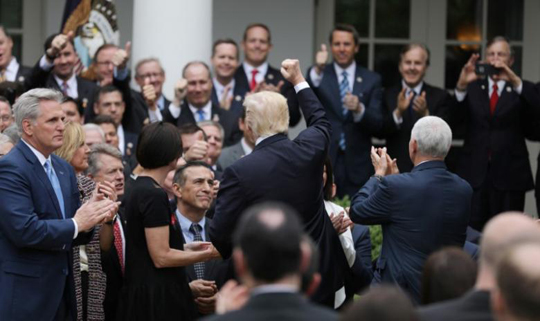
Washington, May 5: The Republican-controlled U.S. House of Representatives plans to turn to tax reform in earnest, after concluding a lengthy healthcare debate this week with a vote to repeal and replace Obamacare.
obama

But even as Republicans predicted that tax reform would succeed before year-end, lawmakers encountered new uncertainties about what a final tax package might contain, as well as doubts about whether Republicans will be able to enact reforms without Democratic help.

President Donald Trump and Republicans in Congress have pledged to complete the biggest tax reform since 1986, when President Ronald Reagan was in office, before the end of 2017. But they face an uphill battle, mainly over policy differences within their own ranks.

Thursday's 217-213 House vote on healthcare legislation raised confidence in the Republican-controlled chamber's ability to move major legislation after two earlier pushes ended in failure.

But to move forward on tax reform, the House, Senate and Trump administration must agree on where to set tax rates, how to pay for cuts and whether the final package should add to the deficit or pay for itself, all areas where common ground may be hard to find.

A plan to enact reforms without Democratic support will also require Republicans to pass a 2018 budget authorizing the parliamentary process known as reconciliation. But a new budget agreement poses a daunting task given Republican opposition to Trump demands for deep domestic spending cuts.

"That may prove to be one, if not the most difficult votes of the tax reform process," Jonathan Traub, a managing principal at the consulting firm Deloitte Tax LLP.

Meanwhile, the need to reach agreement between the House, Senate and White House will likely delay introduction of a tax reform bill, which had been expected in early June.

But Republicans say it will ultimately make it easier to enact reforms before the end of the year.

The House Ways and Means Committee, which will unveil the initial tax bill, is still aiming for a revenue-neutral package that raises $2.4 trillion for tax cuts through a new border adjustment tax and elimination of business deductions for net interest payments, both controversial measures.

Panel chairman Kevin Brady told reporters that revenue neutrality is necessary to ensure bold, permanent changes to tax policy that can drive economic growth.

"That's the argument and the case we're going to make to the Senate and the Trump administration," he said.

But Representative Mark Meadows, who chairs the conservative Freedom Caucus that helped block Trump's first healthcare bill, voiced opposition to a revenue neutral approach.

"If it's revenue neutral, you're not really lowering taxes. You're shifting the burden," Meadows told reporters.

The Trump tax plan unveiled last week calls for steep tax cuts financed by government revenues that officials say will result from higher growth. Some fear the plan could add trillions of dollars to the deficit if growth does not materialize.

Meadows said tax cuts should be offset by cuts to entitlement programs including Social Security and Medicare, which Trump has promised not to touch.

Comments

Add new comment

  • Coastaldigest.com reserves the right to delete or block any comments.
  • Coastaldigset.com is not responsible for its readers’ comments.
  • Comments that are abusive, incendiary or irrelevant are strictly prohibited.
  • Please use a genuine email ID and provide your name to avoid reject.
News Network
May 20,2020

Washington, May 20: Once dubbed as historic by him, US President Donald Trump on Tuesday said he now feels ‘differently’ about the trade deal he signed with China earlier this year.

He said this while once again venting out his frustration with the Beijing leadership, accusing it of letting coronavirus spread.

Till Tuesday, over 92,000 Americans have died and 1.5 million tested positive for coronavirus that has globally killed around 320,000 people.

The US and China had signed a deal in January to end their 22-month-long trade war during which the two countries slapped tit-for-tat tariff hikes on products worth nearly half a trillion USD.

Under it, Beijing agreed to increase its purchase of US goods by USD 200 billion in 2020-2021.

“I feel differently now about that deal than I did three months ago,” Trump told reporters during a Cabinet meeting at the White House.

“We will see what all happens, but it's been a very disappointing situation. A very disappointing thing happened with China because the plague flowed in and that wasn't supposed to happen and it could have been stopped," he said.

Trump said he was very excited when the trade deal with China was signed.

“But once the virus came in, once the plague, as I called it, came in, I said how did they let that happen? And how come it didn't go into other sections of China? Why did they block it from leaving Wuhan? But they didn't block it from going to the rest of the world, including the United States. Why is that? Beijing doesn't have it. Other places don't have it,” he said.

Trump did not respond to questions on retaliation against China.

Meanwhile, top American senators continued to press the administration that rules of engagement with China needs to change post-coronavirus.

“As we know, they unleashed this virus on America and the world with their classic communist cover-up, deception, continued propaganda campaign, costing now over 90,000 American lives, 35 million Americans losing their jobs so far,” Senator Martha McSally said during a Congressional hearing.

“We don’t know who patient zero is, they destroyed samples, they silenced doctors, they kicked out journalists, they impacted international travel to seed this and their reckless behaviour continues to be the root of all this,” she said.

As a result of coronavirus, the American economy has been thrown into recession; more than 36 million people have lost their job – the worst ever after last century’s great depression.

Many of the US states have now started opening up, after taking necessary precautions.

By conservative estimates, it will take several quarters for the economy to be back on track.

Trump in the last a few weeks has exuded confidence that the economy will be back on track next year.

Comments

Add new comment

  • Coastaldigest.com reserves the right to delete or block any comments.
  • Coastaldigset.com is not responsible for its readers’ comments.
  • Comments that are abusive, incendiary or irrelevant are strictly prohibited.
  • Please use a genuine email ID and provide your name to avoid reject.
Agencies
April 2,2020
Thailand's controversial king has created a category of his own with his idea of self-isolation.
 
According to reports, King Maha Vajiralongkorn, also known as Rama X, has hired out an entire luxury hotel in Germany, where he has been 'self-isolating' with 20 women.
 
The luxury hotel, the Grand Hotel Sonnenbichl, is in the Alpine resort town of Garmisch-Partenkirchen.
 
The 67-year-old king is self-isolating with his entourage that includes a 'harem' of 20 concubines and several servants, reported Bild.
 
However, it is unclear if his four wives are currently living in the same hotel.

Comments

Add new comment

  • Coastaldigest.com reserves the right to delete or block any comments.
  • Coastaldigset.com is not responsible for its readers’ comments.
  • Comments that are abusive, incendiary or irrelevant are strictly prohibited.
  • Please use a genuine email ID and provide your name to avoid reject.
Agencies
August 4,2020

Washington, Aug 4: US President Donald Trump gave popular Chinese-owned video app TikTok six weeks to sell its US operations to an American company, saying Monday it would be "out of business" otherwise, and that the government wanted a financial benefit from the deal.

"It's got to be an American company... it's got to be owned here," Trump said. "We don't want to have any problem with security."

Trump said that Microsoft was in talks to buy TikTok, which has as many as one billion worldwide users who make quirky 60-second videos with its smartphone app.

But US officials say the app constitutes a national security risk because it could share millions of Americans' personal data with Chinese intelligence.

Trump gave the company's Chinese parent ByteDance until mid-September to strike a deal.

"I set a date of around September 15, at which point it's going to be out of business in the United States," he said.

Whatever the price is, he said, "the United States should get a very large percentage of that price because we're making it possible."

Trump compared the demand for a piece of the pie to a landlord demanding under-the-table "key money" from a new tenant, a practice widely illegal including in New York, where the billionaire president built his real estate empire.

"TikTok is a big success, but a big portion of it is in the country," he said. "I think it's very fair."

But Trump also threw a surprise new condition in any deal, saying the sale of TikTok's US business would have to result in a significant payout to the US Treasury for initiating it.

"A very substantial portion of that price is going to have to come into the Treasury of the United States, because we're making it possible for this deal to happen," Trump told reporters.

"They don't have any rights unless we give it to them," he said.

Sell or shut down

The pressure for a sale of TikTok's US and international business, based in Los Angeles, left the company and ByteDance facing tough decisions.

Trump has made TikTok the latest front in the ongoing political and trade battles between Washington and Beijing.

The app has been under formal investigation on US national security grounds because it collects large amounts of personal data on all its users and is legally bound to share that with authorities in Beijing if they demand it.

Both its huge user base and its algorithm for collecting data make it hugely valuable.

But being forced by the US government to sell at least its US business or be shut down -- and to then split the sale price with the US Treasury as Trump is demanding -- was an almost unheard-of tactic.

Shutting down could force users to switch to competitors, and many content creators are already encouraging followers to follow them on other social media platforms.

"The most obvious beneficiaries are Snapchat, Facebook and Twitter, with Snapchat likely being the biggest beneficiary," said investment analysts at Lightshed Partners.

Earlier Monday, ByteDance founder Zhang Yiming acknowledged the hefty pressure and said in a letter to staff, reported by Chinese media, that they were working around-the-clock "for the best outcome."

"We have always been committed to ensuring user data security, as well as the platform neutrality and transparency," Zhang said.

However, he said, the company faces "mounting complexities across the geopolitical landscape and significant external pressure."

He said the company must confront the challenge from the United States, though "without giving up exploring any possibilities."

According to Britain's The Sun newspaper Monday, as a possible consequence of the pressure, ByteDance is planning to relocate TikTok's global operations to Britain.

Pushing back

China's foreign ministry pushed back Monday, calling Washington hypocritical for demanding TikTok be sold.

"The US is using an abused concept of national security and, without providing any evidence, is making presumptions of guilt and issuing threats to relevant companies," said spokesman Wang Wenbin.

"This goes against the principle of market economy and exposes the hypocrisy and typical double standards of the US in upholding so-called fairness and freedom," he added.

stm88 info live rtp slot

slot auto scatter hitam

Comments

Add new comment

  • Coastaldigest.com reserves the right to delete or block any comments.
  • Coastaldigset.com is not responsible for its readers’ comments.
  • Comments that are abusive, incendiary or irrelevant are strictly prohibited.
  • Please use a genuine email ID and provide your name to avoid reject.