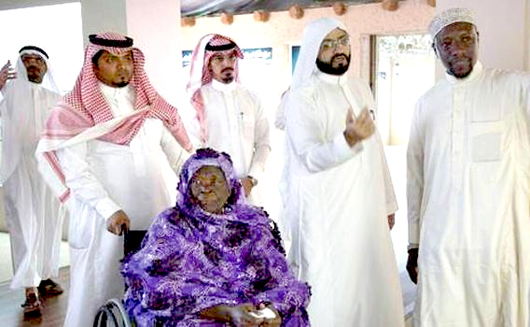
Obama’s grandma arrives for Umrah

April 23, 2015

Jeddah, Apr 23: Sara Omar, grandma of US President Barack Obama, has emphasized the significance of the Prophet Muhammad exhibition in Makkah and said it reflects the moderate teachings of Islam that calls for tolerance and rejects violence.

Obamas grandma

Sara has come to Makkah with her son Saeed Obama, uncle of President Obama and her grandson Mousa Obama to perform Umrah.

She commended the Saudi government’s efforts to expand the two holy mosques.

Sara and her family members visited the Prophet’s show, which is located in the Naseem district of Makkah, for two hours. “I am very happy to visit this exhibition, which is a good example for the propagation of Islam in a modern way, supported by scientific and authentic documents.”

Obama’s grandma also expressed hope that the exhibition would visit other countries with the support of the Saudi government in order to remove the misunderstandings about the divine religion.

Comments

Add new comment

  • Coastaldigest.com reserves the right to delete or block any comments.
  • Coastaldigset.com is not responsible for its readers’ comments.
  • Comments that are abusive, incendiary or irrelevant are strictly prohibited.
  • Please use a genuine email ID and provide your name to avoid reject.
Agencies
June 28,2020

Kuwait, Jun 28: Measures imposed to curb the spread of the novel coronavirus in Kuwait are believed to have increased suicide cases in the country, according to a media report.

Forty suicide cases and 15 failed attempts, mainly among Asian expatriates, have been recorded in Kuwait since late February, Gulf News quoted the Al Qabas newspaper report, citing sources as saying on Saturday.

Investigations into the majority of cases have revealed that those who committed suicide had experienced psychological and economic troubles due to dire financial circumstances after their employers stopped to pay them as a result of economic fallout from the coronavirus-related measures.

In one case, an expat livestreamed his suicide while chatting with his fiancee on a social networking platform, the newspaper report said.

Suicide cases have increased by around 40 per cent since the start of the COVID-19 crisis, according to the sources.

Some 70 to 80 suicide cases are recorded annually in Kuwait. Last year, they reached 80 suicides against 77 in 2018.

"Suicide cases have started to go up in Kuwait during the coronavirus pandemic due to fear, anxiety, isolation and instability experienced by people and absence of daily aims that could help the person to spend time regularly as before," the newspaper quoted social psychology consultant Samira Al Dosari as saying.

Uncertainty for some expatriates, whose countries have refused to take them in, is another motive for attempting suicide, according to Jamil Al Muri, a sociology professor at the Kuwait University.

"This is in addition to greed of the iqamat traders, who have brought into the country workers in names of phantom companies and abandoned them on the streets," he added.

Starting from Tuesday, Kuwait will embark on the second phase of a stepwise plan to bring life to normal, Gulf News reportd.

According to Phase 2, a nationwide night-time curfew will be reduced by one hour to run daily from 8 p.m. until 5 a.m. for three weeks.

Kuwait has so far reported 44,391 COVID-19 cases, with 344 deaths.

Comments

Angry indian
 - 
Tuesday, 30 Jun 2020

YA ALLah save all dispressed people in the earth..

Add new comment

  • Coastaldigest.com reserves the right to delete or block any comments.
  • Coastaldigset.com is not responsible for its readers’ comments.
  • Comments that are abusive, incendiary or irrelevant are strictly prohibited.
  • Please use a genuine email ID and provide your name to avoid reject.
News Network
June 12,2020

Beirut, Jun 12: Angry Lebanese protesters blocked roads across the country with burning tyres, debris and their vehicles, incensed over the local currency's depreciation by more than 25 percent in just two days.

The demonstrations from northern Akkar and Tripoli to central Zouk, the eastern Bekaa Valley, Beirut and southern Tyre and Nabatieh on Thursday were some of the most widespread in months of upheaval over a calamitous economic and financial crisis.

Protesters set ablaze a branch of the Central Bank, vandalised several private banks and clashed with security forces in several areas. At least 41 people were injured in Tripoli alone, according to the Lebanese Red Cross.

"I'm really pissed off, that's all. If politicians think they can burn our hearts like this the fire is going to reach them too," unemployed computer engineer Ali Qassem, 26, told Al Jazeera after pouring fuel onto smouldering tyres on a main Beirut thoroughfare.

Tens of thousands of Lebanese have lost jobs in the past six months and hundreds of businesses have shuttered as a dollar shortage led the Lebanese pound to slide from 1,500 to $1 last summer - where it was pegged for 23 years - to roughly 4,000 for each US dollar last month.

But the slide turned into a freefall between Wednesday and Thursday when the pound plummeted to roughly 5,000 to $1 on black markets, which have become a main source of hard currency. There was widespread speculation the rate hit 6,000 or even 7,000 pounds to the dollar, though most markets stopped trading.

Protesters began amassing on streets across the country before sunset and increased into the thousands across the country as the night fell.

Prime Minister Hassan Diab cancelled all meetings scheduled for Friday to hold an emergency cabinet session at 9:30am and another at 3pm at the presidential palace to be headed by President Michel Aoun.

The pound's collapse is the perhaps the biggest challenge yet for Diab's young cabinet, which gained confidence in February after former prime minister Saad Hariri's government was toppled by an unprecedented October uprising that had the country's economic crisis at its core.

Economy Minister Raoul Nehme told Al Jazeera that there was "disinformation" being circulated about the exchange rate on social media and said he was investigating possible currency manipulation.

"I don't understand how the exchange rate increased by so much in two days," he said.

Many protesters have pitted blame on Central Bank governor Riad Salameh, nominally in charge of  keeping the currency stable. But they have also called on the government to resign.

"If people want reform between dawn and dusk, that's not going to work, and if someone thinks they can do a better job then please come forward," Nehme said.

"But what we can't have is a power vacuum - then the exchange rate won't be 5000, it'll be a catastrophe."

'Everyone paying the price'

When protesters set a large fire in Beirut's Riad al-Solh Square, which lies at the foot of a grand Ottoman-era building that serves as the seat of government, firefighters did not intervene to extinguish it.

It later became clear why: Civil Defence told local news channel LBCI they had run out of diesel to fuel their firetrucks.

Basic imports such as fuel have been hit hard by the currency crisis, making already-weak state services increasingly feeble.

A half-dozen or so police officers with Lebanon's Internal Security Forces observed the scene unfolding in front of them in the square.

"Why do you destroy shops and things and attack us security forces - do you think we're happy? Go and f****** break that wall or go to the politicians' houses," one police officer told Al Jazeera, referring to a large concrete barrier separating protesters from the seat of government.

"In the end we are with you and we want the country to change. Don't you dare think we're happy. My salary is now worth $130," the officer said.

The currency's spectacular fall seems to have pushed many Lebanese to put common interests above their differences.

Large convoys of men on motorbikes from Shia-majority areas of southern Beirut joined the demonstrations on Thursday, though they have clashed with protesters many times before - including at a protest on Saturday.

Some chanted sectarian insults, leading to brief clashes in areas that were formerly front lines during the country's devastating 15-year civil war.

Instead, the motorbike-riding demonstrators on Thursday chanted: "Shia, Sunni, F*ck sectarianism."

"We are Shia, and Sunnis and Christian are our brothers," Hisham Houri, 39, told Al Jazeera, perched on a moped with his fiancee behind him just a few metres from a pile of burning tyres.

The blaze sent thick black smoke into the sky towards an iconic blue-domed mosque and church in downtown Beirut.

"Politicians play on these sectarian issues and sometimes succeed, but in the end, they'll fail because all the people have been hurt," he said. "The dollar isn't just worth 6,000 for Shias or for Sunnis, everyone is paying that price."


Comments

Add new comment

  • Coastaldigest.com reserves the right to delete or block any comments.
  • Coastaldigset.com is not responsible for its readers’ comments.
  • Comments that are abusive, incendiary or irrelevant are strictly prohibited.
  • Please use a genuine email ID and provide your name to avoid reject.
News Network
July 1,2020

Riyadh, Jul 1: Saudis braced Wednesday for a tripling in value added tax, another unpopular austerity measure after the twin shocks of coronavirus and an oil price slump triggered the kingdom's worst economic decline in decades.

Retailers in the country reported a sharp uptick in sales this week of everything from gold and electronics to cars and building materials, as shoppers sought to stock up before VAT is raised to 15 percent.

The hike could stir public resentment as it weighs on household incomes, pushing up inflation and depressing consumer spending as the kingdom emerges from a three-month coronavirus lockdown.

"Cuts, cuts, cuts everywhere," a Saudi teacher in Riyadh told AFP, bemoaning vanishing subsidies as salaries remain stagnant.

"Air conditioner, television, electronic items," he said, rattling off a list of items he bought last week ahead of the VAT hike.

"I can't afford these things from Wednesday."

With its vast oil wealth funding the Arab world's biggest economy, the kingdom had for decades been able to fund massive spending with no taxes at all.

It only introduced VAT in 2018, as part of a push to reduce its dependence on crude revenues.

Then, seeking to shore up state finances battered by sliding oil prices and the coronavirus crisis, it announced in May that it would triple VAT and halt a cost-of-living monthly allowance to citizens.

The austerity push underscores how Saudi Arabia's once-lavish spending is becoming a thing of the past, with the erosion of the welfare system leaving a mostly young population to cope with reduced incomes and a lifestyle downgrade.

That could pile strain on a decades-old social contract whereby citizens were given generous subsidies and handouts in exchange for loyalty to the absolute monarchy.

The rising cost of living may prompt many to ask why state funds are being lavished on multi-billion-dollar projects and overseas assets, including the proposed purchase of English football club Newcastle United.

Shopping malls in the kingdom have drawn large crowds in recent days as retailers offered "pre-VAT sales" and discounts before the hike kicks in.

A gold shop in Riyadh told AFP it saw a 70 percent jump in sales in recent weeks, while a car dealership saw them tick up by 15 percent.

Once the new rate is in place, businesses are predicting depressed sales of everything from cars to cosmetics and home appliances.

Capital Economics forecast inflation will jump up to six percent year-on-year in July, from 1.1 percent in May, as a result.

"The government ended the country's lockdown (in June) and there are signs that economic activity has started to recover," Capital Economics said in a report.

"Nonetheless, we expect the recovery to be slow-going as fiscal austerity measures bite."

The kingdom also risks losing its edge against other Gulf states, including its principal ally the United Arab Emirates, which introduced VAT at the same time but has so far refrained from raising it beyond five percent.

"Saudi Arabia is taking massive risks with contractionary fiscal policies," said Tarek Fadlallah, chief executive officer of the Middle East unit of Nomura Asset Management.

But the kingdom has few choices as oil revenue declines.

Its finances have taken another blow as authorities massively scaled back this year's hajj pilgrimage, from 2.5 million pilgrims last year to around a thousand already inside the country, and suspended the lesser umrah because of coronavirus.

Together the rites rake in some $12 billion annually.

The International Monetary Fund warned the kingdom's GDP will shrink by 6.8 percent this year -- its worst performance since the 1980s oil glut.

The austerity drive would boost state coffers by 100 billion riyals ($26.6 billion), according to state media.

But the measures are unlikely to plug the kingdom's huge budget deficit.

The Saudi Jadwa Investment group forecasts the shortfall will rise to a record $112 billion this year.

Comments

Add new comment

  • Coastaldigest.com reserves the right to delete or block any comments.
  • Coastaldigset.com is not responsible for its readers’ comments.
  • Comments that are abusive, incendiary or irrelevant are strictly prohibited.
  • Please use a genuine email ID and provide your name to avoid reject.