



Oil prices rise amid optimism over production cuts

December 28, 2016

London/New York, Dec 28: Oil edged further above $55 a barrel on Tuesday, drawing support from expectations of tighter supply once the first output cut deal between OPEC and non-OPEC producers in 15 years takes effect on Sunday.
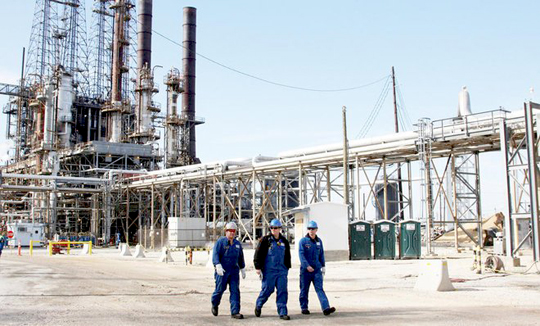
Oilpro

Jan. 1 is the official start of the deal agreed by the Organization of Petroleum Exporting Countries (OPEC) and several non-OPEC producers to lower production by almost 1.8 million barrels per day (bpd).

Brent crude was up 17 cents at $55.33 a barrel at 1340 GMT. The global benchmark reached $57.89 on Dec. 12, the highest since July 2015. US crude gained 30 cents to $53.32.

Trading was thin on Tuesday, with less than one-third of the usual volume in futures contracts in West Texas Intermediate crude oil.

“Some of the doubts (in OPEC) people are showing are going to have to be put to rest,” said Phil Flynn, analyst at Price Futures Group in Chicago. “There is a strong possibility that we are going to rally into the end of the year.”

The members of an OPEC and non-OPEC committee formed to monitor the market may meet on Jan. 13, two sources said. Oil rallied further after news of the meeting, which may give an early indication of compliance with the deal.

“From January, we will start to have a better idea about the level of OPEC production,” said Olivier Jakob, oil analyst at Petromatrix.

“To go above $60 is going to be difficult. We are already close to the top rather than the bottom of the range right now,” he said.”

Russian oil producer Gazprom Neft said on Tuesday it planned to increase oil production by 4.5 to 5 percent next year, less than intended before Russia joined the supply cut deal.

Major OPEC members such as Saudi Arabia and Iraq have informed customers of lower supplies. But Libya and Nigeria — which are exempt from reductions because conflict has curbed their output — have been increasing production.

Products markets outpaced crude on Tuesday, as the price of reformulated blendstock gasoline gained 2.4 percent to $1.6652 a gallon, while heating oil gained 2.9 percent to trade at $1.71 a gallon. Those contracts expire Friday; options on those contracts are expiring Tuesday.

Venezuela said on Tuesday it would cut 95,000 barrels-per-day of oil production in the New Year.

“Without prejudicing its international contractual obligations, from Jan. 1, 2017, (state oil company) PDVSA and/or its subsidiaries will implement a reduction in the volumes of its main crude sale contracts, all in conformity with existing terms and conditions,” the Energy Ministry said.

Comments

Add new comment

  • Coastaldigest.com reserves the right to delete or block any comments.
  • Coastaldigset.com is not responsible for its readers’ comments.
  • Comments that are abusive, incendiary or irrelevant are strictly prohibited.
  • Please use a genuine email ID and provide your name to avoid reject.
Agencies
May 26,2020

Riyadh, May 26: The authorities in Saudi Arabia have decided to ease some restrictions put in place over coronavirus fears, allowing movement and resumption of some economic and commercial activities, Saudi Press Agency reported early Tuesday citing an official source at the Interior Ministry.

The move also allows restarting of domestic flights, opening of mosques, restaurants and cafes and work attendance, however, the temporary suspension of Umrah pilgrimage remains in force.

The easing of restrictions will be carried out in a phased manner, with the first phase beginning on Thursday (May 28) and ending on May 30.

In the first phase, the movement within and between all regions of the Kingdom in private cars will be allowed from 6 a.m. to 3 p.m. except in Makkah. Economic and commercial activities will resume in retail and wholesale shops and malls but beauty salons, barber shops, sports clubs, health clubs, entertainment centers and cinemas will continue to remain shut due to social distancing concerns.

In the second phase, which begins on May 31 and ends on June 20, the movement is allowed from 6 a.m. and 8 p.m. in all areas of the Kingdom, except in Makkah. All congregational prayers, including Friday prayers, will resume in all mosques across the Kingdom except in Makkah.

The suspension of workplace attendance will end, allowing all employees in ministries, government entities and private sector companies to return to working from their offices provided that they follow strict precautionary guidelines.

The suspension on travel between regions in the Kingdom using various transport methods will no longer be in place. Airlines will be allowed to operate domestic flights if they adhere to precautionary measures set by the civil aviation authority and the Ministry of Health. The suspension of international flights, will, however, continue until further notice.

Restaurants and cafes serving food and beverages can reopen, however, beauty salons, barber shops, sports clubs, health clubs, entertainment centers and cinemas will be barred from reopening in the second phase. The ban on social gatherings of more than fifty people, such as weddings and funerals will also continue to remain in force.

In the third phase commencing on June 21, the Kingdom will return to "normal" conditions as it was before the coronavirus lockdown measures were implemented.

Meanwhile in Makkah, the first phase measures will be implemented between May 31 to June 20 and the second phase will begin on May 21. Friday prayers and all congregational prayers will continue to be held in the Grand Mosque, only to be attended by Imams and the employees.

Comments

Mohammed Sarfraz
 - 
Tuesday, 26 May 2020

I think second phase is May 31 to June 20. Must be a typo. 

Add new comment

  • Coastaldigest.com reserves the right to delete or block any comments.
  • Coastaldigset.com is not responsible for its readers’ comments.
  • Comments that are abusive, incendiary or irrelevant are strictly prohibited.
  • Please use a genuine email ID and provide your name to avoid reject.
Agencies
July 16,2020

Riyadh, Jul 16: Prince Abdul Aziz bin Saud bin Naif, minister of interior and chairman of the Hajj Supreme Committee, chaired a virtual meeting on Wednesday with the heads of  security agencies and officials in charge of this year’s Hajj season.

During the meeting, the minister and security officials discussed organizational issues related to Hajj, including preventive and precautionary steps related to fighting the coronavirus disease, procedures related to pilgrims commuting to the holy sites, and mechanisms to facilitate performing the Hajj rituals.

Prince Abdul Aziz confirmed abiding by the directives of King Salman and Crown Prince Mohammed bin Salman to take all precautions to preserve the safety of the pilgrims, and facilitate their performance of their Hajj rituals, according to the highest health standards to contain the new coronavirus pandemic.

Saudi Arabia has decided to allow only a limited number of domestic pilgrims to perform Hajj this year in the wake of the COVID-19 outbreak.

Only those expatriates between the ages of 20 and 50 who are not suffering from any chronic diseases can apply for the pilgrimage.

Earlier, the Ministry of Hajj and Umrah said that requests from people of 160 nationalities in the Kingdom have been screened electronically to select who will perform Hajj this year.

Of the pilgrims who will receive approval, 70 percent will be non-Saudis residing in the Kingdom and the remaining 30 percent will be Saudi citizens.

Meanwhile, the Ministry of Interior said that anyone found entering the sites of Hajj (Mina, Muzdalifah and Arafat) without a permit from July 18 till the end of Dhu Al-Hijjah 12 will be issued with a fine of SR10,000 ($2,600).

The fine will be doubled if the offence is repeated. Security personnel will be posted on roads leading to the holy sites to ensure that anyone who breaks the law will be stopped and fined.

Around 2.5 million foreign and domestic pilgrims performed Hajj last year.

Comments

Add new comment

  • Coastaldigest.com reserves the right to delete or block any comments.
  • Coastaldigset.com is not responsible for its readers’ comments.
  • Comments that are abusive, incendiary or irrelevant are strictly prohibited.
  • Please use a genuine email ID and provide your name to avoid reject.
News Network
April 5,2020

Beirut, Apr 5: The novel coronavirus has put global trade on hold, placed half of the world population in confinement and has the potential to topple governments and reshape diplomatic relations.

The United Nations has appealed for ceasefires in all the major conflicts rocking the planet, with its chief Antonio Guterres on Friday warning "the worst is yet to come". But it remains unclear what the pandemic's impact will be on the multiple wars roiling the Middle East.

Here is an overview of the impact so far on the conflicts in Syria, Yemen, Libya and Iraq:

The COVID-19 outbreak turned into a pandemic just as a ceasefire reached by the two main foreign power brokers in Syria's nine-year-old war -- Russia and Turkey -- was taking effect.

The three million people living in the ceasefire zone, in the country's northwestern region of Idlib, had little hope the deal would hold.

Yet fears the coronavirus could spread like wildfire across the devastated country appear to have given the truce an extended lease of life.

According to the Syrian Observatory for Human Rights, the month of March saw the lowest civilian death toll since the conflict started in 2011, with 103 deaths.

The ability of the multiple administrations in Syria -- the Damascus government, the autonomous Kurdish administration in the northeast and the jihadist-led alliance that runs Idlib -- to manage the coronavirus threat is key to their credibility.

"This epidemic is a way for Damascus to show that the Syrian state is efficient and all territories should be returned under its governance," analyst Fabrice Balanche said.

However the pandemic and the global mobilisation it requires could precipitate the departure of US-led troops from Syria and neighbouring Iraq.

This in turn could create a vacuum in which the Islamic State jihadist group, still reeling from the demise of its "caliphate" a year ago, could seek to step up its attacks.

The Yemeni government and the Huthi rebels initially responded positively to the UN appeal for a ceasefire, as did neighbouring Saudi Arabia, which leads a military coalition in support of the government.

That rare glimmer of hope in the five-year-old conflict was short-lived however and last week Saudi air defences intercepted ballistic missiles over Riyadh and a border city fired by the Iran-backed rebels.

The Saudi-led coalition retaliated by striking Huthi targets in the rebel-held capital Sanaa on Monday.

Talks have repeatedly faltered but the UN envoy Martin Griffiths is holding daily consultations in a bid to clinch a nationwide ceasefire.

More flare-ups in Yemen could compound a humanitarian crisis often described as the worst in the world and invite a coronavirus outbreak of catastrophic proportions.

In a country where the health infrastructure has collapsed, where water is a rare commodity and where 24 million people require humanitarian assistance, the population fears being wiped out if a ceasefire doesn't allow for adequate aid.

"People will end up dying on the streets, bodies will be rotting in the open," said Mohammed Omar, a taxi driver in the Red Sea port city of Hodeida.

Much like Yemen, the main protagonists in the Libyan conflict initially welcomed the UN ceasefire call but swiftly resumed hostilities.

Fierce fighting has rocked the south of the capital Tripoli in recent days, suggesting the risk of a major coronavirus outbreak is not enough to make guns fall silent.

Turkey has recently played a key role in the conflict, throwing its weight behind the UN-recognised Government of National Accord.

Fabrice Balanche predicted that accelerated Western disengagement from Middle East conflicts could limit Turkish support to the GNA.

That could eventually favour forces loyal to eastern-based strongman Khalifa Haftar, who launched an assault on Tripoli one year ago and has the backing of Russia, Egypt and the United Arab Emirates.

Western countries have been hit hardest by the pandemic, which could prompt them to divert both military resources and peace-brokering capacity from foreign conflicts.

A report by the International Crisis Group said European officials had reported that efforts to secure a ceasefire in Libya were no longer receiving high-level attention due to the pandemic.

Iraq is no longer gripped by fully-fledged conflict but it remains vulnerable to an IS resurgence in some regions and its two main foreign backers are at each other's throats.

Iran and the United States are two of the countries most affected by the coronavirus but there has been no sign of any let-up in their battle for influence that has largely played out on Iraqi soil.

With most non-US troops in the coalition now gone and some bases evacuated, American personnel are now regrouped in a handful of locations in Iraq.

Washington has deployed Patriot air defence missiles, prompting fears of a fresh escalation with Tehran, whose proxies it blames for a spate of rocket attacks on bases housing US troops.

Comments

Add new comment

  • Coastaldigest.com reserves the right to delete or block any comments.
  • Coastaldigset.com is not responsible for its readers’ comments.
  • Comments that are abusive, incendiary or irrelevant are strictly prohibited.
  • Please use a genuine email ID and provide your name to avoid reject.