


Olympics-Rio kicks off Games with ode to forests, favelas and funk

August 6, 2016

Rio De Janeiro, Aug 6: Brazil unfurled a vast canvas celebrating its rainforest and the creative energy of its wildly diverse population to the tune of samba, bossa nova and funk in welcoming the world on Friday to the Olympic Games in Rio de Janeiro.
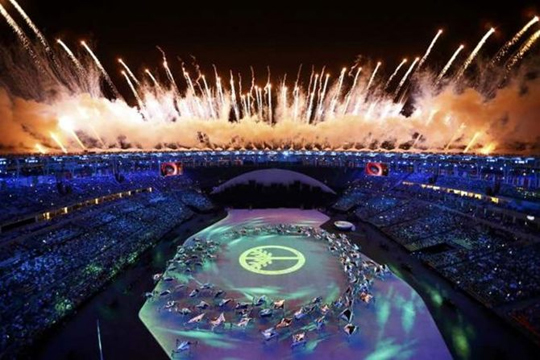
Olympics

In a country of great economic inequality, the opening ceremony celebrated the culture of the favelas, the slums that hang vertiginously above the renowned beaches of Rio and ring the site of Friday's spectacle, the famed Maracana stadium.

There was no glossing over history either: from the arrival of the Portuguese and their conquest of the indigenous populations to the use of African slave labor for 400 years. The clash of cultures, as the ceremony showed, is what makes Brazil the complex mosaic that it is.

Home to the Amazon, the world's largest forest, Brazil used the ceremony to call on the 3 billion people watching the opening of the world's premiere sporting event to take care of the planet, plant seeds and reconquer the verdant land that Europeans found here five centuries ago.

Unlike the opening ceremonies in Beijing in 2008 and London 2012, a financially constrained Brazil had little choice but to put on a more "analogue" show, with minimal high-tech and a heavy dependence on the vast talent of Brazil and its Carnival party traditions.

While the Rio 2016 organizing committee has not said how much the ceremony cost, it is believed to be about half of the $42 million spent by London in 2012.

The show drew homegrown stars, like supermodel Gisele Bundchen, who walked across the stadium to the sound of bossa nova hit "Girl from Ipanema" and Paulinho da Viola, a samba songwriter who sang the national anthem with a string orchestra. Everyone performed for free.

Loud cheers erupted when Brazil's beloved pioneer of aviation Alberto Santos-Dumont was depicted taking off from the stadium and flying over modern-day Rio.

The joyful opening of South America's first Games contrasted with months of turmoil and chaos, not only in the organization of the Olympics but across Brazil as it endures its worst economic recession in decades and a deep political crisis.

Interim President Michel Temer presided over the opening of the Games inside Maracana with dozens of heads of state. He took over from suspended President Dilma Rousseff, who is facing an impeachment trial and tweeted that she was "sad to not be at the party."

The $12 billion price tag to organize the Games has aggrieved many in the nation of 200 million and in Rio, where few can see the benefits of the spectacle or even afford to attend the Games.

Police used stun grenades against a few hundred anti-Olympic protesters near the stadium, armored tanks lined the streets, and the 50,000 attendees faced two-hour-long lines as Brazil staged its most intense security operation ever.

People on the periphery

The creative minds behind the opening ceremony were determined to put on a show that would not offend a country in dire economic straits but would showcase the famously upbeat nature of Brazilians.

It started with the beginning of life itself in Brazil, and the population that formed in the vast forests and built their communal huts, the ocas.

The Portuguese bobbed to shore in boats, the African slaves rolled in on wheels and together they plowed through the forests and planted the seeds of modern Brazil.

The mega-cities of Brazil formed in a dizzying video display as acrobats jumped from roof to roof of emerging buildings and then on to the steep favela that served as the front stage for the ceremony.

From the favela came Brazilian funk, a contemporary mash-up of 20th century rhythms, sung by stars Karol Conka and MC Soffia.

"This is a conquest. The people on the periphery are having an influence, it's a recognition of their art," said Eduardo Alves, director of social watchdog Observatorio de Favelas.

Before the entry of hundreds of the 11,000 athletes that will be competing in the Games, the playful rhythms of the ceremony gave way to a sober message about climate change and rampant deforestation of the Amazon. Actresses Judi Dench and Fernanda Montenegro lent their voices for a classic poem about hope for the future.

Each athlete will be asked to plant seeds that will eventually grow into trees and be planted in the Athletes Forest in Rio in a few years.

Still to come, Brazilians waited to see who had been selected to light the Olympic cauldron after soccer great Pele declined to take part because of health problems.

Comments

Add new comment

  • Coastaldigest.com reserves the right to delete or block any comments.
  • Coastaldigset.com is not responsible for its readers’ comments.
  • Comments that are abusive, incendiary or irrelevant are strictly prohibited.
  • Please use a genuine email ID and provide your name to avoid reject.
Agencies
February 7,2020

New Delhi, Feb 7: It was on February 7, 1999, that Anil Kumble became just the second bowler in the history of cricket to take all ten wickets in an innings of a Test match.

He achieved the feat against Pakistan at Feroz Shah Kotla Stadium, now known as Arun Jaitley cricket stadium in Delhi during the second Test of the two-match series.

India had set Pakistan a target of 420 runs in the match and the visitors got off to a steady start as openers Shahid Afridi and Saeed Anwar put on 101 runs for the first wicket.

It was then Kumble who came into the attack and wreaked havoc on the Pakistani batting line-up.

The spinner, also known as 'Jumbo' first dismissed Afridi (41) in the 25th over. After the right-handed batter's dismissal, India kept on taking wickets through Kumble and Pakistan was reduced to 128/6 in no time.

Kumble then kept on taking wickets at regular intervals and he got his tenth scalp in the 61st over after dismissing Wasim Akram.

This effort enabled India to register a win by 212 runs, and Kumble became the second bowler after England's Jim Laker to take all ten wickets in a single Test inning.

Kumble finished with the bowling figures of 10-74 from 26.3 overs.

Kumble announced his retirement from international cricket in 2008 and finished with 619 wickets in the longest format of the game.

He has the third-highest number of wickets in Tests, only behind Sri Lanka's Muttiah Muralitharan (800) and Australia's Shane Warne (708).

Comments

Add new comment

  • Coastaldigest.com reserves the right to delete or block any comments.
  • Coastaldigset.com is not responsible for its readers’ comments.
  • Comments that are abusive, incendiary or irrelevant are strictly prohibited.
  • Please use a genuine email ID and provide your name to avoid reject.
coastaldigest.com web desk
August 3,2020

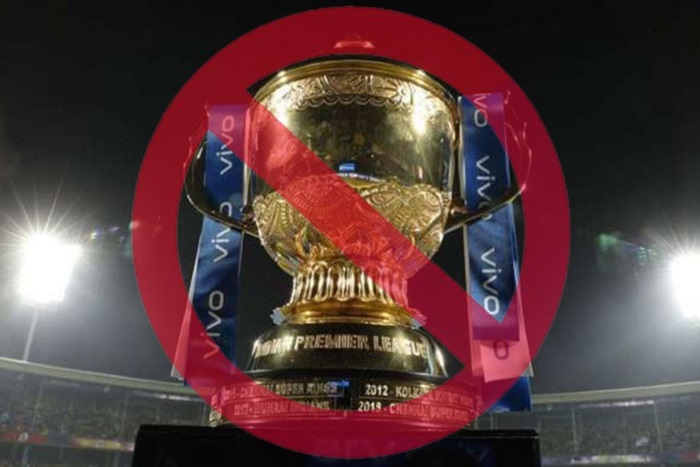
The Board of Control for Cricket in India (BCCI) will not end its partnership with Chinese companies. Vivo, the Chinese smartphone maker, is the main sponsor of the new IPL season as well. Apart from Vivo, PayTM and Dream 11 will also be at the helm of the 13th edition of the IPL. The IPL governing council meeting on Sunday decided to retain the old sponsors.

As soon as the IPL GC announced the decision of retaining the sponsors, a huge number of fans took to Twitter to slam the board for the same. #BoycottIPL started trending as the users urged others to boycott the tournament for the Chinese connection.

Earlier, the demand for exclusion of Chinese companies from the IPL was strong in the wake of the India-China border dispute. But the BCCI cannot abruptly end its collaboration with them. Because of the signed contract itself. And in this age of declining economy, it is difficult to find new sponsors quickly.

The current BCCI contract with Vivo is for five years. Vivo has invested Rs 2,199 crore to become the main sponsor of the IPL. The contract was signed in 2017. However, the BCCI’s move is paving the way for new discussions as calls are mounting across the country to boycott Chinese companies.

The BCCI announced other important decisions besides retaining sponsors. The IPL will be held from September 19 to November 10. The Indian government has given permission to the BCCI to hold the IPL in the UAE. With this, all obstacles in the way of organizing the tournament were removed.

The IPL matches will be played at 7.30 pm Indian time (6 pm UAE time). Most matches are about one match a day. There are a total of ten ‘double headers’ (two matches a day) in the tournament. Franchisees are allowed to appoint as many replacements as they want in the new season in view of the new health situation. At the same time, the maximum number of players a franchise can accommodate is 24. The BCCI is also planning to host a women’s IPL tournament.

Comments

Add new comment

  • Coastaldigest.com reserves the right to delete or block any comments.
  • Coastaldigset.com is not responsible for its readers’ comments.
  • Comments that are abusive, incendiary or irrelevant are strictly prohibited.
  • Please use a genuine email ID and provide your name to avoid reject.
News Network
June 9,2020

Jun 9: Former West Indies skipper Darren Sammy has released a video, alleging racism within the SunRisers Hyderabad camp. Last week, Sammy had lost his cool after learning the meaning of the word "Kalu", which he alleged was directed at him during his Indian Premier League (IPL) stint with the SunRisers Hyderabad. The T20 World Cup-winning Windies skipper had said that he along with Sri Lanka player Thisara Perera were sometimes called that word when they played for SunRisers Hyderabad. However, Sammy did not specify as to who directed these slurs at him, but now the player has released a video, saying he will message all those who called him that word.

"I have played all over the world and I have been loved by many people, I have embraced all dressing rooms where I have played, so I was listening to Hasan Minhaj as to how some of the people in his culture describe black people," Sammy said in a video posted on his Instagram account.

"This does not apply to all people, so after I found out a meaning of a certain word, I had said I was angry on finding out the meaning and it was degrading, instantly I remembered when I played for SunRisers Hyderabad, I was being called exactly the same word which is degrading to us black people," he added.

Sammy said that at the time when he was being called with the word, he didn''t know the meaning, and his team-mates used to laugh every time after calling him by that name.

"I will be messaging those people, you guys know who you are, I must admit at that time when I was being called as that word I thought the word meant strong stallion or whatever it is, I did not know what it meant, every time I was called with that word, there was laughter at that moment, I thought teammates are laughing so it must be something funny," Sammy said.

"Now, I realise it was degrading, I will be texting you guys and I will ask you as to when you called me with that name, did you all mean it in any bad way or form? I have had great memories in all my dressing rooms, so all those who used to you call me with that word, think about it, let's have a conversation, if it was in a bad way then I would be really disappointed," he added.

The former Windies skipper has been a vocal supporter of the protests that are currently going on in the United States over the death of an African-American man named George Floyd.

Sammy had also made an appeal to the ICC and other cricket boards to support the fight against social injustice and racism.

Comments

Add new comment

  • Coastaldigest.com reserves the right to delete or block any comments.
  • Coastaldigset.com is not responsible for its readers’ comments.
  • Comments that are abusive, incendiary or irrelevant are strictly prohibited.
  • Please use a genuine email ID and provide your name to avoid reject.