



An open letter to Narendra Modi

[email protected] (Gopalkrishna Gandhi, The Hindu)
May 19, 2014

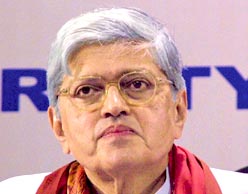
New Delhi, May 19: Let this historic win be followed by a historic innings, which stuns the world by surprises your supporters may not want of you but many more would want to see you unfurl, writes Gopalkrishna Gandhi.Gopalkrishna Gandhi
Dear Prime Minister-designate,

This comes with my hearty felicitations. I mean and say that in utter sincerity, which is not very easy for me to summon, because I am not one of those who wanted to see you reach the high office that you have reached. You know better than anyone else, that while many millions are ecstatic that you will become Prime Minister, many more millions may, in fact, be disturbed, greatly disturbed by it.

Until recently I did not believe those who said you were headed there. But, there you are, seated at the desk at which Jawaharlal Nehru sat, Lal Bahadur Shastri did, and, after a historic struggle against Indira Gandhi's Emergency, another Gujarati, Morarji Desai did, as did later, your own political mentor, Atal Bihari Vajpayee. Those who did not want you there have to accept the fact that you are there.

Despite all my huge misgivings about your deserving that rare privilege, I respect someone coming from so sharply disadvantaged a community and family as yours, becoming Prime Minister of India. That fulfils, very quintessentially, the vision of our egalitarian Constitution.

Revisting the idea of desh

When some spoke rashly and derisively of your having been a “chaiwala,” I felt sick to my stomach. What a wonderful thing it is, I said to myself, that one who has made and served chai for a living should be able to head the government of India. Far better bearing a pyala to many than being a chamcha to one.

But, Mr. Modi, with that said, I must move to why your being at India's helm disturbs millions of Indians. You know this more clearly than anyone else that in the 2014 election, voters voted, in the main, for Modi or against Modi. It was a case of “Is Narendra Modi the country's best guardian — desh ka rakhvala — or is he not?” The BJP has won the seats it has because you captured the imagination of 31 per cent of our people (your vote share) as the nation's best guardian, in fact, as its saviour. It has also to be noted that 69 per cent of the voters did not see you as their rakhvala. They also disagreed on what, actually, constitutes our desh. And this — the concept of desh — is where, Mr. Modi, the Constitution of India, upon the authority of which you are entering the office of Prime Minister, matters. I urge you to revisit the idea of desh.

Reassuring the minorities

In invoking unity and stability, you have regularly turned to the name and stature of Sardar Vallabhbhai Patel. The Sardar, as you would know, chaired the Constituent Assembly's Committee on Minorities. If the Constitution of India gives crucial guarantees — educational, cultural and religious — to India's minorities, Sardar Patel has to be thanked, as do other members of that committee, in particular Rajkumari Amrit Kaur, the Christian daughter of Sikh Kapurthala. Adopt, in toto, Mr. Modi, not adapt or modify, dilute or tinker with, the vision of the Constitution on the minorities. You may like to read what the indomitable Sardar said in that committee.

Why is there, in so many, so much fear, that they dare not voice their fears?

It is because when you address rallies, they want to hear a democrat who carries the Peoplehood of India with him, not an Emperor who issues decrees. Reassure the minorities, Mr. Modi, do not patronise them. “Development” is no substitute to security. You spoke of “the Koran in one hand, a laptop in the other,” or words to that effect. That visual did not quite reassure them because of a counter visual that scares them — of a thug masquerading as a Hindu holding a Hindu epic's DVD in one hand and a minatory trishul in the other.

In the olden days, headmasters used to keep a salted cane in one corner of the classroom, visible and scary, as a reminder of his ability to lash the chosen skin. Memories, no more than a few months old, of the riots in Muzaffarnagar which left at least 42 Muslims and 20 Hindus dead and displaced over 50,000 persons, are that salted cane. “Beware, this is what will be done to you!” is not a threat that anyone in a democracy should fear. But that is the message that has entered the day's fears and night's terrors of millions.

It is in your hands, Mr. Modi, to dispel that. You have the authority and the power to do that, the right and the obligation as well. I would like to believe that, overcoming small-minded advice to the contrary, you will dispel that fear.

All religious minorities in India, not just the Muslim, bear scars in their psyche even as Hindus and Sikhs displaced from West Punjab, and Kashmiri Pandits do. There is the fear of a sudden riot caused with real or staged provocation, and then returned with multiplied retribution, targeted very specially on women. Dalits and Adivasis, especially the women, live and relive humiliation and exploitation every minute of their lives. The constant tug of unease because of slights, discrimination, victimisation is de-citizenising, demoralising, dehumanising. Address that tug, Mr. Modi, vocally and visibly and win their trust. You can, by assuring them that you will be the first spokesman for their interests.

No one should have the impudence to speak the monarchist language of uniformism to a republic of pluralism, the vocabulary of “oneness” to an imagination of many-nesses, the grammar of consolidation to a sensibility that thrives in and on its variations. India is a diverse forest. It wants you to nurture the humus that sustains its great variety, not place before it the monochromatic monoculturalism of a political monotheism.

What has been taken as your stand on Article 370 of the Constitution, the old and hackneyed demand for a Uniform Civil Code, the Ram Mandir in Ayodhya, and what the media have reported as your statements about “Hindu refugees” in our North and North-West and “Muslim refugees” in our East and North-East, strikes fear, not trust. Mass fear, Mr. Modi, cannot be an attribute of the Republic of India. And, as Prime Minister of India, you are the Republic's alter ego.

India's minorities are not a segment of India, they are an infusion in the main. Anyone can burn rope to cinder, no one can take the twist out of it. Bharat mata ki jai, sure, Mr. Modi, but not superseding the compelling urgency of Netaji Subhas Chandra Bose's clarion — Jai Hind!

A historic win it has been for you, Mr. Modi, for which, once again, congratulations. Let it be followed by a historic innings, which stuns the world by surprises your supporters may not want of you but many more would want to see you unfurl. You are hugely intelligent and will not mind unsolicited but disinterested advice of one from an earlier generation. Requite the applause of your support-base but, equally, redeem the trust of those who have not supported you. When you reconstitute the Minorities Commission, ask the Opposition to give you all the names and accept them without change. And do the same for the panels on Scheduled Castes and Tribes, and Linguistic Minorities. And when it comes to choosing the next Chief Information Commissioner, the next CAG, CVC, go sportingly by the recommendation of the non-government members on the selection committee, as long as it is not partisan. You are strong and can afford such risks.

Addressing the southern deficit

Mr. Modi, there is a southern deficit in your India calculus. The Hindi-belt image of your victory should not tighten itself into a North-South divide. Please appoint a deputy prime minister from the South, who is not a politician at all, but an expert social scientist, ecologist, economist or a demographer. Nehru had Shanmukham Chetty, John Mathai, C.D. Deshmukh and K.L. Rao in his cabinet. They were not Congressmen, not even politicians. Indira Gandhi had S. Chandrashekhar, V.K.R.V. Rao. I cannot, for the life of me, understand why the UPA did not make Professor M.S. Swaminathan and Shyam Benegal, both nominated members in the Rajya Sabha, ministers. There is a convention, one may even say, a healthy convention, that nominated members should not be made ministers. But exigencies are exigencies. Professor Nurul Hasan, a nominated member, was one of the best Ministers of Education we have had.

Imperial and ideological exemplars appeal to you. So, be Maharana Pratap in your struggle as you conceive it, but be an Akbar in your repose. Be a Savarkar in your heart, if you must, but be an Ambedkar in your mind. Be an RSS-trained believer in Hindutva in your DNA, if you need to be, but be the Wazir-e-Azam of Hindostan that the 69 per cent who did not vote for you, would want you to be.

With every good wish as you take your place at the helm of our desh,

I am, your fellow-citizen,

Gopalkrishna Gandhi

(The writer is a former administrator and diplomat. He was Governor of West Bengal, 2004-2009, and officiating Governor of Bihar, 2005-2006.)

Comments

Add new comment

  • Coastaldigest.com reserves the right to delete or block any comments.
  • Coastaldigset.com is not responsible for its readers’ comments.
  • Comments that are abusive, incendiary or irrelevant are strictly prohibited.
  • Please use a genuine email ID and provide your name to avoid reject.
Agencies
January 26,2020

New Delhi, Jan 26: Google on Sunday marked India's 71st Republic Day by dedicating a doodle illustrating the country's rich cultural heritage that permeates and unites the diverse nation.

From its world-famous landmarks like the Taj Mahal and India Gate, to the wide array of fauna such as its national bird (the Indian peafowl), to classical arts, textiles, and dances, the doodle, designed by Singapore-based artist Meroo Seth, brings together the rich cultural heritage of the country.

Republic Day marks the completion of India's transition towards becoming an independent republic after its constitution came into effect. The governing document had taken nearly three years of careful deliberation to finalise, and its eventual enactment was joyfully celebrated across the country.

While the Constitution was adopted by the Indian Constituent Assembly on 26 November 1949, it came into effect on January 26 -- a day when Declaration of Indian Independence (Purna Swaraj) was proclaimed by the Indian National Congress back in 1929, as opposed to the Dominion status offered by the British Regime.

Festivities embody the essence of diversity found in one of the world's most populous nations, celebrated over a three-day period with cultural events displaying national pride.

Last year's doodle on Republic Day, designed by artist Reshidev RK, had featured Rashtrapati Bhavan in the background along with a display of the country's iconic monuments and heritage.

Comments

Add new comment

  • Coastaldigest.com reserves the right to delete or block any comments.
  • Coastaldigset.com is not responsible for its readers’ comments.
  • Comments that are abusive, incendiary or irrelevant are strictly prohibited.
  • Please use a genuine email ID and provide your name to avoid reject.
News Network
April 17,2020

Paris, Apr 17: Even as virologists zero in on the virus that causes COVID-19, a very basic question remains unanswered: do those who recover from the disease have immunity?

There is no clear answer to this question, experts say, even if many have assumed that contracting the potentially deadly disease confers immunity, at least for a while.

"Being immunised means that you have developed an immune response against a virus such that you can repulse it," explained Eric Vivier, a professor of immunology in the public hospital system in Marseilles.

"Our immune systems remember, which normally prevents you from being infected by the same virus later on."

For some viral diseases such a measles, overcoming the sickness confers immunity for life.

But for RNA-based viruses such as Sars-Cov-2 -- the scientific name for the bug that causes the COVID-19 disease -- it takes about three weeks to build up a sufficient quantity of antibodies, and even then they may provide protection for only a few months, Vivier told AFP.

At least that is the theory. In reality, the new coronavirus has thrown up one surprise after another, to the point where virologists and epidemiologists are sure of very little.

"We do not have the answers to that -- it's an unknown," Michael Ryan, executive director of the World Health Organization's Emergencies Programme said in a press conference this week when asked how long a recovered COVID-19 patient would have immunity.

"We would expect that to be a reasonable period of protection, but it is very difficult to say with a new virus -- we can only extrapolate from other coronaviruses, and even that data is quite limited."

For SARS, which killed about 800 people across the world in 2002 and 2003, recovered patients remained protected "for about three years, on average," Francois Balloux director of the Genetics Institute at University College London, said.

"One can certainly get reinfected, but after how much time? We'll only know retroactively."

A recent study from China that has not gone through peer review reported on rhesus monkeys that recovered from Sars-Cov-2 and did not get reinfected when exposed once again to the virus.

"But that doesn't really reveal anything," said Pasteur Institute researcher Frederic Tangy, noting that the experiment unfolded over only a month.

Indeed,several cases from South Korea -- one of the first countries hit by the new coronavirus -- found that patients who recovered from COVID-19 later tested positive for the virus.

But there are several ways to explain that outcome, scientists cautioned.

While it is not impossible that these individuals became infected a second time, there is little evidence this is what happened.

More likely, said Balloux, is that the virus never completely disappeared in the first place and remains -- dormant and asymptomatic -- as a "chronic infection", like herpes.

As tests for live virus and antibodies have not yet been perfected, it is also possible that these patients at some point tested "false negative" when in fact they had not rid themselves of the pathogen.

"That suggests that people remain infected for a long time -- several weeks," Balloux added. "That is not ideal."

Another pre-publication study that looked at 175 recovered patients in Shanghai showed different concentrations of protective antibodies 10 to 15 days after the onset of symptoms.

"But whether that antibody response actually means immunity is a separate question," commented Maria Van Kerhove, Technical Lead of the WHO Emergencies Programme.

"That's something we really need to better understand -- what does that antibody response look like in terms of immunity."

Indeed, a host of questions remain.

"We are at the stage of asking whether someone who has overcome COVID-19 is really that protected," said Jean-Francois Delfraissy, president of France's official science advisory board.

For Tangy, an even grimmer reality cannot be excluded.

"It is possible that the antibodies that someone develops against the virus could actually increase the risk of the disease becoming worse," he said, noting that the most serious symptoms come later, after the patient had formed antibodies.

For the moment, it is also unclear whose antibodies are more potent in beating back the disease: someone who nearly died, or someone with only light symptoms or even no symptoms at all. And does age make a difference?

Faced with all these uncertainties, some experts have doubts about the wisdom of persuing a "herd immunity" strategy such that the virus -- unable to find new victims -- peters out by itself when a majority of the population is immune.

"The only real solution for now is a vaccine," Archie Clements, a professor at Curtin University in Perth Australia, told AFP.

At the same time, laboratories are developing a slew of antibody tests to see what proportion of the population in different countries and regions have been contaminated.

Such an approach has been favoured in Britain and Finland, while in Germany some experts have floated the idea of an "immunity passport" that would allow people to go back to work.

"It's too premature at this point," said Saad Omer, a professor of infectious diseases at the Yale School of Medicine.

"We should be able to get clearer data very quickly -- in a couple of months -- when there will be reliable antibody tests with sensitivity and specificity."

One concern is "false positives" caused by the tests detecting antibodies unrelated to COVID-19.

The idea of immunity passports or certificates also raises ethical questions, researchers say.

"People who absolutely need to work -- to feed their families, for example -- could try to get infected," Balloux.

Comments

Add new comment

  • Coastaldigest.com reserves the right to delete or block any comments.
  • Coastaldigset.com is not responsible for its readers’ comments.
  • Comments that are abusive, incendiary or irrelevant are strictly prohibited.
  • Please use a genuine email ID and provide your name to avoid reject.
Agencies
July 24,2020

Pune, Jul 24: Agile and dexterous, 85-year-old Shantabai Pawar wields sticks with absolute ease as she displays 'lathi-kathi' on the streets of Pune.

A video of her, displaying her skills in the Indian martial art form for livelihood, has gone viral on social media.

Pawar told media persons that she learnt the art form when she was only eight and has been practising it since then. The ancient martial art s believed to be linked to Dombari community, a nomadic tribe in Maharashtra.

"I have been pursuing the art of lathi-kathi since I was eight. I have never left it. It is part of me and it is an honour to practice it. My father taught me this. He taught me to work hard," Pawar told media persons.

In the video, the sari-clad octogenarian takes a warrior-like stride and effortlessly rotates a stick several times in a second in her hand and around her head and then does it with two sticks together with a smile on her face. She also tosses a stick in the air and catches it with ease.

The assembled gathering is impressed and enthused.

"People come and say, 'Well done Daadi!' I practice it to earn money for my children and grandchildren," she said.

Pawar leaves her home in the morning in the conditions created by coronavirus and performs the art form on roads and streets.

"I go to various areas to perform the art form and people give money," she said.

The artiste also uses thali and stick to gather the attention of people as most of them are indoors due to conditions created by COVID-19.

Senior citizens have been advised against venturing out due to their greater susceptibility to coronavirus but Pawar said she is not afraid to step out.

"People do advise me to not go out due to fear of COVID-19 but I am not scared. Whenever I step out, I pray to my God and he has kept me safe so far," she said.

Aishwarya Kale, a dancer and the person who uploaded the video on social media, said that it is "only an artist who can understand what help another artist needs".

"I was in that area shopping for some items and it was then I saw her performing and thought that I should film her and upload her video on social media. But I never thought that the video would go viral and she would receive financial help not just from people in the country but overseas as well," Kale told media persons.

"She is now getting honour for her craft that she couldn't get in the last 85 years. I feel good that through my small video, her art form has become viral," she added. 

Comments

Add new comment

  • Coastaldigest.com reserves the right to delete or block any comments.
  • Coastaldigset.com is not responsible for its readers’ comments.
  • Comments that are abusive, incendiary or irrelevant are strictly prohibited.
  • Please use a genuine email ID and provide your name to avoid reject.