



Our Moon is much older than thought: study

January 14, 2017

Los Angeles, Jan 14: The Moon is at least 4.51 billion years old - up to 140 million years older than previously thought, according to a new study of minerals called zircons brought back from the lunar body to the Earth by the Apollo 14 mission in 1971.
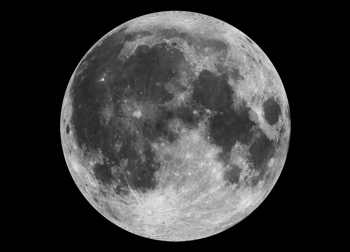
moonThe Moon's age has been a hotly debated topic, even though scientists have tried to settle the question over many years and using a wide range of scientific techniques.

"We have finally pinned down a minimum age for the Moon; it is time we knew its age and now we do," said Melanie Barboni, research geochemist at University of California, Los Angeles (UCLA) in the US.

The Moon was formed by a violent, head-on collision between the early Earth and a "planetary embryo" called Theia.

The new study would mean that Moon formed "only" about 60 million years after the birth of the solar system, providing critical information for astronomers and planetary scientists who seek to understand the early evolution of the Earth and our solar system, researchers said.

That has been a difficult task, Barboni said, because "whatever was there before the giant impact has been erased."

While scientists cannot know what occurred before the collision with Theia, these findings are important because they will help scientists continue to piece together major events that followed it.

It is usually difficult to determine the age of Moon rocks because most of them contain a patchwork of fragments of multiple other rocks. However, Barboni was able to analyse eight zircons in pristine condition.

She examined how the uranium they contained had decayed to lead and how the lutetium they contained had decayed to an element called hafnium.

The researchers analysed those elements together to determine the Moon's age.

"Zircons are nature's best clocks. They are the best mineral in preserving geological history and revealing where they originated," said Kevin McKeegan, a UCLA professor of geochemistry and cosmochemistry.

The Earth's collision with Theia created a liquefied Moon, which then solidified. Scientists believe most of the Moon's surface was covered with magma right after its formation.

The uranium–lead measurements reveal when the zircons first appeared in the Moon's initial magma ocean, which later cooled down and formed the Moon's mantle and crust; the lutetium–hafnium measurements reveal when its magma formed, which happened earlier.

Previous studies concluded the Moon's age based on Moon rocks that had been contaminated by multiple collisions. McKeegan said those rocks indicated the date of some other events, "but not the age of the Moon."

The study was published in the journal Science Advances.

Comments

Add new comment

  • Coastaldigest.com reserves the right to delete or block any comments.
  • Coastaldigset.com is not responsible for its readers’ comments.
  • Comments that are abusive, incendiary or irrelevant are strictly prohibited.
  • Please use a genuine email ID and provide your name to avoid reject.
Agencies
May 31,2020

Cape Canaveral, May 31: SpaceX, the private rocket company of billionaire entrepreneur Elon Musk, launched two Americans into orbit from Florida on Saturday in a landmark mission marking the first spaceflight of NASA astronauts from U.S. soil in nine years.

A SpaceX Falcon 9 rocket lifted off from the Kennedy Space Center at 3:22 p.m. EDT (19:22 GMT), launching Doug Hurley and Bob Behnken on a 19-hour ride aboard the company’s newly designed Crew Dragon capsule bound for the International Space Station.

Just before liftoff, Hurley said, “SpaceX, we’re go for launch. Let’s light this candle,” paraphrasing the famous comment uttered on the launch pad in 1961 by Alan Shepard, the first American flown into space.

Minutes after launch, the first-stage booster rocket of the Falcon 9 separated from the upper second-stage rocket and flew itself back to Earth to descend safely onto a landing platform floating in the Atlantic.

High above the Earth, the Crew Dragon jettisoned moments later from the second-stage rocket, sending the capsule on its way to the space station.

The exhilarating spectacle of the rocket soaring flawlessly into the heavens came as a welcome triumph for a nation gripped by racially-charged civil unrest as well as ongoing fear and economic upheaval from the coronavirus pandemic.

The Falcon 9 took off from the same launch pad used by NASA’s final space shuttle flight, piloted by Hurley, in 2011. Since then, NASA astronauts have had to hitch rides into orbit aboard Russia’s Soyuz spacecraft.

“It’s incredible, the power, the technology,” said U.S. President Donald Trump, who was at Kennedy Space Center at Cape Canaveral in Florida for the launch. “That was a beautiful sight to see.”

The mission’s first launch attempt on Wednesday was called off with less than 17 minutes remaining on the countdown clock. Weather again threatened Saturday’s launch, but cleared in time to proceed with the mission.

SPACEFLIGHT MILESTONES

NASA chief Jim Bridenstine has said resuming launches of American astronauts on American-made rockets from U.S. soil is the space agency’s top priority.

“I’m breathing a sigh of relief, but I will also tell you I’m not gonna celebrate until Bob and Doug are home safely.” Bridenstine said.

For Musk, the launch represents another milestone for the reusable rockets his company pioneered to make spaceflight less costly and more frequent. And it marks the first time commercially developed space vehicles - owned and operated by a private entity rather than NASA - have carried Americans into orbit.

The last time NASA launched astronauts into space aboard a brand new vehicle was 40 years ago at the start of the space shuttle program.

Musk, the South African-born high-tech entrepreneur who made his fortune in Silicon Valley, is also chief executive of electric carmaker and battery manufacturer Tesla Inc. He founded Hawthorne, California-based SpaceX, formally known as Space Exploration Technologies, in 2002.

Hurley, 53, and Behnken, 49, NASA employees under contract to fly with SpaceX, are expected to remain at the space station for several weeks, assisting a short-handed crew aboard the orbital laboratory.

Boeing Co, producing its own launch system in competition with SpaceX, is expected to fly its CST-100 Starliner vehicle with astronauts aboard for the first time next year. NASA has awarded nearly $8 billion combined to SpaceX and Boeing for development of their rival rockets.

Trump also hailed the launch as a major advance toward the goal of eventually sending humans to Mars.

He was joined at the viewing by Musk, as well as Vice President Mike Pence, Commerce Secretary Wilbur Ross, Education Secretary Betsy DeVos, Florida congressman Matt Gaetz and Senator Rick Scott.

Earlier on Saturday, the crew bid goodbye to their families. Prior to climbing into a specially designed Tesla automobile for the ride to the launch site, Behnken told his young son, “Be good for mom. Make her life easy.”

During the drive, Behnken and Hurley passed former astronaut Garrett Reisman who held a sign saying, “Take me with you.”

Comments

Add new comment

  • Coastaldigest.com reserves the right to delete or block any comments.
  • Coastaldigset.com is not responsible for its readers’ comments.
  • Comments that are abusive, incendiary or irrelevant are strictly prohibited.
  • Please use a genuine email ID and provide your name to avoid reject.
News Network
July 9,2020

U.S. electric vehicle maker Tesla Inc is "very close" to achieving level 5 autonomous driving technology, Chief Executive Elon Musk said on Thursday, referring to the capability to navigate roads without any driver input.

"I'm extremely confident that level 5 or essentially complete autonomy will happen and I think will happen very quickly," Musk said in remarks made via a video message at the opening of Shanghai's annual World Artificial Intelligence Conference (WAIC).

"I remain confident that we will have the basic functionality for level 5 autonomy complete this year."

Automakers and tech companies including Alphabet Inc Waymo and Uber Technologies are investing billions in the autonomous driving industry.

However industry insiders have said it would take time for the technology to get ready and public to trust autonomous vehicles fully.

The California-based automaker currently builds cars with an Autopilot driver-assistance system.

Tesla is also developing new heat-projection or cooling systems to enable more advanced computers in cars, Musk said.

Industry data showed Tesla sold nearly 15,000 China-made Model 3 sedans last month.

Tesla has become the highest-valued automaker as its shares surged to record highs and its market capitalisation overtook that of former front-runner Toyota Motors Corp.

Comments

Add new comment

  • Coastaldigest.com reserves the right to delete or block any comments.
  • Coastaldigset.com is not responsible for its readers’ comments.
  • Comments that are abusive, incendiary or irrelevant are strictly prohibited.
  • Please use a genuine email ID and provide your name to avoid reject.
Agencies
July 2,2020

Paris, Jul 2: Several interacting exoplanets have already been spotted by satellites. But a new breakthrough has been achieved with, for the first time, the detection directly from the ground of an extrasolar system of this type.

An international collaboration including CNRS researchers has discovered an unusual planetary system, dubbed WASP-148, using the French instrument SOPHIE at the Observatoire de Haute-Provence (CNRS/Aix-Marseille Universite).

The scientists analysed the star's motion and concluded that it hosted two planets, WASP-148b and WASP-148c. The observations showed that the two planets were strongly interacting, which was confirmed from other data.

Whereas the first planet, WASP-148b, orbits its star in nearly nine days, the second one, WASP-148c, takes four times longer. This ratio between the orbital periods implies that the WASP-148 system is close to resonance, meaning that there is enhanced gravitational interaction between the two planets. And it turns out that the astronomers did indeed detect variations in the orbital periods of the planets.

While a single planet, uninfluenced by a second one, would move with a constant period, WASP-148b and WASP-148c undergo acceleration and deceleration that provides evidence of their interaction.

The study will shortly be published in the journal Astronomy & Astrophysics.

Comments

Add new comment

  • Coastaldigest.com reserves the right to delete or block any comments.
  • Coastaldigset.com is not responsible for its readers’ comments.
  • Comments that are abusive, incendiary or irrelevant are strictly prohibited.
  • Please use a genuine email ID and provide your name to avoid reject.