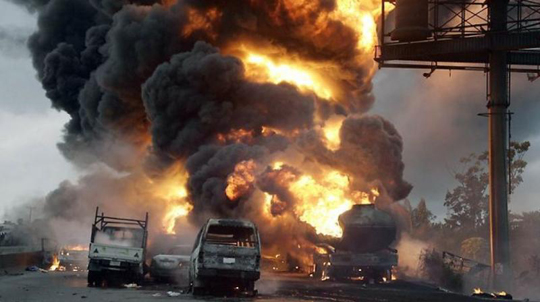
Over 30 dead as Kenya petrol tanker crashes, explodes

December 11, 2016

Nairobi, Dec 11: More than 30 people died when a petrol tanker crashed into other vehicles and burst into flames outside the town of Naivasha in Kenya late on Saturday night, officials said.

Kenya

"Over 30 people confirmed dead, many injured and over 11 vehicles burnt at a road traffic accident along Nairobi-Naivasha," Pius Masai of Kenya's National Disaster Management Unit said in a statement early Sunday.

Kenya's Red Cross said the driver had lost control of the fuel tanker which then crashed into other vehicles and "burst into flames".

The accident occurred at Karai on the busy Nairobi-Nakuru highway, the main cross-country road leading from Kenya's capital to the west of the country and on to Uganda. Around 11 vehicles are thought to have been involved in the fire.

Witnesses described a fireball engulfing the vehicles with passengers inside.

"It's a terrible incident, people are burnt, some in their cars and others as they tried to escape," said a police officer on the scene.

Given the scale of the disaster it is expected that the death toll may rise. The accident comes as Kenya is in the throes of a nationwide doctors' strike.

Comments

Add new comment

  • Coastaldigest.com reserves the right to delete or block any comments.
  • Coastaldigset.com is not responsible for its readers’ comments.
  • Comments that are abusive, incendiary or irrelevant are strictly prohibited.
  • Please use a genuine email ID and provide your name to avoid reject.
News Network
May 19,2020

May 19: A Chinese laboratory has been developing a drug it believes has the power to bring the coronavirus pandemic to a halt.

The outbreak first emerged in China late last year before spreading across the world, prompting an international race to find treatments and vaccines.

A drug being tested by scientists at China's prestigious Peking University could not only shorten the recovery time for those infected, but even offer short-term immunity from the virus, researchers say.

Sunney Xie, director of the university's Beijing Advanced Innovation Center for Genomics, told AFP that the drug has been successful at the animal testing stage.

"When we injected neutralising antibodies into infected mice, after five days the viral load was reduced by a factor of 2,500," said Xie.

"That means this potential drug has (a) therapeutic effect."

The drug uses neutralising antibodies -- produced by the human immune system to prevent the virus infecting cells -- which Xie's team isolated from the blood of 60 recovered patients.

A study on the team's research, published Sunday in the scientific journal Cell, suggests that using the antibodies provides a potential "cure" for the disease and shortens recovery time.

Xie said his team had been working "day and night" searching for the antibody.

"Our expertise is single-cell genomics rather than immunology or virology. When we realised that the single-cell genomic approach can effectively find the neutralising antibody we were thrilled."

He added that the drug should be ready for use later this year and in time for any potential winter outbreak of the virus, which has infected 4.8 million people around the world and killed more than 315,000.

"Planning for the clinical trial is underway," said Xie, adding it will be carried out in Australia and other countries since cases have dwindled in China, offering fewer human guinea pigs for testing.

"The hope is these neutralised antibodies can become a specialised drug that would stop the pandemic," he said.

China already has five potential coronavirus vaccines at the human trial stage, a health official said last week.

But the World Health Organization has warned that developing a vaccine could take 12 to 18 months.

Scientists have also pointed to the potential benefits of plasma -- a blood fluid -- from recovered individuals who have developed antibodies to the virus enabling the body's defences to attack it.

More than 700 patients have received plasma therapy in China, a process which authorities said showed "very good therapeutic effects".

"However, it (plasma) is limited in supply," Xie said, noting that the 14 neutralising antibodies used in their drug could be put into mass production quickly.

Using antibodies in drug treatments is not a new approach, and it has been successful in treating several other viruses such as HIV, Ebola and Middle East Respiratory Syndrome (MERS).

Xie said his researchers had "an early start" since the outbreak started in China before spreading to other countries.

Ebola drug Remdesivir was considered a hopeful early treatment for COVID-19 -- clinical trials in the US showed it shortened the recovery time in some patients by a third -- but the difference in mortality rate was not significant.

The new drug could even offer short-term protection against the virus.

The study showed that if the neutralising antibody was injected before the mice were infected with the virus, the mice stayed free of infection and no virus was detected.

This may offer temporary protection for medical workers for a few weeks, which Xie said they are hoping to "extend to a few months".

More than 100 vaccines for COVID-19 are in the works globally, but as the process of vaccine development is more demanding, Xie is hoping that the new drug could be a faster and more efficient way to stop the global march of the coronavirus.

"We would be able to stop the pandemic with an effective drug, even without a vaccine," he said.

Comments

Add new comment

  • Coastaldigest.com reserves the right to delete or block any comments.
  • Coastaldigset.com is not responsible for its readers’ comments.
  • Comments that are abusive, incendiary or irrelevant are strictly prohibited.
  • Please use a genuine email ID and provide your name to avoid reject.
News Network
May 6,2020

Washington, May 6: The Chinese Army is indulging in aggressive behaviour in the South China Sea and the Chinese Communist Party has ramped up its disinformation campaign to try to shift the blame on coronavirus and burnish its image, US Defense Secretary Mark Esper said on Tuesday.

"While the Chinese Communist Party ramps up its disinformation campaign to try to shift blame and burnish its image, we continue to see aggressive behaviour by the PLA in the South China Sea, from threatening a Philippine Navy ship to sinking a Vietnamese fishing boat and intimidating other nations from engaging in offshore oil and gas development," Esper told reporters at a Pentagon news conference.

Last week, two US Navy ships conducted freedom of navigation operations in the South China Sea to send a clear message to Beijing that America will continue to protect the freedom of navigation and commerce for all nations large and small, he said.

Many countries, Esper said, have turned inward to recover from the pandemic and in the meantime, America's strategic competitors are attempting to exploit this crisis to their benefit at the expense of others.

Responding to a question, he said the Chinese have not been transparent from the beginning on the coronavirus pandemic.

"If they had been more transparent, more open, upfront in terms of giving us access, the reporting, giving us access not to the people on the ground but to the virus they had so we could understand it, we would probably be in a far different place right now. But where we are now is this," Esper said.

China needs to allow the United States in to talk to early patients, Chinese researchers and scientists, and to have access, he added.

Instead, Esper alleged that the Chinese are trying to capitalise on this by promoting their own image that somehow, China is the good guy here.

"Despite everything they did or, more importantly, failed to do, now they want to go out and say well, here's masks. We will give you masks, provide this, or provide that, we will provide you funding. Look at all the good things we are doing," he said.

"Yet, what we know is that they provide masks, they provide supplies. In many cases, it is not good. It does not do what it is supposed to do. It is broken equipment. Also, the strings attached are enormous in many cases. So, they are telling a country you can take these masks, but please, put out publicly how good China is, how great we are doing, et cetera, et cetera," Esper said.

"So there is a number of things they are doing to try and burnish their image. That is just two of them right there," he said.

The Chinese are also doing a lot of strong-arming behind the scenes, Esper said and referred to the war of words between China and Australia. He said he plans to talk to his Australian counterpart later in the day.

"All these activities are going on. It is straight from the Chinese playbook. Once again, it is just a little bit more obvious this time with what they are doing and how they are using a combination of compelling and coercion and everything else to try and shape the narrative and burnish the image of the Chinese Communist Party," Esper said.

Comments

Add new comment

  • Coastaldigest.com reserves the right to delete or block any comments.
  • Coastaldigset.com is not responsible for its readers’ comments.
  • Comments that are abusive, incendiary or irrelevant are strictly prohibited.
  • Please use a genuine email ID and provide your name to avoid reject.
News Network
April 12,2020

Apr 12: India and other South Asian countries are likely to record their worst growth performance in four decades this year due to the coronavirus outbreak, the World Bank said on Sunday.

The South Asian region, comprising eight countries, is likely to show economic growth of 1.8 per cent to 2.8 per cent this year, the World Bank said in its South Asia Economic Focus report, well down from the 6.3 per cent it projected six months ago.

India's economy, the region's biggest, is expected to grow 1.5 per cent to 2.8 per cent in the fiscal year that started on April 1. The World Bank has estimated it will grow 4.8 per cent to 5 per cent in the fiscal year that ended on March 31.

"The green shoots of a rebound that were observable at the end of 2019 have been overtaken by the negative impacts of the global crisis," the World Bank report said.

Other than India, the World Bank forecast that Sri Lanka, Nepal, Bhutan and Bangladesh will also see sharp falls in economic growth.

Three other countries - Pakistan, Afghanistan and the Maldives - are expected to fall into recession, the World Bank said in the report, which was based on country-level data available as of April 7.

Measures taken to counter the coronavirus have disrupted supply chains across South Asia, which has recorded more than 13,000 cases so far - still lower than many parts of the world.

India's lockdown of 1.3 billion people has also left millions out of work, disrupted big and small businesses and forced an exodus of migrant workers from the cities to their homes in villages.

In the event of prolonged and broad national lockdowns, the report warned of a worst-case scenario in which the entire region would experience an economic contraction this year.

To minimize short-term economic pain, the Bank called for countries in the region to announce more fiscal and monetary steps to support unemployed migrant workers, as well as debt relief for businesses and individuals.

India has so far unveiled a $23 billion economic plan to offer direct cash transfers to millions of poor people hit by its lockdown. In neighbouring Pakistan, the government has announced a $6 billion plan to support the economy.

"The priority for all South Asian governments is to contain the virus spread and protect their people, especially the poorest who face considerable worse health and economic outcomes," said senior World Bank official Hartwig Schafer.

Comments

Add new comment

  • Coastaldigest.com reserves the right to delete or block any comments.
  • Coastaldigset.com is not responsible for its readers’ comments.
  • Comments that are abusive, incendiary or irrelevant are strictly prohibited.
  • Please use a genuine email ID and provide your name to avoid reject.