


'This Is Painful': Hillary Clinton Addresses Stunned Staff And Nation In Defeat

November 10, 2016

Washington, Nov 10: Hillary Clinton saw a rancorous campaign through to its bitter end on Wednesday, conceding the presidency to a man she had called unfit for the office and a threat to the fabric of the country.
clinton

In defeat, Clinton turned one of her central attacks on Donald Trump into a charge for the presidency she was denied, urging the next president and her disheartened supporters to respect the peaceful transfer of power.

"We have seen that our nation is more deeply divided than we thought," Clinton said hours after losing a presidential election she had been widely seen as sure to win. "But I still believe in America, and I always will. And if you do, then we must accept this result and then look to the future."

Speaking to a hastily assembled group of campaign staff, volunteers and supporters, Clinton went on: "Donald Trump is going to be our president. We owe him an open mind and the chance to lead."

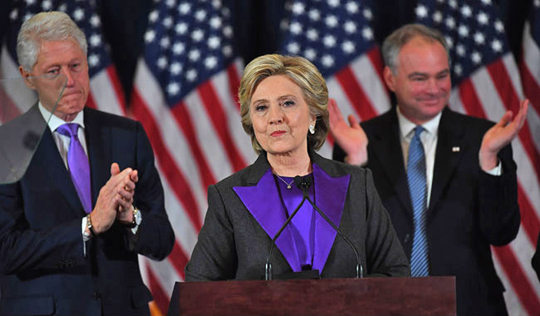
She grew misty-eyed but maintained her composure even as her supporters could not throughout a speech she never imagined giving, in a hotel ballroom farther in feel than in distance from the exquisitely planned celebration she did not have on Tuesday night.

Hours earlier, Clinton had also planned to speak of the promise of "an America that's hopeful, inclusive and big-hearted." She had planned to call for unity and healing, with her own history-making election as the first female president a galvanizing example.

That dream started to unravel about 8:30 p.m. Tuesday, when roughly half the states had voted and results showed a Trump lead that Clinton's confident, data-driven campaign had not foreseen.

Clinton's second unsuccessful run for the White House relied heavily on a complex computer algorithm that the campaign was prepared to publicly unveil after the election.

As election results rolled in Tuesday, Clinton watched from a suite in the Peninsula Hotel in Manhattan as her would-be electoral advantage disappeared. The gulf opened and never closed as Trump performed more strongly than expected in several upper-Midwestern states that had voted for Democrats for a generation.

Earlier in the night, top Clinton aides bounced around the room doing media interviews and chatting with reporters, projecting optimism that Clinton's voters would come through with record turnout.

But by 9 p.m., the early warning signs had become dire. Virginia, a state that they thought would be an easy win, was looking like a squeaker. Florida had begun to appear out of reach. And Trump's victories in Iowa and Ohio, which were expected, became the leading edge of a Trump wave that swamped Clinton.

Not only did Trump capture big margins in battleground states, outperforming expectations for a divisive and damaged candidate, but he outperformed 2012 nominee Mitt Romney in some categories. Meanwhile, Clinton underperformed with the groups she needed most - minorities and younger voters - showing that she could neither recreate the much-admired "Obama coalition" nor assemble what her aides had begun to call her own "Hillary coalition."

One by one, Clinton aides began disappearing from the main hall and not answering their phones. They retreated to a nearby war room, which was cordoned off and guarded, and never returned. The mood outside the room turned from confusion to disbelief, anger and dejection.

Back at the Peninsula, campaign aides who were not part of Clinton's small core of intimate friends and advisers gradually peeled away and came to the Javits Center in ones and twos. Eventually it was only Clinton, her family and the closest advisers including Huma Abedin and Cheryl Mills making the decision first to put off a concession speech and then to concede by phone.

Mills smiled softly and shook her head when asked Wednesday what those hours were like.

"It's too raw," she said as she talked with Clinton supporters outside the New Yorker Hotel, where Clinton, flanked by running mate Sen. Tim Kaine, Va., and her husband and daughter, had said goodbye.

Clinton did not dwell Wednesday on what other friends said was an agonizing reckoning in that hotel room, but the mood was akin to the funeral for a sudden death - shocking, mystifying and starkly real. It was clear that no one - not Clinton, not her husband, not her supporters, not the core team of her campaign - had seen it coming.

"I know how disappointed you feel because I feel it too, and so do tens of millions of Americans who invested their hopes and dreams in this effort," Clinton said. "This is painful, and it will be for a long time."

Time and time again, Clinton and the team seemed to miss the magnitude of the forces that would overtake her in the Democratic primary and later against Trump.

It wasn't until Sen. Bernie Sanders of Vermont showed surprising strength in Iowa that the Clinton campaign put real stock in the strength of his populist economic message. The same forces helped Trump win on Tuesday.

Clinton would need voters to choose her over her opponents because of how she would "handle the economy and relate to the middle class," her campaign manager Robby Mook wrote in an email to close advisers in March 2014.

But more often, the effort to disqualify Trump based on his temperament took precedence over an economic focus.

Clinton's aides knew that there were soft spots in the Obama voting coalition that could pose problems for Clinton's bid. Her support among young voters was fragile, and in early voting, African American turnout and enthusiasm lagged.

In the end, Clinton's inability to bring out Democratic voters in the election was a dramatic failure that left her more than 5 million votes shy of Obama's total in 2012, according to preliminary results. Trump was ultimately able to claim victory having earned fewer votes than Romney did in 2012.

Latino voters did turn out in 2016, but many more than expected were willing to give Trump a shot at the White House. Among nonwhite voters, Clinton led Trump by 54 points - a whopping advantage but less than Obama's 61-point lead four years ago.

These miscalculations probably cost Clinton key states that Obama won four years ago: Michigan, Wisconsin, Florida and Pennsylvania. Clinton walked away having won the popular vote but having lost badly to Trump in the electoral college.

While her reliance on analytics became well known, the particulars of "Ada" the algorithm's work were kept under tight wraps, according to aides. The algorithm operated on a separate server than the rest of the Clinton operation as a security precaution, and only a few senior aides had access.

According to aides, a raft of polling numbers, public and private, were fed into the algorithm, as well as ground-level voter data collected by the campaign. Once early voting began, those numbers were factored in, too.

With that, aides said, Ada ran 400,000 simulations a day of what the race against Trump might look like. It spat out a report giving campaign manager Mook and others a detailed picture of which battleground states were most likely to tip the race in one direction or another - and guiding decisions about where to spend time and deploy resources.

But was it the right guidance? It appears that the importance of some states Clinton would lose - including Michigan and Wisconsin - never became fully apparent or that it was too late once it did.

Clinton made several visits to Michigan during the general election, but it wasn't until the final days that she, Obama and her husband made a concerted effort.

As for Wisconsin, Clinton didn't make any general-election appearances there at all.

Said Mook, in a wee-hours thank-you note to campaign workers: "Campaigns are incredibly hard, and sometimes the results don't reflect the merit, work and commitment that goes into them. This is one of those times."

Comments

Add new comment

  • Coastaldigest.com reserves the right to delete or block any comments.
  • Coastaldigset.com is not responsible for its readers’ comments.
  • Comments that are abusive, incendiary or irrelevant are strictly prohibited.
  • Please use a genuine email ID and provide your name to avoid reject.
News Network
July 18,2020

Global coronavirus infections passed 14 million on Friday, according to a Reuters tally, marking the first time there has been a surge of 1 million cases in under 100 hours.

The first case was reported in China in early January and it took three months to reach 1 million cases. It has taken just four days to climb to 14 million cases from 13 millionrecorded on July 13.

The United States, with more than 3.6 million confirmed cases, is still seeing huge daily jumps in its first wave of Covid-19 infections. The United States reported a daily global record of more than 77,000 new infections on Thursday, while Sweden has reported 77,281 total cases since the pandemic began.

Despite the surging cases, a cultural divide is growing in the country over wearing masks to slow the spread of the virus, a precaution routinely taken in many other nations.

U.S. President Donald Trump and his followers have resisted a full-throated endorsement of masks and have been calling for a return to normal economic activity and reopening schools despite the surging cases.

COVID-19 Pandemic Tracker: 15 countries with the highest number of coronavirus cases, deaths

Other hard-hit countries have “flattened the curve” and are easing lockdowns put in place to slow the spread of the novel virus while others, such as the cities of Barcelona and Melbourne, are implementing a second round of local shutdowns.

The number of cases globally is around triple that of severe influenza illnesses recorded annually, according to the World Health Organization.

The pandemic has now killed more than 590,000 people in almost seven months, edging towards the upper range of yearly influenza deaths reported worldwide. The first death was reported on Jan. 10 in Wuhan, China before infections and fatalities then surged in Europe and later in the United States.

The Reuters tally, which is based on government reports, shows the disease is accelerating the fastest in the Americas, which account for more than half the world’s infections and half its deaths.
In Brazil, more than 2 million people have tested positive including President Jair Bolsonaro, and more than 76,000 people have died.

India, the only other country with more than 1 millioncases, has been grappling with an average of almost 30,000 new infections each day for the last week.

Those countries were the main drivers behind the World Health Organization on Friday reporting a record one-day increase in global coronavirus cases of 237,743.

In countries with limited testing capacity, case numbers reflect only a proportion of total infections. Experts say official data likely under-represents both infections and deaths.

Comments

Add new comment

  • Coastaldigest.com reserves the right to delete or block any comments.
  • Coastaldigset.com is not responsible for its readers’ comments.
  • Comments that are abusive, incendiary or irrelevant are strictly prohibited.
  • Please use a genuine email ID and provide your name to avoid reject.
News Network
June 9,2020

Jun 9: The World Health Organization says it still believes the spread of the coronavirus from people without symptoms is “rare,” despite warnings from numerous experts worldwide that such transmission is more frequent and likely explains why the pandemic has been so hard to contain.

Maria Van Kerkhove, WHO''s technical lead on COVID-19 said at a press briefing on Monday that many countries are reporting cases of spread from people who are asymptomatic, or those with no clinical symptoms.

But when questioned in more detail about these cases, Van Kerkhove said many of them turn out to have mild disease, or unusual symptoms.

Although health officials in countries including Britain, the U.S. and elsewhere have warned that COVID-19 is spreading from people without symptoms, WHO has maintained that this type of spread is not a driver of the pandemic and is probably accounts for about 6 per cent of spread, at most.

Numerous studies have suggested that the virus is spreading from people without symptoms, but many of those are either anecdotal reports or based on modeling.

Van Kerkhove said that based on data from countries, when people with no symptoms of COVID-19 are tracked over a long period to see if they spread the disease, there are very few cases of spread.

“We are constantly looking at this data and we''re trying to get more information from countries to truly answer this question,” she said. “It still appears to be rare that asymptomatic individuals actually transmit onward.”

Comments

Add new comment

  • Coastaldigest.com reserves the right to delete or block any comments.
  • Coastaldigset.com is not responsible for its readers’ comments.
  • Comments that are abusive, incendiary or irrelevant are strictly prohibited.
  • Please use a genuine email ID and provide your name to avoid reject.
Agencies
July 1,2020

The ILO has warned that if another Covid-19 wave hits in the second half of 2020, there would be global working-hour loss of 11.9 percent - equivalent to the loss of 340 million full-time jobs.

According to the 5th edition of International Labour Organisation (ILO) Monitor: Covid-19 and the world of work, the recovery in the global labour market for the rest of the year will be uncertain and incomplete.

The report said that there was a 14 percent drop in global working hours during the second quarter of 2020, equivalent to the loss of 400 million full-time jobs.

The number of working hours lost across the world in the first half of 2020 was significantly worse than previously estimated. The highly uncertain recovery in the second half of the year will not be enough to go back to pre-pandemic levels even in the best scenario, the agency warned.

The baseline model – which assumes a rebound in economic activity in line with existing forecasts, the lifting of workplace restrictions and a recovery in consumption and investment – projects a decrease in working hours of 4.9 percent (equivalent to 140 million full-time jobs) compared to last quarter of 2019.

It says that in the pessimistic scenario, the situation in the second half of 2020 would remain almost as challenging as in the second quarter.

“Even if one assumes better-tailored policy responses – thanks to the lessons learned throughout the first half of the year – there would still be a global working-hour loss of 11.9 per cent at the end of 2020, or 340 million full-time jobs, relative to the fourth quarter of 2019,” it said.

The pessimistic scenario assumes a second pandemic wave and the return of restrictions that would significantly slow recovery. The optimistic scenario assumes that workers’ activities resume quickly, significantly boosting aggregate demand and job creation. With this exceptionally fast recovery, the global loss of working hours would fall to 1.2 per cent (34 million full-time jobs).

The agency said that under the three possible scenarios for recovery in the next six months, “none” sees the global job situation in better shape than it was before lockdown measures began.

“This is why we talk of an uncertain but incomplete recovery even in the best of scenarios for the second half of this year. So there is not going to be a simple or quick recovery,” ILO Director-General Guy Ryder said.

The new figures reflect the worsening situation in many regions over the past weeks, especially in developing economies. Regionally, working time losses for the second quarter were: Americas (18.3 percent), Europe and Central Asia (13.9 percent), Asia and the Pacific (13.5 percent), Arab States (13.2 percent), and Africa (12.1 percent).

The vast majority of the world’s workers (93 per cent) continue to live in countries with some sort of workplace closures, with the Americas experiencing the greatest restrictions.

During the first quarter of the year, an estimated 5.4 percent of global working hours (equivalent to 155 million full-time jobs) were lost relative to the fourth quarter of 2019. Working- hour losses for the second quarter of 2020 relative to the last quarter of 2019 are estimated to reach 14 per cent worldwide (equivalent to 400 million full-time jobs), with the largest reduction (18.3 per cent) occurring in the Americas.

The ILO Monitor also found that women workers have been disproportionately affected by the pandemic, creating a risk that some of the modest progress on gender equality made in recent decades will be lost, and that work-related gender inequality will be exacerbated.

The severe impact of Covid-19 on women workers relates to their over-representation in some of the economic sectors worst affected by the crisis, such as accommodation, food, sales and manufacturing.

Globally, almost 510 million or 40 percent of all employed women work in the four most affected sectors, compared to 36.6 percent of men, it said.

The report said that women also dominate in the domestic work and health and social care work sectors, where they are at greater risk of losing their income and of infection and transmission and are also less likely to have social protection.

The pre-pandemic unequal distribution of unpaid care work has also worsened during the crisis, exacerbated by the closure of schools and care services.

Even as countries have adopted policy measures with unprecedented speed and scope, the ILO Monitor highlights some key challenges ahead, including finding the right balance and sequencing of health, economic and social and policy interventions to produce optimal sustainable labour market outcomes; implementing and sustaining policy interventions at the necessary scale when resources are likely to be increasingly constrained and protecting and promoting the conditions of vulnerable, disadvantaged and hard-hit groups to make labour markets fairer and more equitable.

“The decisions we adopt now will echo in the years to come and beyond 2030. Although countries are at different stages of the pandemic and a lot has been done, we need to redouble our efforts if we want to come out of this crisis in a better shape than when it started,” Ryder said. 

Comments

Add new comment

  • Coastaldigest.com reserves the right to delete or block any comments.
  • Coastaldigset.com is not responsible for its readers’ comments.
  • Comments that are abusive, incendiary or irrelevant are strictly prohibited.
  • Please use a genuine email ID and provide your name to avoid reject.