Pak army rejects report on Bajwa's 'read book on India' advice

February 20, 2017

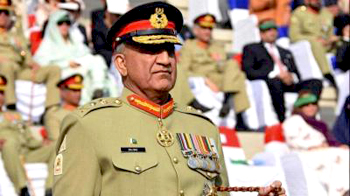
Islamabad, Feb 20: After days of silence, Pakistan Army today dismissed as "disinformation" a media report that said army chief Gen Qamar Javed Bajwa urged officers to read a book about how India succeeded in keeping the military out of politics.

PakarmyThe Nation newspaper reported on February 12 that Bajwa addressed a gathering of senior army officers of Rawalpindi Garrison in the General Headquarters in December and recommended 'Army and Nation: The Military and Indian Democracy Since Independence' written by Steven Wilkinson.

The book provides details of changes made in the structure and recruitment pattern of the Indian Army to suit the fledgling democracy in the new country.

Army Spokesperson Major General Asif Ghafoor issued a brief statement to reject the contents of the report. "News/comments quoting COAS' address to officers at Rawalpindi regarding book 'Army and Nation' is a disinformation," he said in the statement posted on Facebook.

It had been reported that Bajwa in the address dwelt on the thorny issue of civil-military equation in the country where the army has ruled for almost half of the history since independence in 1947.

The report said the new army chief in a poised manner communicated it to his officers in unequivocal terms that there should be cooperation and not competition between army and civilian leadership of the country.

"The army has no business trying to run the government. The army must remain within its constitutionally defined role," Bajwa was quoted as saying. He also urged officers to read Wilkinson's book, according to the report.

Comments

Add new comment

  • Coastaldigest.com reserves the right to delete or block any comments.
  • Coastaldigset.com is not responsible for its readers’ comments.
  • Comments that are abusive, incendiary or irrelevant are strictly prohibited.
  • Please use a genuine email ID and provide your name to avoid reject.
April 5,2020

Washington, Apr 5: US President Donald Trump on Saturday said that he has requested Prime Minister Narendra Modi to supply Hydroxychloroquine tablets that can be used to treat COVID-19 patients.

"After call today with Indian Prime Minister Narendra Modi, India is giving serious consideration to releasing the hold it put on a US order for hydroxychloroquine," Trump announced at the White House Coronavirus task force briefing that he requested PM Narendra Modi for more Hydroxychloroquine tablets.

President Trump did not shy away from saying he too will take a tablet of hydroxychloroquine after announcing that he has requested Prime Minister during his telephonic conversation earlier today to lift a hold on the US order of the medicine.

"I may take it too, will have to talk to my doctors," he added.

"India makes a lot of it. They need a lot too for their billion-plus people. 

The hydroxychloroquine, the anti-malaria drug will be released through the Strategic National Stockpile for treatment," he said.

"I said I would appreciate if they would release the amounts that we ordered" of hydroxychloroquine, he said.

The Indian government has put on hold the export of anti-malarial drug hydroxychloroquine and its formulations.

Prime Minister Narendra Modi said on Twitter, "Had an extensive telephone conversation with President @realDonaldTrump. 

We had a good discussion, and agreed to deploy the full strength of the India-US partnership to fight COVID-19."

Prime Minister conveyed deep condolences for the loss of lives in the United States and his prayers for the early recovery of those still suffering from the disease.

As on Sunday, the United States has at least 301,902 cases of coronavirus according to Johns Hopkins University's tally. 

At least 8,175 people have died in the US from coronavirus.

There was a steep rise in the number of cases in the last 24 hours. At least 23,949 new cases were reported, and at least 1,023 new deaths in the US have been reported in the last 24 hours.

US Secretary of State Michael Pompeo had discussions with External Affairs Minister S Jaishankar about the importance of continued close cooperation between the United States and India to combat coronavirus by strengthening global pharmaceutical supply chains.

Comments

Add new comment

  • Coastaldigest.com reserves the right to delete or block any comments.
  • Coastaldigset.com is not responsible for its readers’ comments.
  • Comments that are abusive, incendiary or irrelevant are strictly prohibited.
  • Please use a genuine email ID and provide your name to avoid reject.
Agencies
July 28,2020

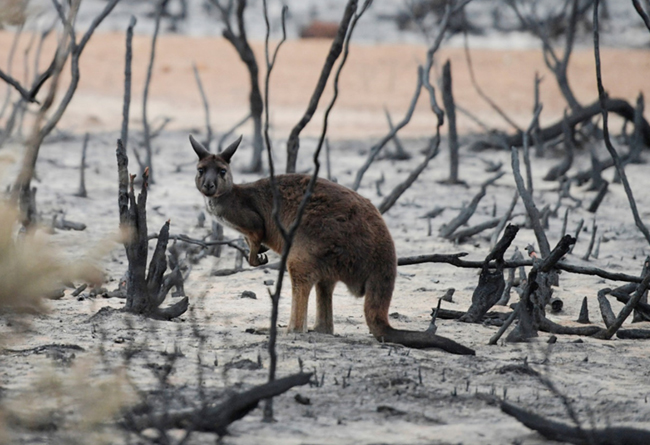
Sydney, Jul 28: Nearly 3 billion koalas, kangaroos and other native Australian animals were killed or displaced by bushfires in 2019 and 2020, a study by the World Wide Fund for Nature (WWF) said on Tuesday, triple the group's earlier estimates.

Some 143 million mammals, 2.46 billion reptiles, 180 million birds and 51 million frogs were impacted by the country's worst bushfires in decades, the WWF said.

When the fires were still blazing, the WWF estimated the number of affected animals at 1.25 billion. The fires destroyed more than 11 million hectares (37 million acres) across the Australian southeast, equal to about half the area of the United Kingdom.

"This ranks as one of the worst wildlife disasters in modern history," said WWF-Australia Chief Executive Officer Dermot O'Gorman in a statement.

The project leader Lily Van Eeden, from the University of Sydney, said the research was the first continent-wide analysis of animals impacted by the bushfires, and "other nations can build upon this research to improve understanding of bushfire impacts everywhere".

The total number included animals which were displaced because of destroyed habitats and now faced lack of food and shelter or the prospect of moving to habitat that was already occupied.

The main reason for raising the number of animal casualties was that researchers had now assessed the total affected area, rather than focusing on the most affected states, they said.

After years of drought made the Australian bush unusually dry, the country battled one of its worst bushfire seasons ever from September 2019 to March 2020, resulting in 34 human deaths and nearly 3,000 homes lost.

Comments

Add new comment

  • Coastaldigest.com reserves the right to delete or block any comments.
  • Coastaldigset.com is not responsible for its readers’ comments.
  • Comments that are abusive, incendiary or irrelevant are strictly prohibited.
  • Please use a genuine email ID and provide your name to avoid reject.
News Network
May 19,2020

May 19: A Chinese laboratory has been developing a drug it believes has the power to bring the coronavirus pandemic to a halt.

The outbreak first emerged in China late last year before spreading across the world, prompting an international race to find treatments and vaccines.

A drug being tested by scientists at China's prestigious Peking University could not only shorten the recovery time for those infected, but even offer short-term immunity from the virus, researchers say.

Sunney Xie, director of the university's Beijing Advanced Innovation Center for Genomics, told AFP that the drug has been successful at the animal testing stage.

"When we injected neutralising antibodies into infected mice, after five days the viral load was reduced by a factor of 2,500," said Xie.

"That means this potential drug has (a) therapeutic effect."

The drug uses neutralising antibodies -- produced by the human immune system to prevent the virus infecting cells -- which Xie's team isolated from the blood of 60 recovered patients.

A study on the team's research, published Sunday in the scientific journal Cell, suggests that using the antibodies provides a potential "cure" for the disease and shortens recovery time.

Xie said his team had been working "day and night" searching for the antibody.

"Our expertise is single-cell genomics rather than immunology or virology. When we realised that the single-cell genomic approach can effectively find the neutralising antibody we were thrilled."

He added that the drug should be ready for use later this year and in time for any potential winter outbreak of the virus, which has infected 4.8 million people around the world and killed more than 315,000.

"Planning for the clinical trial is underway," said Xie, adding it will be carried out in Australia and other countries since cases have dwindled in China, offering fewer human guinea pigs for testing.

"The hope is these neutralised antibodies can become a specialised drug that would stop the pandemic," he said.

China already has five potential coronavirus vaccines at the human trial stage, a health official said last week.

But the World Health Organization has warned that developing a vaccine could take 12 to 18 months.

Scientists have also pointed to the potential benefits of plasma -- a blood fluid -- from recovered individuals who have developed antibodies to the virus enabling the body's defences to attack it.

More than 700 patients have received plasma therapy in China, a process which authorities said showed "very good therapeutic effects".

"However, it (plasma) is limited in supply," Xie said, noting that the 14 neutralising antibodies used in their drug could be put into mass production quickly.

Using antibodies in drug treatments is not a new approach, and it has been successful in treating several other viruses such as HIV, Ebola and Middle East Respiratory Syndrome (MERS).

Xie said his researchers had "an early start" since the outbreak started in China before spreading to other countries.

Ebola drug Remdesivir was considered a hopeful early treatment for COVID-19 -- clinical trials in the US showed it shortened the recovery time in some patients by a third -- but the difference in mortality rate was not significant.

The new drug could even offer short-term protection against the virus.

The study showed that if the neutralising antibody was injected before the mice were infected with the virus, the mice stayed free of infection and no virus was detected.

This may offer temporary protection for medical workers for a few weeks, which Xie said they are hoping to "extend to a few months".

More than 100 vaccines for COVID-19 are in the works globally, but as the process of vaccine development is more demanding, Xie is hoping that the new drug could be a faster and more efficient way to stop the global march of the coronavirus.

"We would be able to stop the pandemic with an effective drug, even without a vaccine," he said.

Comments

Add new comment

  • Coastaldigest.com reserves the right to delete or block any comments.
  • Coastaldigset.com is not responsible for its readers’ comments.
  • Comments that are abusive, incendiary or irrelevant are strictly prohibited.
  • Please use a genuine email ID and provide your name to avoid reject.