


Pak army rejects report on Bajwa's 'read book on India' advice

February 20, 2017

Islamabad, Feb 20: After days of silence, Pakistan Army today dismissed as "disinformation" a media report that said army chief Gen Qamar Javed Bajwa urged officers to read a book about how India succeeded in keeping the military out of politics.
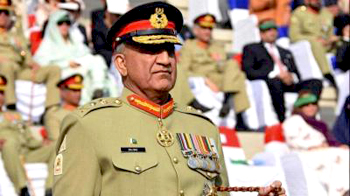
PakarmyThe Nation newspaper reported on February 12 that Bajwa addressed a gathering of senior army officers of Rawalpindi Garrison in the General Headquarters in December and recommended 'Army and Nation: The Military and Indian Democracy Since Independence' written by Steven Wilkinson.

The book provides details of changes made in the structure and recruitment pattern of the Indian Army to suit the fledgling democracy in the new country.

Army Spokesperson Major General Asif Ghafoor issued a brief statement to reject the contents of the report. "News/comments quoting COAS' address to officers at Rawalpindi regarding book 'Army and Nation' is a disinformation," he said in the statement posted on Facebook.

It had been reported that Bajwa in the address dwelt on the thorny issue of civil-military equation in the country where the army has ruled for almost half of the history since independence in 1947.

The report said the new army chief in a poised manner communicated it to his officers in unequivocal terms that there should be cooperation and not competition between army and civilian leadership of the country.

"The army has no business trying to run the government. The army must remain within its constitutionally defined role," Bajwa was quoted as saying. He also urged officers to read Wilkinson's book, according to the report.

Comments

Add new comment

  • Coastaldigest.com reserves the right to delete or block any comments.
  • Coastaldigset.com is not responsible for its readers’ comments.
  • Comments that are abusive, incendiary or irrelevant are strictly prohibited.
  • Please use a genuine email ID and provide your name to avoid reject.
News Network
April 13,2020

Manila, Apr 13: The Asian Development Bank (ADB) on Monday tripled the size of its response to novel coronavirus disease (COVID-19) pandemic to 20 billion dollars and approved measures to streamline its operations for quicker and more flexible delivery of assistance.

The package expands ADB's 6.5 billion dollars initial response announced on March 18, adding 13.5 billion dollars in resources to help ADB's developing member countries counter the severe macroeconomic and health impacts caused by COVID-19.

The 20 billion dollar package includes about 2.5 billion dollars in concessional and grant resources.

"This pandemic threatens to severely set back economic, social, and development gains in Asia and the Pacific, reverse progress on poverty reduction and throw economies into recession," said ADB President Masatsugu Asakawa.

"Our expanded and comprehensive package of assistance, made possible with the strong support of our board, will be delivered more quickly, flexibly and forcefully to the governments and the private sector in our developing member countries to help them address the urgent challenges in tackling the pandemic and economic downturn," he said in a statement.

ADB's most recent assessment released on April 3 estimates the global impact of the pandemic at between 2.3 and 4.8 per cent of gross domestic product. Regional growth is forecast to decline from 5.2 per cent last year to 2.2 per cent in 2020.

The new package includes the establishment of a COVID-19 pandemic response option under ADB's countercyclical support facility.

Up to 13 billion dollars will be provided through this new option to help governments of developing member countries implement effective countercyclical expenditure programs to mitigate impacts of the COVID-19 pandemic, with a particular focus on the poor and the vulnerable.

Grant resources will continue to be deployed quickly for providing medical and personal protective equipment and supplies from expanded procurement sources.

Some 2 billion dollars from the 20 billion dollar package will be made available for the private sector. Loans and guarantees will be provided to financial institutions to rejuvenate trade and supply chains.

Enhanced microfinance loan and guarantee support and a facility to help liquidity-starved small and medium-sized enterprises, including those run by female entrepreneurs, will be implemented alongside direct financing of companies responding to or impacted by COVID-19.

The response package includes a number of adjustments to policies and business processes that will allow ADB to respond more rapidly and flexibly to the crisis. These include measures to streamline internal business processes, widen the eligibility and scope of various support facilities and make the terms and conditions of lending more tailored.

All support under the expanded package will be provided in close collaboration with international organisations, including the International Monetary Fund, World Bank Group, World Health Organisation, UNICEF, other UN agencies and the broader global community.

Comments

Add new comment

  • Coastaldigest.com reserves the right to delete or block any comments.
  • Coastaldigset.com is not responsible for its readers’ comments.
  • Comments that are abusive, incendiary or irrelevant are strictly prohibited.
  • Please use a genuine email ID and provide your name to avoid reject.
Agencies
July 29,2020

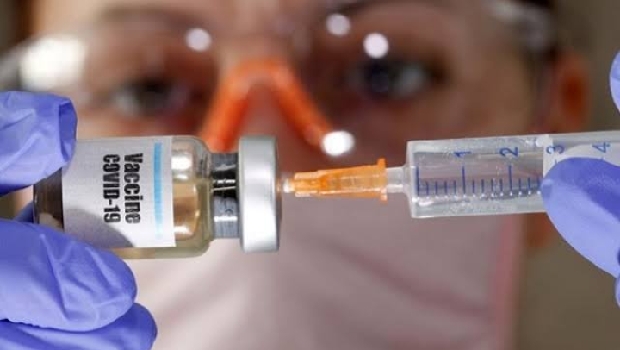
If everything goes as Russia’s expectation, it will be world’s first country to approve a coronavirus vaccine for widespread in the second week of August despite safety and efficacy concerns, according to a report. The adenoviral vector-based vaccine developed by Russian military and government researchers is currently in phase 2 trials.

According to a report from CNN, Russian officials are hoping to get approval for the COVID-19 vaccine developed by the Moscow-based Gamaleya Institute on Agust 10 or even before that. The officials told the outlet that the vaccine will be approved for public use with frontline healthcare workers receiving it first.

“It’s a Sputnik moment,” said Kirill Dmitriev, head of Russia’s sovereign wealth fund, which is financing Russian vaccine research, referring to the successful 1957 launch of the world’s first satellite by the Soviet Union, according to CNN.

“Americans were surprised when they heard Sputnik’s beeping. It’s the same with this vaccine. Russia will have got there first,” he was quoted as saying.

However, Russia is yet to release the scientific data on its coronavirus vaccine trials, hence, questions remain about the safety and efficacy of the vaccine, said the report. The vaccine is in the second phase of testing with developers planning to launch the phase 3 trials sometime after August 3.

Earlier, Interfax reported, citing Health Minister Mikhail Murashko, that the vaccine will be widely used in parallel with phase 3 trials. He said the country plans to vaccinate medics who are at high-risk for COVID-19 next month before clinical trials are completed.

Murashko added that individuals at higher risk of getting infected with the coronavirus such as older people or those with health conditions will also be prioritised for the vaccine, although he did not estimate or reveal when that would happen. The minister added 800 people will be recruited for the phase 3 trials.

Meanwhile, health officials were more cautious considering the fact that human testing of the vaccine is incomplete, and the state registration is expected to begin after August 3, reported The Moscow Times.

On Monday, Moderna and Pfizer announced the commencement of the final phase 3 trials of their candidate vaccines against the SARS-CoV-2 virus, which has so far claimed at least 654,477 lives and infected 16,514,500 people worldwide. 

Researchers will recruit up to 30,000 volunteers in separate trials both backed by the US government. India's first indigenous coronavirus vaccine, COVAXIN, is undergoing phase 1 human clinical trials across the country. More than 150 COVID-19 vaccines are being developed all over the world with at least six candidates already in late-stage clinical trials.

Comments

Add new comment

  • Coastaldigest.com reserves the right to delete or block any comments.
  • Coastaldigset.com is not responsible for its readers’ comments.
  • Comments that are abusive, incendiary or irrelevant are strictly prohibited.
  • Please use a genuine email ID and provide your name to avoid reject.
Agencies
February 29,2020

Islamabad, Feb 29: A coalition comprising digital media giants Facebook, Google and Twitter (among others) have spoken out against the new regulations approved by the Pakistani government for social media, threatening to suspend services in the country if the rules were not revised, it was reported.

In a letter to Prime Minster Imran Khan earlier this month, the Asia Internet Coalition (AIC) called on his government to revise the new sets of rules and regulations for social media, The News International reported on Friday.

"The rules as currently written would make it extremely difficult for AIC Members to make their services available to Pakistani users and businesses," reads the letter, referring to the Citizens Protection Rules (Against Online Harm).

The new set of regulations makes it compulsory for social media companies to open offices in Islamabad, build data servers to store information and take down content upon identification by authorities.

Failure to comply with the authorities in Pakistan will result in heavy fines and possible termination of services.

It said that the regulations were causing "international companies to re-evaluate their view of the regulatory environment in Pakistan, and their willingness to operate in the country".

Referring to the rules as "vague and arbitrary in nature", the AIC said that it was forcing them to go against established norms of user privacy and freedom of expression.

"We are not against regulation of social media, and we acknowledge that Pakistan already has an extensive legislative framework governing online content. However, these Rules fail to address crucial issues such as internationally recognized rights to individual expression and privacy," The News International quoted the letter as saying.

According to the law, authorities will be able to take action against Pakistanis found guilty of targeting state institutions at home and abroad on social media.

The law will also help the law enforcement authorities obtain access to data of accounts found involved in suspicious activities.

It would be the said authority's prerogative to identify objectionable content to the social media platforms to be taken down.

In case of failure to comply within 15 days, it would have the power to suspend their services or impose a fine worth up to 500 million Pakistani rupees ($3 million).

Comments

Add new comment

  • Coastaldigest.com reserves the right to delete or block any comments.
  • Coastaldigset.com is not responsible for its readers’ comments.
  • Comments that are abusive, incendiary or irrelevant are strictly prohibited.
  • Please use a genuine email ID and provide your name to avoid reject.