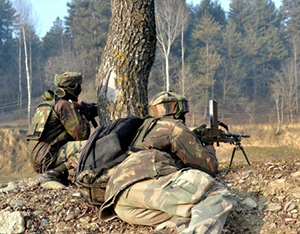
Pak claims killing 11 Indian soldiers at LoC

November 17, 2016

Islamabad, Nov 17: Pakistan Army Chief General Raheel Sharif today claimed that his troops killed at least 11 Indian jawans the day seven Pakistani soldiers were killed in firing by Indian troops across the Line of Control (LoC)army

General Raheel said this in an informal chat with journalists in the President House where a banquet was organised by the President in honour of visiting Turkish President.

"The day seven of our soldiers were martyred on the border, we killed at least 11 Indian soldiers," he claimed.

He claimed that Pakistan has killed "40-44 Indian troops" in the current clashes but the Indian army was refusing to accept and own its casualties. General Raheel said India should "show courage" and own the deaths of its security personnel."The Indian army should man up and accept their losses," he said.

He said Pakistan army was professional force and was accepting its "casualties" while giving befitting response to "unprovoked" firing.

The army chief, who is set to retire later this month, said a message has been conveyed to Prime Minister Narendra Modi that his "aggressive actions" will not bear any results.

Pakistan had claimed that seven of its soldiers were killed at the LoC in an alleged ceasefire violation by Indian troops on November 13.

It was a rare direct media talk by the Pakistani COAS who normally avoids media and lets the media wing of army to interact with journalists.

Comments

Add new comment

  • Coastaldigest.com reserves the right to delete or block any comments.
  • Coastaldigset.com is not responsible for its readers’ comments.
  • Comments that are abusive, incendiary or irrelevant are strictly prohibited.
  • Please use a genuine email ID and provide your name to avoid reject.
News Network
February 24,2020

Beijing, Feb 24: The lockdown of Guo Jing's neighbourhood in Wuhan -- the city at the heart of China's new coronavirus epidemic -- came suddenly and without warning.

Unable to go out, the 29-year-old is now sealed inside her compound where she has to depend on online group-buying services to get food.

"Living for at least another month isn't an issue," Guo told news agency, explaining that she had her own stash of pickled vegetables and salted eggs.

But what scares her most is the lack of control -- first, the entire city was sealed off, and then residents were limited to exiting their compound once every three days.

Now even that has been taken away.

Guo is among some 11 million residents in Wuhan, a city in central Hubei province that has been under effective quarantine since January 23 as Chinese authorities race to contain the epidemic.

Since then, its people have faced a number of tightening controls over daily life as the death toll from the virus swelled to over 2,500 in China alone.

But the new rules this month barring residents from leaving their neighbourhoods are the most restrictive yet -- and for some, threaten their livelihoods.

"I still don't know where to buy things once we've finished eating what we have at home," said Pan Hongsheng, who lives with his wife and two children.

Some neighbourhoods have organised group-buying services, where supermarkets deliver orders in bulk.

But in Pan's community, "no one cares".

"The three-year-old doesn't even have any milk powder left," Pan told news agency, adding that he has been unable to send medicine to his in-laws -- both in their eighties -- as they live in a different area.

"I feel like a refugee."

The "closed management of neighbourhoods is bound to bring some inconvenience to the lives of the people", Qian Yuankun, vice secretary of Hubei's Communist Party committee, said at a press briefing last week.

Authorities on Monday allowed healthy non-residents of the city to leave if they never had contact with patients, but restrictions remained on those who live in Wuhan.

Demand for group-buying food delivery services has rocketed with the new restrictions, with supermarkets and neighbourhood committees scrambling to fill orders.

Most group-buying services operate through Chinese messaging app WeChat, which has ad-hoc chat groups for meat, vegetables, milk -- even "hot dry noodles", a famous Wuhan dish.

More sophisticated shops and compounds have their own mini-app inside WeChat, where residents can choose packages priced by weight before orders are sent in bulk to grocery stores.

In Guo's neighbourhood, for instance, a 6.5-kilogramme (14.3-pound) set of five vegetables, including potatoes and baby cabbage, costs 50 yuan ($7.11).

"You have no way to choose what you like to eat," Guo said. "You cannot have personal preferences anymore."

The group-buying model is also more difficult for smaller communities to adopt, as supermarkets have minimum order requirements for delivery.

"To be honest, there's nothing we can do," said Yang Nan, manager of Lao Cun Zhang supermarket, which requires a minimum of 30 orders.

"We only have four cars," she said, explaining that the store did not have the staff to handle smaller orders.

Another supermarket told AFP it capped its daily delivery load to 1,000 orders per day.

"Hiring staff is difficult," said Wang Xiuwen, who works at the store's logistics division, adding that they are wary about hiring too many outsiders for fear of infection.

Closing off communities has split the city into silos, with different neighbourhoods rolling out controls of varying intensity.

In some compounds, residents have easier access to food -- albeit a smaller selection than normal -- and one woman said her family pays delivery drivers to run grocery errands.

Her compound has not been sealed off either, the 24-year-old told AFP under condition of anonymity, though they are limited to one person leaving at a time.

Some districts have implemented their own rules, such as prohibiting supermarkets from selling to individuals, forcing neighbourhoods to buy in bulk or not at all.

"In the neighbourhood where I live, the reality is really terrible," said David Dai, who is based on the outskirts of Wuhan.

Though his apartment complex has organised group-buying, Dai said residents were unhappy with price and quality.

"A lot of tomatoes, a lot of onions -- they were already rotten," he told , estimating over a third of the food had to be thrown away.

His family must "totally depend" on themselves, added the 49-year-old, who has resorted to saving and drying turnip skins to add nutrients to future meals.

The uncertainty of not knowing when the controls will be lifted is also frustrating, said Ma Chen, a man in his 30s who lives alone.

"I have no way of knowing how much (food) I should buy."

Comments

Add new comment

  • Coastaldigest.com reserves the right to delete or block any comments.
  • Coastaldigset.com is not responsible for its readers’ comments.
  • Comments that are abusive, incendiary or irrelevant are strictly prohibited.
  • Please use a genuine email ID and provide your name to avoid reject.
News Network
June 10,2020

Islamabad, Jun 10: The World Health Organization has told Pakistan it should implement "intermittent" lockdowns to counter a surge in coronavirus infections that has come as the country loosens restrictions, officials said.

Since the start of Pakistan's outbreak in March, Prime Minister Imran Khan opposed a nationwide lockdown of the sort seen elsewhere, arguing the impoverished country could not afford it.

Instead, Pakistan's four provinces ordered a patchwork of closures, but last week Khan said most of these restrictions would be lifted.

Health officials on Wednesday declared a record number of new cases in the past 24 hours. The country has now confirmed a total of more than 113,000 cases and 2,200 deaths -- though with testing still limited, real rates are thought to be much higher.

"As of today, Pakistan does not meet any of the pre-requisite conditions for opening the lockdown", the WHO said in a letter confirmed by Pakistan officials on Tuesday.

Many people have not adopted behavioural changes such as social distancing and frequent hand-washing, meaning "difficult" decisions will be required including "intermittent lockdowns" in targeted areas, the letter states.

Some 25 percent of tests in Pakistan come back positive for COVID-19, the WHO said, indicating high levels of infection in the general population.

The health body recommended an intermittent lockdown cycle of two weeks on, two weeks off.

Responding to the WHO's letter, Zafar Mirza, the prime minister's special advisor for health, said the country had "consciously but gradually" eased lockdowns while enforcing guidelines in shops, mosques and public transport.

"We have to make tough policy choices to strike a balance between lives and livelihoods," Mirza said Wednesday.

Punjab's provincial health minister Yasmin Rashid, who received the WHO's letter, said the provincial government had already given "orders to take strict action against those violating" virus guidelines.

Hospitals across Pakistan say they are at or near capacity, and some are turning COVID-19 patients away.

WHO Director-General Tedros Adhanom Ghebreyesus said Monday that 136,000 cases had been reported in the previous 24 hours, "the most in a single day so far", with the majority of them in South Asia and the Americas.

Comments

Add new comment

  • Coastaldigest.com reserves the right to delete or block any comments.
  • Coastaldigset.com is not responsible for its readers’ comments.
  • Comments that are abusive, incendiary or irrelevant are strictly prohibited.
  • Please use a genuine email ID and provide your name to avoid reject.
News Network
May 29,2020

Karachi, May 29: Investigators and rescue officials have found around Rs 3 crore in cash in the wreckage of the Pakistan International Airlines' aircraft that crashed wth 99 people on board, killing 97 people, including nine children.

Flight PK-8303 from Lahore to Karachi crashed in a residential area near Karachi International Airport on Friday, with only two passengers miraculously surviving the crash.

Investigators and rescue officials have found currencies of different countries and denominations worth around Rs 30 million from the aircraft's wreckage, an official said on Thursday.

"An investigation has been ordered into how such a huge amount of cash got through airport security and baggage scanners and found its way into the ill-fated flight," the official said.

He said that the amount was recovered from two bags in the wreckage.

"The process of identifying the bodies and their luggage which will be handed over to their families and relatives is going on," he said.

A total of 97 people including the aircraft crew died in the crash, one of the most catastrophic aviation disasters in Pakistan's history.

A government official said on Thursday that the identification of 47 bodies had been completed, while 43 bodies were handed over for burial.

Friday's accident was the first major aircraft crash in Pakistan after December 7, 2016 when a PIA ATR-42 aircraft from Chitral to Islamabad crashed midway. The crash claimed the lives of all 48 passengers and crew, including singer-cum-evangelist Junaid Jamshed.

Comments

Add new comment

  • Coastaldigest.com reserves the right to delete or block any comments.
  • Coastaldigset.com is not responsible for its readers’ comments.
  • Comments that are abusive, incendiary or irrelevant are strictly prohibited.
  • Please use a genuine email ID and provide your name to avoid reject.