


Pakistan in mourning as Peshawar buries its children

December 17, 2014

Peshawar, December 17: Pakistan woke up to a day of mourning on Wednesday after Taliban militants killed 132 students at a school in the city of Peshawar in a grisly attack which shocked the nation and put pressure on the government to do more to tackle the insurgency.Pakistan
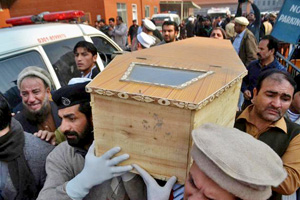
People around the country lit candles and staged overnight vigils as parents prepared to bury their children during mass funerals in and around Peshawar — a big, volatile city on the edge of Pakistan's lawless tribal belt.

Pakistanis may be used to almost daily militant attacks against the security forces but an outright assault on children stunned the country, prompting commentators to call for a tough military response.

In Peshawar, the vast grounds of the military-run Army Public School were all but deserted, with a handful of snipers manning the roofs of its pink brick-and-stone buildings.

Army vehicles and soldiers wearing face masks and carrying automatic rifles were deployed by the entrance.

A day after the attack, Peshawar appeared subdued and many were still in shock, recalling the gruesome events and trying to soothe each other. More details of the well-organised attack emerged as witnesses came forward with their stories.

“The attackers came around 10.30 a.m. on a pickup van,” said Issam Uddin, a 25-year-old school bus driver.

“They drove it around the back of the school and set it on fire to block the way. Then they went to Gate 1 and killed a soldier, a gatekeeper and a gardener. Firing began and the first suicide attack took place.”

The government of Prime Minister Nawaz Sharif has announced a three-day mourning period but people's anxiety focused on what the authorities can do to protect the country.

Mr. Sharif came to power last year promising to negotiate peace with the Pakistani Taliban — but those efforts failed this year, weakening his position and prompting the Army to launch an air-and-ground operation against insurgents along the Afghan border.

The military staged more air strikes against Taliban positions there late on Tuesday, a security source said, but it was unclear whether it was done in response to the school attack.

GOOD AND BAD TALIBAN

Yet, despite the well-publicised crackdown, the military has long been accused of being too lenient towards Islamist militants who critics say are used to carry out the Army's bidding in places like Jammu and Kashmir and Afghanistan.

The military denies the accusations.

“People will have to stop equivocating and come together in the face of national tragedy,” said Sherry Rehman, a former ambassador to the United States and an opposition politician.

“There have been national leaders who had been apologetic about the Taliban, who have not named the Taliban in their speeches.”

The Pakistani Taliban, who are fighting to impose strict Islamic rule in Pakistan, are holed up in the inaccessible mountains straddling the Pakistan-Afghanistan border.

They are allied with the Afghan Taliban as well as al-Qaeda and other foreign fighters, and Pakistan has long accused Afghanistan of not doing enough to crack down on their bases.

Afghanistan, for its part, blames Pakistan for allowing militant groups such as the Afghan Taliban and the Haqqani network to operate freely on its territory and stage attacks in Afghanistan.

Pakistan's Army chief was expected to visit Afghanistan on Wednesday for what is likely to be a day of uneasy talks with his Afghan counterparts on how to tackle the insurgency.

Pakistan's Dawn newspaper quoted a source as saying that the militants were acting on direct orders from their handlers in Afghanistan and that prominent Taliban commander Umar Naray was the ultimate mastermind of the attack.

Speaking late on Tuesday, Army spokesman Major General Asim Saleem Bajwa hinted at that without naming Afghanistan.

“When these militants reached the school ... we found out which group was involved, who they were talking to, from where the operation was being controlled,” he said. “God willing, in coming two-four days you will get to know.”

Comments

Add new comment

  • Coastaldigest.com reserves the right to delete or block any comments.
  • Coastaldigset.com is not responsible for its readers’ comments.
  • Comments that are abusive, incendiary or irrelevant are strictly prohibited.
  • Please use a genuine email ID and provide your name to avoid reject.
News Network
April 29,2020

Apr 29: US President Donald Trump doubled down on China for failing to tame the coronavirus at its very origin, saying it has led to 184 countries "going through hell", as several American lawmakers demanded steps to reduce dependence on Beijing for manufacturing and minerals.

Trump has been publicly blaming China for the global spread of the "invisible enemy" and launched an investigation against it. He has also indicated that the US may be looking at "a lot more money" in damages from China than the USD 140 billion being sought by Germany from Beijing for the pandemic.

Leaders of the US, the UK and Germany believe that the deaths and the destruction of the global economy could have been avoided, had China shared the information about the virus in its early phases.

"It's in 184 countries, as you hear me say often. It's hard to believe. It's inconceivable," Trump told reporters at White House Tuesday. "It should have been stopped at the source, which was China. It should have been stopped very much at the source, but it wasn't. And now we have 184 countries going through hell.”

The virus, which originated in China's Wuhan city in mid-November, has killed more than two lakh people and infected over three million globally. The largest number of them are in the US: nearly 59,000 deaths and over one million infections.

The massive outbreak in the US has put Trump under increasing pressure from American lawmakers to decrease US dependence on Beijing and they have also sought compensation from China.

Senator Ted Cruz and his colleagues have urged Defence Secretary Mark Esper and Interior Secretary David Bernhardt to support the development of a fully domestic supply chain of rare earths and other minerals that are critical for manufacturing defence technologies and supporting national security.

“It is clear that our dependence on China for vital rare earths threatens our US manufacturing and defence-industrial base. As the October 2018 Defence Industrial Base Report states: ‘China represents a significant and growing risk to the supply of materials deemed strategic and critical to US national security.' [...] Ensuring a US supply of domestically sourced rare earths will reduce our vulnerability to supply disruptions that poses a grave risk to our military readiness," the Senators wrote.

The US is 100 percent import-dependent for rare earths as well as 13 other metals and minerals on the US Government Critical Minerals List and more than 75 percent import reliant for an additional 10 minerals.

Congressman Brian Mast on Tuesday introduced a legislation to hold China accountable for its "coronavirus deception". The resolution would empower the US to withhold payments on debts owed to China equal to the costs incurred by the US in response to COVID-19.

“China's total lack of transparency and mishandling of the coronavirus outbreak has cost tens of thousands of lives, millions of jobs and left untold economic destruction. Congress must hold China accountable for their cover-up and force them to pay back the taxpayer dollars that have been spent as a result,” Mast said.

Cruz, member of the Senate Foreign Relations Committee, announced his intention to introduce a legislation to cut off Hollywood studios from assistance they receive from the Department of Defence if those studios censor their films for screening in China.

This legislation is part of Sen. Cruz's comprehensive push to combat China's growing influence over what Americans see and hear, which includes legislation targeting information warfare from the Chinese Communist Party across higher education, sports, films, radio broadcasts, and more.

Indian-American Congressman Ami Bera and Congressman Ted S. Yoho, both members of the House Foreign Affairs Committee, will lead a bipartisan virtual Special Order to highlight the importance of US global leadership during the COVID-19 pandemic.

“If we abdicate our place as a leader in global health, there is another country eager to take the reins. China has not been subtle in asserting itself on global health issues, and often not for the benefit of other nations. China's recent coronavirus debacle should be evidence enough that their communist regime cannot be trusted to lead with accountability, transparency, or pragmatism, traits that are essential when fighting widespread disease,” Yoho said.

“As for how China would fare as a global health leader, look no further than the disastrous initial response by the WHO to coronavirus, one that was clearly influenced by Beijing. Information was slow-walked, warnings from nations like Taiwan were ignored at crucial turning points, and cooperation with outside health experts was spurned until it was too late. And it has resulted in the largest public health disaster the world has seen in over a century,” he said.

In an interview to Fox News, Senator Marco Rubio alleged that if China had acted when those warnings were being made, instead of silencing the people that were talking about it, they could have limited the spread.

“So there was no doubt that that was a deliberate decision made on their part. The one way to hold them accountable is to do what we should be doing anyway. That is moving the means of production to become less and less dependent upon them. What you're going to see after this pandemic is that more and more countries are going to prioritize their healthcare manufacturing capabilities and other industries,” he said.

Comments

Add new comment

  • Coastaldigest.com reserves the right to delete or block any comments.
  • Coastaldigset.com is not responsible for its readers’ comments.
  • Comments that are abusive, incendiary or irrelevant are strictly prohibited.
  • Please use a genuine email ID and provide your name to avoid reject.
News Network
March 30,2020

Mar 30: Thomas Schaefer, the finance minister of Germany's Hesse state, has committed suicide apparently after becoming "deeply worried" over how to cope with the economic fallout from the coronavirus, state premier Volker Bouffier said Sunday.

Schaefer, 54, was found dead near a railway track on Saturday. The Wiesbaden prosecution's office said they believe he died by suicide.

"We are in shock, we are in disbelief and above all we are immensely sad," Bouffier said in a recorded statement.

Hesse is home to Germany's financial capital Frankfurt, where major lenders like Deutsche Bank and Commerzbank have their headquarters. The European Central Bank is also located in Frankfurt.

A visibly shaken Bouffier recalled that Schaefer, who was Hesse's finance chief for 10 years, had been working "day and night" to help companies and workers deal with the economic impact of the pandemic.

"Today we have to assume that he was deeply worried," said Bouffier, a close ally of Chancellor Angela Merkel.

"It's precisely during this difficult time that we would have needed someone like him," he added.

Popular and well-respected, Schaefer had long been touted as a possible successor to Bouffier.

Like Bouffier, Schaefer belonged to Merkel's centre-right CDU party.

He leaves behind a wife and two children.

Comments

Add new comment

  • Coastaldigest.com reserves the right to delete or block any comments.
  • Coastaldigset.com is not responsible for its readers’ comments.
  • Comments that are abusive, incendiary or irrelevant are strictly prohibited.
  • Please use a genuine email ID and provide your name to avoid reject.
Agencies
July 2,2020

Moscow, Jul 2: Russian voters approved changes to the constitution that will allow President Vladimir Putin to hold power until 2036, but the weeklong plebiscite that concluded Wednesday was tarnished by widespread reports of pressure on voters and other irregularities.

With most of the nation's polls closed and 20% of precincts counted, 72% voted for the constitutional amendments, according to election officials.

For the first time in Russia, polls were kept open for a week to bolster turnout without increasing crowds casting ballots amid the coronavirus pandemic a provision that Kremlin critics denounced as an extra tool to manipulate the outcome.

A massive propaganda campaign and the opposition's failure to mount a coordinated challenge helped Putin get the result he wanted, but the plebiscite could end up eroding his position because of the unconventional methods used to boost participation and the dubious legal basis for the balloting.

By the time polls closed in Moscow and most other parts of Western Russia, the overall turnout was at 65%, according to election officials. In some regions, almost 90% of eligible voters cast ballots.

On Russia's easternmost Chukchi Peninsula, nine hours ahead of Moscow, officials quickly announced full preliminary results showing 80% of voters supported the amendments, and in other parts of the Far East, they said over 70% of voters backed the changes.

Kremlin critics and independent election observers questioned the turnout figures.

We look at neighboring regions, and anomalies are obvious there are regions where the turnout is artificially (boosted), there are regions where it is more or less real, Grigory Melkonyants, co-chair of the independent election monitoring group Golos, told The Associated Press.

Putin voted at a Moscow polling station, dutifully showing his passport to the election worker. His face was uncovered, unlike most of the other voters who were offered free masks at the entrance.

The vote completes a convoluted saga that began in January, when Putin first proposed the constitutional changes.

He offered to broaden the powers of parliament and redistribute authority among the branches of government, stoking speculation he might seek to become parliamentary speaker or chairman of the State Council when his presidential term ends in 2024.

His intentions became clear only hours before a vote in parliament, when legislator Valentina Tereshkova, a Soviet-era cosmonaut who was the first woman in space in 1963, proposed letting him run two more times.

The amendments, which also emphasize the primacy of Russian law over international norms, outlaw same-sex marriages and mention a belief in God as a core value, were quickly passed by the Kremlin-controlled legislature.

Putin, who has been in power for more than two decades longer than any other Kremlin leader since Soviet dictator Josef Stalin said he would decide later whether to run again in 2024.

He argued that resetting the term count was necessary to keep his lieutenants focused on their work instead of darting their eyes in search for possible successors.

Analyst Gleb Pavlovsky, a former Kremlin political consultant, said Putin's push to hold the vote despite the fact that Russia has thousands of new coronavirus infections each day reflected his potential vulnerabilities.

Putin lacks confidence in his inner circle and he's worried about the future, Pavlovsky said.

He wants an irrefutable proof of public support.

Even though the parliament's approval was enough to make it law, the 67-year-old Russian president put his constitutional plan to voters to showcase his broad support and add a democratic veneer to the changes.

But then the coronavirus pandemic engulfed Russia, forcing him to postpone the April 22 plebiscite.

The delay made Putin's campaign blitz lose momentum and left his constitutional reform plan hanging as the damage from the virus mounted and public discontent grew.

Plummeting incomes and rising unemployment during the outbreak have dented his approval ratings, which sank to 59%, the lowest level since he came to power, according to the Levada Center, Russia's top independent pollster.

Moscow-based political analyst Ekaterina Schulmann said the Kremlin had faced a difficult dilemma: Holding the vote sooner would have brought accusations of jeopardizing public health for political ends, while delaying it raised the risks of defeat.

Holding it in the autumn would have been too risky, she said.

In Moscow, several activists briefly lay on Red Square, forming the number 2036 with their bodies in protest before police stopped them.

Some others in Moscow and St. Petersburg staged one-person pickets and police didn't intervene.

Several hundred opposition supporters rallied in central Moscow to protest the changes, defying a ban on public gatherings imposed for the coronavirus outbreak. Police didn't intervene and even handed masks to the participants.

Authorities mounted a sweeping effort to persuade teachers, doctors, workers at public sector enterprises and others who are paid by the state to cast ballots. Reports surfaced from across the vast country of managers coercing people to vote.

The Kremlin has used other tactics to boost turnout and support for the amendments.

Comments

Add new comment

  • Coastaldigest.com reserves the right to delete or block any comments.
  • Coastaldigset.com is not responsible for its readers’ comments.
  • Comments that are abusive, incendiary or irrelevant are strictly prohibited.
  • Please use a genuine email ID and provide your name to avoid reject.