


Pakistan in mourning as Peshawar buries its children

December 17, 2014

Peshawar, December 17: Pakistan woke up to a day of mourning on Wednesday after Taliban militants killed 132 students at a school in the city of Peshawar in a grisly attack which shocked the nation and put pressure on the government to do more to tackle the insurgency.Pakistan
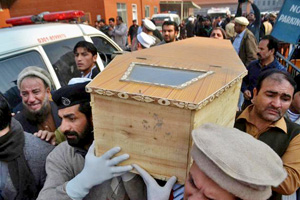
People around the country lit candles and staged overnight vigils as parents prepared to bury their children during mass funerals in and around Peshawar — a big, volatile city on the edge of Pakistan's lawless tribal belt.

Pakistanis may be used to almost daily militant attacks against the security forces but an outright assault on children stunned the country, prompting commentators to call for a tough military response.

In Peshawar, the vast grounds of the military-run Army Public School were all but deserted, with a handful of snipers manning the roofs of its pink brick-and-stone buildings.

Army vehicles and soldiers wearing face masks and carrying automatic rifles were deployed by the entrance.

A day after the attack, Peshawar appeared subdued and many were still in shock, recalling the gruesome events and trying to soothe each other. More details of the well-organised attack emerged as witnesses came forward with their stories.

“The attackers came around 10.30 a.m. on a pickup van,” said Issam Uddin, a 25-year-old school bus driver.

“They drove it around the back of the school and set it on fire to block the way. Then they went to Gate 1 and killed a soldier, a gatekeeper and a gardener. Firing began and the first suicide attack took place.”

The government of Prime Minister Nawaz Sharif has announced a three-day mourning period but people's anxiety focused on what the authorities can do to protect the country.

Mr. Sharif came to power last year promising to negotiate peace with the Pakistani Taliban — but those efforts failed this year, weakening his position and prompting the Army to launch an air-and-ground operation against insurgents along the Afghan border.

The military staged more air strikes against Taliban positions there late on Tuesday, a security source said, but it was unclear whether it was done in response to the school attack.

GOOD AND BAD TALIBAN

Yet, despite the well-publicised crackdown, the military has long been accused of being too lenient towards Islamist militants who critics say are used to carry out the Army's bidding in places like Jammu and Kashmir and Afghanistan.

The military denies the accusations.

“People will have to stop equivocating and come together in the face of national tragedy,” said Sherry Rehman, a former ambassador to the United States and an opposition politician.

“There have been national leaders who had been apologetic about the Taliban, who have not named the Taliban in their speeches.”

The Pakistani Taliban, who are fighting to impose strict Islamic rule in Pakistan, are holed up in the inaccessible mountains straddling the Pakistan-Afghanistan border.

They are allied with the Afghan Taliban as well as al-Qaeda and other foreign fighters, and Pakistan has long accused Afghanistan of not doing enough to crack down on their bases.

Afghanistan, for its part, blames Pakistan for allowing militant groups such as the Afghan Taliban and the Haqqani network to operate freely on its territory and stage attacks in Afghanistan.

Pakistan's Army chief was expected to visit Afghanistan on Wednesday for what is likely to be a day of uneasy talks with his Afghan counterparts on how to tackle the insurgency.

Pakistan's Dawn newspaper quoted a source as saying that the militants were acting on direct orders from their handlers in Afghanistan and that prominent Taliban commander Umar Naray was the ultimate mastermind of the attack.

Speaking late on Tuesday, Army spokesman Major General Asim Saleem Bajwa hinted at that without naming Afghanistan.

“When these militants reached the school ... we found out which group was involved, who they were talking to, from where the operation was being controlled,” he said. “God willing, in coming two-four days you will get to know.”

Comments

Add new comment

  • Coastaldigest.com reserves the right to delete or block any comments.
  • Coastaldigset.com is not responsible for its readers’ comments.
  • Comments that are abusive, incendiary or irrelevant are strictly prohibited.
  • Please use a genuine email ID and provide your name to avoid reject.
Agencies
July 9,2020

The new visa regulations requiring international students in the US with an F-1 visa to take at least one in-person course or face the prospect of deportation is likely to "cause uncertainties and difficulties" for some students, the Indian Embassy has said.

"These new modifications at a time when many of the US universities and colleges are yet to announce their plans for the new academic year are likely to cause uncertainties and difficulties for some Indian students wishing to pursue their studies in the US," said a spokesperson of the Indian Embassy.

Responding to media queries, the spokesperson said the Indian government has taken up the matter with concerned US officials.

At the India US Foreign Office Consultations held on July 7, Foreign Secretary Harsh Vardhan Shringla conveyed India's concerns on the matter to Under Secretary of State for Political Affairs David Hale.

According to a recent report of Student and Exchange Visitor Program (SEVP), there were 1,94,556 Indian students enrolled in various academic institutions of the US in January this year. Of these 1,26,132 were males and 68,405 were females.

Noting that partnership in higher education is a key component of the strong people-to-people ties between India and the US, the spokesperson said in the last two decades Indian students in American universities and colleges have been the harbingers of a strong partnership between technology and innovation sectors between the two countries.

The spokesperson hoped that the US authorities would provide adequate flexibility in their visa rule, keeping in mind the extraordinary circumstances created by the COVID-19 pandemic for the Indian students community.

We continue to engage all the stakeholders in the matters, including the US administration officials, Congressional leaders, universities and colleges as well as the Indian students community in the US as we move forward towards the 2020-21 academic year to further strengthen our bilateral partnership in higher education, the spokesperson said.

Announced by the SEVP on July 6, the new rules provide temporary exemptions for nonimmigrant students on F-1 and M-1 visas taking online classes due to the COVID-19 pandemic for the fall semester of the 2020 academic year.

While these modifications do provide some flexibility for US universities and colleges to adopt a hybrid model -- that is a mixture of online and in person classes -- they also restrict international students on F-1 and M-1 visas from taking courses entirely online, the spokesperson said.

Comments

Add new comment

  • Coastaldigest.com reserves the right to delete or block any comments.
  • Coastaldigset.com is not responsible for its readers’ comments.
  • Comments that are abusive, incendiary or irrelevant are strictly prohibited.
  • Please use a genuine email ID and provide your name to avoid reject.
News Network
January 21,2020

Beijing, Jan 21: The Chinese official investigating a pneumonia outbreak stemming from a new coronavirus said the disease can spread from person to person but can be halted with increased vigilance, as authorities on Tuesday confirmed a fourth death.

Zhong Nanshan said there was no danger of a repeat of the Severe Acute Respiratory Syndrome (SARS) epidemic that killed nearly 800 people globally during a 2002-2003 outbreak, which started in China, as long as precautions were taken.

"It took only two weeks to identify the novel coronavirus," state news agency Xinhua quoted Zhong as saying late on Monday.

The outbreak was still in its early stages and China had good surveillance and quarantine systems to help control it, he added.

The outbreak has spread from the central city of Wuhan to cities including Beijing and Shanghai, with more than 200 cases reported so far. Four cases have been reported outside China - in South Korea, Thailand and Japan.

Australia on Tuesday said it would screen passengers on flights from Wuhan amid rising concerns that the virus will spread globally as Chinese travellers take flights abroad for the Lunar New Year holiday starting this week.

Authorities around the globe, including in the United States and many Asian countries, have stepped up screening of travellers from Wuhan.

Chinese authorities confirmed a total of 217 cases of the virus in China as of 6 p.m. (1000 GMT) on Monday, state television reported, 198 of which were in Wuhan.

A fourth person died on Jan. 19, the Wuhan Municipal Health Commission said. The 89-year-old man, who had underlying health diseases including coronary heart disease, developed symptoms on Jan. 13 and was admitted to hospital five days later, it added.

Zhong, who is renowned in China for his work fighting SARS in 2003, confirmed that the virus can pass from person-to-person.

Fifteen medical workers in Wuhan had been diagnosed with pneumonia, with one other suspected case, the Wuhan Municipal Health Commission said. Of the infected staff, one was in critical condition.

In Shanghai, officials on Tuesday confirmed a second case involving a 35-year-man who had visited Wuhan in early January, and said they were monitoring four other suspected cases.

The virus causes a type of pneumonia and belongs to the same family of coronaviruses as SARS. Symptoms include fever and difficulty in breathing, which are similar to many other respiratory diseases and pose complications for screening efforts.

The World Health Organisation (WHO) said on Monday an animal source appeared most likely to be the primary origin of the outbreak and that some "limited human-to-human transmission" occurred between close contacts.

The Geneva-based U.N. agency convened an emergency committee for Wednesday to assess whether the outbreak constitutes an international health emergency and what measures should be taken to manage it.

So far, the WHO has not recommended trade or travel restrictions, but a panel of independent experts could do so or make other recommendations to limit spread.

Comments

Add new comment

  • Coastaldigest.com reserves the right to delete or block any comments.
  • Coastaldigset.com is not responsible for its readers’ comments.
  • Comments that are abusive, incendiary or irrelevant are strictly prohibited.
  • Please use a genuine email ID and provide your name to avoid reject.
News Network
February 4,2020

Kuala Lumpur, Feb 4: Malaysia said on Tuesday that India's move to cut back on palm oil purchases is "temporary" and will be resolved amicably between the two nations.

Last month, India restricted imports of refined palm oil and asked importers to avoid purchases from Malaysia after its criticism of actions in Kashmir and a new citizenship law.

"Having long-standing bilateral ties, the two nations will overcome the current challenges, and prevail towards mutual and beneficial outcomes," the Malaysian Palm Oil Council said in a statement, citing Primary Industries Minister Teresa Kok.

Malaysia's push to implement B20 biodiesel starting this month will also help sustain high crude palm oil prices, the statement read.

Comments

Add new comment

  • Coastaldigest.com reserves the right to delete or block any comments.
  • Coastaldigset.com is not responsible for its readers’ comments.
  • Comments that are abusive, incendiary or irrelevant are strictly prohibited.
  • Please use a genuine email ID and provide your name to avoid reject.