


Pakistan in mourning as Peshawar buries its children

December 17, 2014

Peshawar, December 17: Pakistan woke up to a day of mourning on Wednesday after Taliban militants killed 132 students at a school in the city of Peshawar in a grisly attack which shocked the nation and put pressure on the government to do more to tackle the insurgency.Pakistan
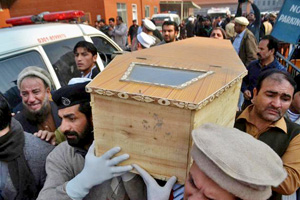
People around the country lit candles and staged overnight vigils as parents prepared to bury their children during mass funerals in and around Peshawar — a big, volatile city on the edge of Pakistan's lawless tribal belt.

Pakistanis may be used to almost daily militant attacks against the security forces but an outright assault on children stunned the country, prompting commentators to call for a tough military response.

In Peshawar, the vast grounds of the military-run Army Public School were all but deserted, with a handful of snipers manning the roofs of its pink brick-and-stone buildings.

Army vehicles and soldiers wearing face masks and carrying automatic rifles were deployed by the entrance.

A day after the attack, Peshawar appeared subdued and many were still in shock, recalling the gruesome events and trying to soothe each other. More details of the well-organised attack emerged as witnesses came forward with their stories.

“The attackers came around 10.30 a.m. on a pickup van,” said Issam Uddin, a 25-year-old school bus driver.

“They drove it around the back of the school and set it on fire to block the way. Then they went to Gate 1 and killed a soldier, a gatekeeper and a gardener. Firing began and the first suicide attack took place.”

The government of Prime Minister Nawaz Sharif has announced a three-day mourning period but people's anxiety focused on what the authorities can do to protect the country.

Mr. Sharif came to power last year promising to negotiate peace with the Pakistani Taliban — but those efforts failed this year, weakening his position and prompting the Army to launch an air-and-ground operation against insurgents along the Afghan border.

The military staged more air strikes against Taliban positions there late on Tuesday, a security source said, but it was unclear whether it was done in response to the school attack.

GOOD AND BAD TALIBAN

Yet, despite the well-publicised crackdown, the military has long been accused of being too lenient towards Islamist militants who critics say are used to carry out the Army's bidding in places like Jammu and Kashmir and Afghanistan.

The military denies the accusations.

“People will have to stop equivocating and come together in the face of national tragedy,” said Sherry Rehman, a former ambassador to the United States and an opposition politician.

“There have been national leaders who had been apologetic about the Taliban, who have not named the Taliban in their speeches.”

The Pakistani Taliban, who are fighting to impose strict Islamic rule in Pakistan, are holed up in the inaccessible mountains straddling the Pakistan-Afghanistan border.

They are allied with the Afghan Taliban as well as al-Qaeda and other foreign fighters, and Pakistan has long accused Afghanistan of not doing enough to crack down on their bases.

Afghanistan, for its part, blames Pakistan for allowing militant groups such as the Afghan Taliban and the Haqqani network to operate freely on its territory and stage attacks in Afghanistan.

Pakistan's Army chief was expected to visit Afghanistan on Wednesday for what is likely to be a day of uneasy talks with his Afghan counterparts on how to tackle the insurgency.

Pakistan's Dawn newspaper quoted a source as saying that the militants were acting on direct orders from their handlers in Afghanistan and that prominent Taliban commander Umar Naray was the ultimate mastermind of the attack.

Speaking late on Tuesday, Army spokesman Major General Asim Saleem Bajwa hinted at that without naming Afghanistan.

“When these militants reached the school ... we found out which group was involved, who they were talking to, from where the operation was being controlled,” he said. “God willing, in coming two-four days you will get to know.”

Comments

Add new comment

  • Coastaldigest.com reserves the right to delete or block any comments.
  • Coastaldigset.com is not responsible for its readers’ comments.
  • Comments that are abusive, incendiary or irrelevant are strictly prohibited.
  • Please use a genuine email ID and provide your name to avoid reject.
News Network
January 24,2020

Davos, Jan 24: Pakistan Prime Minister Imran Khan claimed that he met with a “brick wall” when he approached Indian Prime Minister Narendra Modi with a peace proposal, soon after assuming office.

In an interview to Foreign Policy magazine on the sidelines of WEF 2020 here, Khan also said he told Modi that Pakistan will act firmly if it was given evidence of any involvement in the Pulwama terror attack, but India instead “bombed” Pakistan.

Tensions have escalated between the two countries, following India withdrawing the special status of Jammu and Kashmir in August 2019. Even since, Khan has been trying to seek global intervention to de-escalate the tensions between the two countries.

On Thursday, India's External Affairs Ministry spokesperson Raveesh Kumar categorically ruled out any third party role on the Kashmir issue, asserting that any issue between the two countries should be resolved bilaterally.

In the interview, Khan said that he is a firm believer that military means are not a solution to ending conflicts. “After assuming office, I immediately reached out to Prime Minister Modi. I was amazed by the reaction I got, which was quite weird.

The subcontinent hosts the greatest number of poor people in the world, and the best way to fight poverty is to have a trading relationship between the two countries rather than spending money on arms. This is what I said to the Indian Prime Minister. But I was met by brick wall,” Khan said.

Khan took charge as Prime Minister in August 2018. Referring to the suicide attack in Pulwama, Khan said he immediately told Modi ,“if you can give us any actionable intelligence (that Pakistanis were involved), we will act on it. But rather than do so, they bombed us.”

Noting that the both countries are not close to conflict right now, Khan said that it is important that the UN and the US act.

When asked about US President Donald Trump’s close relationship with Modi, Khan said the relationship is understandable because India is a huge market. “My concern is not about the US-India relationship. My concern is the direction in which India is going,” Khan said.

Khan also sought to compare the events in India to what happened in Nazi Germany.

“Between 1930 and 1934, Germany went from a liberal democracy to a fascist, totalitarian, racist state. If you look at what is happening in India under the BJP in the last five years, look where it's heading, you'll see the danger. And you're talking about a huge country of 1.3 billion people that is nuclear-armed,” he said.

Comments

Add new comment

  • Coastaldigest.com reserves the right to delete or block any comments.
  • Coastaldigset.com is not responsible for its readers’ comments.
  • Comments that are abusive, incendiary or irrelevant are strictly prohibited.
  • Please use a genuine email ID and provide your name to avoid reject.
News Network
February 12,2020

Saint Martin's Island, Feb 12: At least 15 women and children drowned and more than 50 others were missing after a boat overloaded with Rohingya refugees sank off southern Bangladesh as it tried to reach Malaysia Tuesday, officials said.

Some 138 people -- mainly women and children -- were packed on a trawler barely 13 metres (40 feet) long, trying to cross the Bay of Bengal, a coast guard spokesman told news agency.

"It sank because of overloading. The boat was meant to carry maximum 50 people. The boat was also loaded with some cargo," another coast guard spokesman, Hamidul Islam, added.

Nearly one million Rohingya live in squalid camps near Bangladesh's border with Myanmar, many fleeing the neighbouring country after a 2017 brutal military crackdown.

With few opportunities for jobs and education in the camps, thousands have tried to reach other countries like Malaysia and Thailand by attempting the hazardous 2,000-kilometre journey.

In the latest incident, 71 people have been rescued including 46 women. Among the dead, 11 were women and the rest children.

Anwara Begum said two of her sons, aged six and seven, drowned in the tragedy.

"We were four of us in the boat... Another child (son, aged 10) is very sick," the 40-year-old told news agency.

Fishermen tipped off the coast guard after they saw survivors swimming and crying for help in the sea.

The boat's keel hit undersea coral in shallow water off Saint Martin's Island, Bangladesh's southernmost territory, before it sank, survivors said.

"We swam in the sea before boats came and rescued us," said survivor Mohammad Hossain, 20.

Coast guard commander Sohel Rana said three survivors, including a Bangladeshi, were detained over human trafficking allegations.

An estimated 25,000 Rohingya left Bangladesh and Myanmar on boats in 2015 trying to get to Thailand, Malaysia and Indonesia. Hundreds drowned when overloaded boats sank.

Begum said her family paid a Bangladeshi trafficker $450 per head to be taken to Malaysia.

"We're first taken to a hill where we stayed for five days. Then they used three small trawlers to take us to a large trawler, which sank," she said.

Shakirul Islam, a migration expert whose group works with Rohingya to raise awareness against trafficking, said desperation in the camps was making refugees want to leave.

"It was a tragedy waiting to happen," he said.

"They just want to get out, and fall victim to traffickers who are very active in the camps."

Islam said in the past two months dozens of Rohingya reported approaches from traffickers to his OKUP migration rights group.

"Human smuggling and trafficking in the Bay of Bengal is particularly difficult to address as it requires concerted effort from multiple states," the Bangladesh head of UN agency the International Organization for Migration, Giorgi Gigauri, told news agency.

"The gaps in coordination are easily exploited by criminal networks."

Since last year, Bangladeshi authorities have picked up over 500 Rohingya from rickety fishing trawlers or coastal villages as they waited to board boats.

Trafficking often increases during the November-March period when the sea is safest for the small trawlers used by traffickers.

Bangladesh and Myanmar signed a repatriation deal to send back some Rohingya to their homeland, but none have agreed to return because of safety fears.

The charity Save the Children called on Myanmar to "take all necessary steps to ensure the Rohingya community can return to their homes in a safe and dignified manner".

"The tragic drowning of women and children... should be a wake-up call for us all," the group's Athena Rayburn said in a statement.

Comments

Add new comment

  • Coastaldigest.com reserves the right to delete or block any comments.
  • Coastaldigset.com is not responsible for its readers’ comments.
  • Comments that are abusive, incendiary or irrelevant are strictly prohibited.
  • Please use a genuine email ID and provide your name to avoid reject.
News Network
May 24,2020

Islamabad, May 24: Pakistan recorded 32 coronavirus-related deaths during the last 24 hours, taking the total number of fatalities in the country to 1,133, the health ministry said on Sunday.

The total number of COVID-19 patients in Pakistan also jumped to 54,601, it said.

Read: Coronavirus India update: State-wise total number of confirmed cases, deaths

Sindh reported the maximum number of 21,645 coronavirus cases, followed by Punjab at 19,557, Khyber-Pakhtukhwa at 7,685, Balochistan at 3,306, Islamabad at 1,592, Gilgit-Baltistan at 619 and Pakistan-occupied Kashmir (PoK) at 197.

According to the health ministry, 17,198 coronavirus patients have recovered and 473,607 tests, including 12,915 in the last 24 hours, have been conducted so far.

The government also issued strict instructions to observe social distancing while offering Eid prayer and asked people to avoid visiting relatives and hosting parties.

Eid congregations were held at open places, mosques and Eidgahs in all major cities and towns while following strict standard operating procedures (SOPs) of social distancing and other precautionary measures.

Pakistan Prime Minister's Special Assistant on Health Zafar Mirza on Friday said the deadly infection would continue to multiply if precautions are not taken.

Earlier this month, the government had announced the lifting of the countrywide lockdown imposed to curb the spread of the virus in phases, even as infections continued to rise in the country.

Prime Minister Imran Khan had cited the economic havoc the virus restrictions had wreaked on citizens as the reason behind the decision.

The prime minister on Saturday urged Pakistanis to forgo traditional Eid festivity in view of the hundreds of fatalities caused by the coronavirus and the lives lost in Friday's plane crash in Karachi.

Ninety-seven people, including nine children, were killed and two passengers miraculously survived a fiery crash when a Pakistan International Airlines plane with 99 travellers on board plunged into a densely populated residential area near the Jinnah International Airport in Karachi. Most of the victims were travelling home to celebrate Eid.

Comments

Add new comment

  • Coastaldigest.com reserves the right to delete or block any comments.
  • Coastaldigset.com is not responsible for its readers’ comments.
  • Comments that are abusive, incendiary or irrelevant are strictly prohibited.
  • Please use a genuine email ID and provide your name to avoid reject.