


Pakistan in mourning as Peshawar buries its children

December 17, 2014

Peshawar, December 17: Pakistan woke up to a day of mourning on Wednesday after Taliban militants killed 132 students at a school in the city of Peshawar in a grisly attack which shocked the nation and put pressure on the government to do more to tackle the insurgency.Pakistan
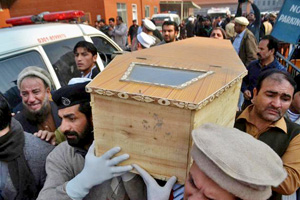
People around the country lit candles and staged overnight vigils as parents prepared to bury their children during mass funerals in and around Peshawar — a big, volatile city on the edge of Pakistan's lawless tribal belt.

Pakistanis may be used to almost daily militant attacks against the security forces but an outright assault on children stunned the country, prompting commentators to call for a tough military response.

In Peshawar, the vast grounds of the military-run Army Public School were all but deserted, with a handful of snipers manning the roofs of its pink brick-and-stone buildings.

Army vehicles and soldiers wearing face masks and carrying automatic rifles were deployed by the entrance.

A day after the attack, Peshawar appeared subdued and many were still in shock, recalling the gruesome events and trying to soothe each other. More details of the well-organised attack emerged as witnesses came forward with their stories.

“The attackers came around 10.30 a.m. on a pickup van,” said Issam Uddin, a 25-year-old school bus driver.

“They drove it around the back of the school and set it on fire to block the way. Then they went to Gate 1 and killed a soldier, a gatekeeper and a gardener. Firing began and the first suicide attack took place.”

The government of Prime Minister Nawaz Sharif has announced a three-day mourning period but people's anxiety focused on what the authorities can do to protect the country.

Mr. Sharif came to power last year promising to negotiate peace with the Pakistani Taliban — but those efforts failed this year, weakening his position and prompting the Army to launch an air-and-ground operation against insurgents along the Afghan border.

The military staged more air strikes against Taliban positions there late on Tuesday, a security source said, but it was unclear whether it was done in response to the school attack.

GOOD AND BAD TALIBAN

Yet, despite the well-publicised crackdown, the military has long been accused of being too lenient towards Islamist militants who critics say are used to carry out the Army's bidding in places like Jammu and Kashmir and Afghanistan.

The military denies the accusations.

“People will have to stop equivocating and come together in the face of national tragedy,” said Sherry Rehman, a former ambassador to the United States and an opposition politician.

“There have been national leaders who had been apologetic about the Taliban, who have not named the Taliban in their speeches.”

The Pakistani Taliban, who are fighting to impose strict Islamic rule in Pakistan, are holed up in the inaccessible mountains straddling the Pakistan-Afghanistan border.

They are allied with the Afghan Taliban as well as al-Qaeda and other foreign fighters, and Pakistan has long accused Afghanistan of not doing enough to crack down on their bases.

Afghanistan, for its part, blames Pakistan for allowing militant groups such as the Afghan Taliban and the Haqqani network to operate freely on its territory and stage attacks in Afghanistan.

Pakistan's Army chief was expected to visit Afghanistan on Wednesday for what is likely to be a day of uneasy talks with his Afghan counterparts on how to tackle the insurgency.

Pakistan's Dawn newspaper quoted a source as saying that the militants were acting on direct orders from their handlers in Afghanistan and that prominent Taliban commander Umar Naray was the ultimate mastermind of the attack.

Speaking late on Tuesday, Army spokesman Major General Asim Saleem Bajwa hinted at that without naming Afghanistan.

“When these militants reached the school ... we found out which group was involved, who they were talking to, from where the operation was being controlled,” he said. “God willing, in coming two-four days you will get to know.”

Comments

Add new comment

  • Coastaldigest.com reserves the right to delete or block any comments.
  • Coastaldigset.com is not responsible for its readers’ comments.
  • Comments that are abusive, incendiary or irrelevant are strictly prohibited.
  • Please use a genuine email ID and provide your name to avoid reject.
News Network
March 28,2020

Washington, Mar 28: The world is in the face of a devastating impact due to the coronavirus pandemic and has clearly entered a recession, the International Monetary Fund said on Friday, but projected a recovery next year.

"We have reassessed the prospects for growth for 2020 and 2021. It is now clear that we have entered a recession as bad or worse than in 2009. We do project recovery in 2021," IMF Managing Director Kristalina Georgieva told reporters at a news conference.

Georgieva was addressing the press after a meeting of governing body of the IMF, the International Monetary and Financial Committee. Representing 189 members, the body met virtually to discuss the unprecedented challenge posed to the world by COVID-19.

The key to recovery in 2021, she said, is only if the international community succeeds in containing the virus everywhere and prevent liquidity problems from becoming a solvency issue.

"The US is in recession, as is the rest of the advanced economies of the world. And in a big chunk of developed and emerging markets in developing economies. How severe? We are working now on our projections for 2020, Georgieva said in response to a question.

The new projections are expected in the next few weeks.

Stressing that while containment is the main reason for the economy to stand still and get into a recession, she said containment is very necessary to come out of this period and step in to recovery. "Until the virus is not contained, it would be very difficult to go to the lives we love."

"A key concern about a long-lasting impact of the sudden stop of the world economy is the risk of a wave of bankruptcies and layoffs that not only can undermine the recovery. But can erode the fabric of our societies," the IMF chief said.

To avoid this from happening, many countries have taken far-reaching measures to address the health crisis and to cushion its impact on the economy, both on the monetary and on the fiscal side, she said.

The IMF chief said 81 emergency financing requests, including 50 from lower-income countries, have been received. She said current estimate for the overall financial needs of emerging markets is 2.5 trillion dollars.

"We believe this is on the lower end. We do know that their own reserves and domestic resources will not be sufficient," she added.

The G-20, a day earlier, reported fiscal measures totalling some 5 trillion dollars or over 6 per cent of the global GDP.

Responding to another question, Georgieva said the IMF is projecting recession for 2020.

"We do expect it to be quite deep and we are very much urging countries to step up containment measures aggressively so we can shorten the duration of this period of time when the economy is in standstill," she said.

"And also to apply well-targeted measures, primarily focusing on the health system to absorb that enormous stress that comes from coronavirus. And on people, businesses and the financial system, I am very pleased to say that when we went through countries' responses, that sense of targeted fiscal measures is there and are also very impressive to see the size of these measures," she added.

"Countries are doing all they can on the fiscal and on the monetary front. We have heard from our members' very impressive decisions taken over the last days," the IMF chief said.

"We also want to caution that as we are responding now, we want to make the recession as possibly short and not too deep. We also want to think about what is going to follow the recovery and make sure that we are putting forward measures that can be supportive in this regard," she said.

Comments

Add new comment

  • Coastaldigest.com reserves the right to delete or block any comments.
  • Coastaldigset.com is not responsible for its readers’ comments.
  • Comments that are abusive, incendiary or irrelevant are strictly prohibited.
  • Please use a genuine email ID and provide your name to avoid reject.
Agencies
June 10,2020

Houston, Jun 10: George Floyd was fondly remembered Tuesday as “Big Floyd” — a father and brother, athlete and neighborhood mentor, and now a catalyst for change — at a funeral for the black man whose death has sparked a global reckoning over police brutality and racial prejudice.

More than 500 mourners wearing masks against the coronavirus packed a Houston church a little more than two weeks after Floyd was pinned to the pavement by a white Minneapolis police officer who put a knee on his neck for what prosecutors said was 8 minutes and 46 seconds.

Cellphone video of the encounter, including Floyd’s pleas of “I can’t breathe,” ignited protests and scattered violence across the U.S. and around the world, turning the 46-year-old Floyd — a man who in life was little known beyond the public housing project where he was raised in Houston’s Third Ward — into a worldwide symbol of injustice.

“Third Ward, Cuney Homes, that’s where he was born at,” Floyd’s brother, Rodney, told mourners at the Fountain of Praise church. “But everybody is going to remember him around the world. He is going to change the world.”

The funeral capped six days of mourning for Floyd in three cities: Raeford, North Carolina, near where he was born; Houston, where he grew up; and Minneapolis, where he died. The memorials have drawn the families of other black victims whose names have become familiar in the debate over race and justice — among them, Eric Garner, Michael Brown, Ahmaud Arbery and Trayvon Martin.

After the service, Floyd’s golden casket was taken by hearse to the cemetery in the Houston suburb of Pearland to be entombed next to his mother, for whom he cried out as he lay dying. A mile from the graveyard, the casket was transferred to a glass-sided carriage drawn by a pair of white horses. A brass band played as his casket was taken inside the mausoleum.

Hundreds of people, some chanting, “Say his name, George Floyd,” gathered along the procession route and outside the cemetery entrance in the mid-90s heat.

“I don’t want to see any black man, any man, but most definitely not a black man sitting on the ground in the hands of bad police,” said Marcus Brooks, 47, who set up a tent with other graduates of Jack Yates High School, Floyd’s alma mater.

In the past two weeks, amid the furor over Floyd’s death, sweeping and previously unthinkable things have taken place: Confederate statues have been toppled, and many cities are debating overhauling, dismantling or cutting funding for police departments. Authorities in some places have barred police from using chokeholds or are otherwise rethinking policies on the use of force.

Dozens of Floyd’s family members, most dressed in white, took part in the four-hour service. Grammy-winning singer Ne-Yo was among those who sang.

The mourners included actors Jamie Foxx and Channing Tatum, J.J. Watt of the NFL’s Houston Texans, rapper Trae tha Truth, Rep. Sheila Jackson Lee, Houston Police Chief Art Acevedo and Houston Mayor Sylvester Turner, who brought the crowd to its feet when he announced he will sign an executive order banning chokeholds in the city.

“I know you have a lot of questions that no child should have to ask, questions that too many black children have had to ask for generations: Why? Why is Daddy gone?” former Vice President Joe Biden, the Democratic presidential candidate, said, addressing Floyd’s 6-year-old daughter in a video eulogy played at the service. “Now is the time for racial justice. That’s the answer we must give to our children when they ask why.”

Biden made no mention of his opponent in November. But other speakers took swipes at President Donald Trump, who has ignored demands to address racial bias and has called on authorities to crack down hard on lawlessness.

“The president talks about bringing in the military, but he did not say one word about 8 minutes and 46 seconds of police murder of George Floyd,” said the Rev. Al Sharpton, the civil rights activist. “He challenged China on human rights. But what about the human right of George Floyd?”

Most of the pews were full, with relatively little space between people.

“So much for social distancing today,” the Rev. Remus Wright told mourners, gently but firmly instructing those attending to wear face masks.

Texas has no limit on how many people can gather in places of worship during the pandemic, though Republican Gov. Greg Abbott has encouraged churches to follow federal health guidelines.

Although the church service was private, at least 50 people gathered outside to pay their respects.

“There’s a real big change going on, and everybody, especially black, right now should be a part of that,” said Kersey Biagase, who traveled more than three hours from Port Barre, Louisiana, with his girlfriend, Brandy Pickney. They wore T-shirts printed with Floyd’s name and “I Can’t Breathe.”

Floyd served nearly five years in prison for robbery with a deadly weapon before becoming a mentor and a church outreach volunteer in Houston. He moved to Minnesota several years ago through a program that tried to change men’s lives by helping them find work in new settings.

At the time of his death, Floyd was out of work as a bouncer at a Minneapolis club that had closed because of the coronavirus outbreak. He was seized by police after being accused of passing a counterfeit $20 bill at a convenience store.

Four Minneapolis officers were arrested in his death: Derek Chauvin, 44, was charged with second-degree murder. J. Alexander Kueng, Thomas Lane and Tou Thao were charged with aiding and abetting. All four could get up to 40 years in prison.

Some of the mostly peaceful demonstrations that erupted after Floyd’s death were marked by bursts of arson, assaults, vandalism and smash-and-grab raids on businesses, with more than 10,000 people arrested. But protests in recent days have been overwhelmingly peaceful.

Comments

Add new comment

  • Coastaldigest.com reserves the right to delete or block any comments.
  • Coastaldigset.com is not responsible for its readers’ comments.
  • Comments that are abusive, incendiary or irrelevant are strictly prohibited.
  • Please use a genuine email ID and provide your name to avoid reject.
Agencies
February 17,2020

Islamabad, Feb 17: Prime Minister Imran Khan on Monday warned that Pakistan may face another refugee crisis if the international community failed to take notice of the current situation in India.

Speaking at the two-day refugee summit in Islamabad on 40 years of hosting Afghan refugees in Pakistan, he said India’s "ultranationalist ideology going unchecked could lead to destruction and the region could become a flashpoint", The Express Tribune quoted him as saying.

Khan said if the international community does not take notice of this situation, it will create another refugee crisis for Pakistan as Muslims of India will move to Pakistan.

"This is not the India of Jawaharlal Nehru and Mahatma Gandhi. The United Nations (UN) must play its role otherwise it will become a very big problem in the future," Duniya News quoted Khan as saying.

He said said that Prime Minister Narendra Modi’s statement that India can destroy Pakistan in 11 days is not a responsible statement by a premier of a nuclear state with a huge population, the paper reported.

Khan made the statement in the presence of visiting UN Secretary General Antonio Guterres, who was also attending the summit.

He said because of the "Hindutva" ideology, Kashmiris have been lockdown for over 200 days. He alleged under the same ideology, the BJP-led government passed two discriminatory nationalistic legislations, targeting 200 million Muslims in India.

Khan was referring to India's Citizenship (Amendment) Act and the revocation of the special status to Jammu and Kashmir.

The new citizenship law passed by the Indian Parliament in December 2019 offers citizenship to non-Muslim persecuted religious minorities from Pakistan, Bangladesh and Afghanistan.

The Indian government has maintained that the CAA is an internal matter of the country and stressed that the goal is to protect the oppressed minorities of neighbouring countries.

India revoked Jammu and Kashmir's special status on August 5. Reacting to India's move, Pakistan downgraded diplomatic ties with New Delhi and expelled the Indian High Commissioner.

India has always maintained that Jammu and Kashmir is its integral part and ruled out any third party mediation, including either from the UN or the US, saying it is a bilateral issue with Pakistan.

Comments

Add new comment

  • Coastaldigest.com reserves the right to delete or block any comments.
  • Coastaldigset.com is not responsible for its readers’ comments.
  • Comments that are abusive, incendiary or irrelevant are strictly prohibited.
  • Please use a genuine email ID and provide your name to avoid reject.