In this Pakistani temple, Muslim woman teaches Hindu students

Agencies
August 22, 2018

Karachi, Aug 22: Inside a Hindu temple in a shanty area in Pakistan's Karachi city, Anum Agha wearing the traditional Muslim Hijab greets her students with 'salaam' and gets a loud 'Jai Shri Ram' in response. 

Anum runs a school inside the temple in the Basti Guru area of the southern port city. The school is situated in the middle of an informal Hindu settlement which is facing constant threats from land grabbers. 

But Anum is determined to impart knowledge about education, health and basic rights to the children of the minority community.

In the settlement, 80 to 90 Hindu families live in a close cluster of wooden huts and some semi-constructed houses.

One can see Anum holding discussions with children of the settlement after her classes are over.

"Everyone is surprised when I tell them about our school inside this temple but we had no other place to hold our classes when I first started coming here last year," she told PTI. 

The classes are conducted in the main area of the temple. The walls of the temple are plastered with posters of Hindu deities and statues of Hindu Gods placed up on a higher perch.

The lack of basic facilities is noticeable as one moves around the settlement located in Rehman Colony near Mahmoodabad but for land grabbers, it is not an ordinary piece of land.

"There have been at least two incidents in the last four years when some huts were set on fire and the Hindu families were threatened and told to get out of the area," Shiva Dharni, a community leader, said.

Recently authorities also cut electricity and water connections to the Basti, which was set up in the 60s when the Hindu families migrated from Ghotki in interior Sindh to Karachi.

The area witnessed tensions a few years ago when a Muslim resident apparently started propagating an idea that a mosque should be constructed over the land.

"These land grabbers try to persuade the Muslim clerics that having a settlement of lower caste Hindu in the center of a proper Muslim neighbourhood is unacceptable," Arif Habib, who heads the non-governmental Initiator Human Development Foundation which has brought Anum to run the school in the temple, said.

"These are vulnerable communities and they are under threat from non-state actors, I mean land grabbers who want them to evacuate the plot where this settlement is located," he said.

Anum reluctantly admits that some of the Muslim residents living around the settlement don't like her involvement with the scheduled caste Hindu families and her holding classes.

"But I do it because these people are not even aware of their basic rights. Their children want to gain knowledge and education. Some of them attended other schools in the area but faced social and religious issues," Anum said.

She said that the Hindu elders were very happy that their children, specially the girls, don't have to leave the settlement for education.

Asked whether she has faced difficulties as a Muslim teacher, Anum said she did face challenges.

"But I never talk about religion and avoid hurting their sensitivities. I try to keep them focused on different subjects and religion is not one of them," she said.

"I respect them as human beings and they respect me back. That is how we work. We celebrate religious festivals together. I say salaam to them and they respond with Jai Shri Ram." 

She feels the school can serve as an example of how different communities can co-exist peacefully in the Muslim majority nation while respecting each other.

Comments

Add new comment

  • Coastaldigest.com reserves the right to delete or block any comments.
  • Coastaldigset.com is not responsible for its readers’ comments.
  • Comments that are abusive, incendiary or irrelevant are strictly prohibited.
  • Please use a genuine email ID and provide your name to avoid reject.
News Network
March 6,2020

New York, Mar 6: A 23-year-old Indian with a student visa in the US has pleaded guilty to sexual enticement of a minor girl, prosecutors have said.

Sachin Aji Bhaskar faces a maximum penalty of life in prison.

He pleaded guilty before Senior US District Judge William M Skretny to sexual enticement of a minor.

The charge carries a minimum penalty of 10 years in prison, a maximum penalty of life in prison, a fine of USD 250,000 or both, US Attorney James P Kennedy said.

Prosecutors alleged that Bhaskar communicated by text and email with an 11-year-old girl for the purpose of engaging in sexual activity.

Through those communications, Bhaskar enticed the victim to engage in a sexual activity with him in August, 2018, they said.

The sentencing in the case is scheduled for June 17.

Comments

Add new comment

  • Coastaldigest.com reserves the right to delete or block any comments.
  • Coastaldigset.com is not responsible for its readers’ comments.
  • Comments that are abusive, incendiary or irrelevant are strictly prohibited.
  • Please use a genuine email ID and provide your name to avoid reject.
coastaldigest.com web desk
August 1,2020

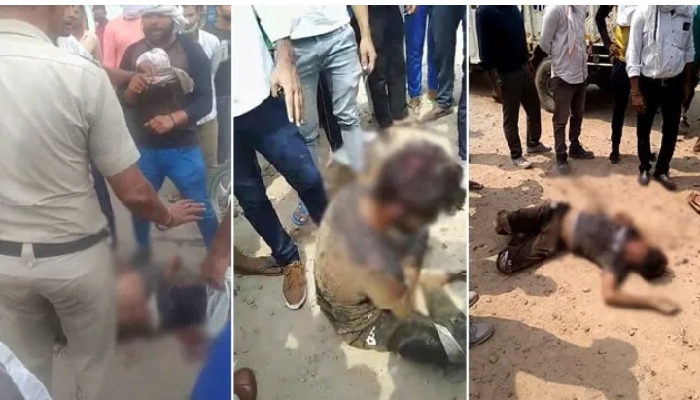
New Delhi, July 1: In a terrific incident with chilling echoes of the 2015 Dadri mob lynching, a Muslim man, who was carrying meat, was savagely attacked by a mob belonging to a saffron outfit in the presence of in BJP ruled Haryana on the eve of Eid al-Adha. 

The incident occurred at around 9 a.m. on Friday, July 31 at Badshahpur village in Haryana’s Gurgaon, when Lukman was transporting meat in a pic-kup truck. 

The attack was captured on mobile phones by onlookers and the video clips of the incident are now spreading on social media. 

A group of saffronite cow vigilantes chased the truck for about 8 km managed waylay it. Lukman, who was driving the truck was pulled out and brutally assaulted on the suspicion that he was transporting cow meat.

Just like Dadri, the police were faster at sending the meat to a lab for testing than catching any one of the suspects. One of the assailants - Pradeep Yadav- has been arrested. 

After being beating to an inch of his life, Lukman was bundled into the pick-up truck and taken back to Gurgaon's Badshahpur village where the goons started thrashing him again.

This is when the police stepped in and stopped them - only to find the assailants fearless enough to even take on them.

Lukman was taken to a hospital and the police filed a case against "unidentified individuals" even though the video of the incident recorded by witnesses shows the faces of the assailants.

The owner of the vehicles said that the meat was buffalo and he has been in the business for 50 years.

The police have so far refused to give a statement on record on the incident and explain their inaction as seen on video.

Comments

Add new comment

  • Coastaldigest.com reserves the right to delete or block any comments.
  • Coastaldigset.com is not responsible for its readers’ comments.
  • Comments that are abusive, incendiary or irrelevant are strictly prohibited.
  • Please use a genuine email ID and provide your name to avoid reject.
News Network
April 28,2020

Washington, Apr 28: After nearly three weeks in an intensive care unit in Los Angeles, doctors treating 41-year-old Broadway actor Nick Cordero for COVID-19 were forced to amputate his right leg.

The flow of blood had been impeded by a blood clot: yet another dangerous complication of the disease that has been bubbling up in frontline reports from China, Europe and the United States.

To be sure, so-called "thrombotic events" occur for a variety of reasons among intensive care patients, but the rates among COVID-19 patients are far higher than would be otherwise expected.

"I have had 40-year-olds in my ICU who have clots in their fingers that look like they'll lose the finger, but there's no other reason to lose the finger than the virus," Shari Brosnahan, a critical care doctor at NYU Langone said.

One of these patients is suffering from a lack of blood flow to both feet and both hands, and she predicts an amputation may be necessary, or the blood vessels may get so damaged that an extremity could drop off by itself.

Blood clots aren't just dangerous for our limbs, but can make their way to the lungs, heart or brain, where they may cause lethal pulmonary embolisms, heart attacks, and strokes.

A recent paper from the Netherlands in the journal Thrombosis Research found that 31 percent of 184 patients suffered thrombotic complications, a figure that the researchers called "remarkably high" -- even if extreme consequences like amputation are rare.

Behnood Bikdeli, a doctor at New York-Presbyterian Hospital, assembled an international consortium of experts to study the issue. Their findings were published in the Journal of The American College of Cardiology.

The experts found the risks were so great that COVID-19 patients "may need to receive blood thinners, preventively, prophylactically," even before imaging tests are ordered, said Bikdeli.

What exactly is causing it? The reasons aren't fully understood, but he offered several possible explanations.

People with severe forms of COVID-19 often have underlying medical conditions like heart or lung disease -- which are themselves linked to higher rates of clotting.

Next, being in intensive care makes a person likelier to develop a clot because they are staying still for so long. That's why for example people are encouraged to stretch and move around on long haul flights.

It's also now clear the COVID-19 illness is associated with an abnormal immune reaction called "cytokine storm" -- and some research has indicated this too is linked to higher rates of clotting.

There could also be something about the virus itself that is causing coagulation, which has some precedent in other viral illnesses.

A paper in the journal The Lancet last week showed that the virus can infect the inner cell layer of organs and of blood vessels, called the endothelium. This, in theory, could interfere with the clotting process.

According to Brosnahan, while thinners like Heparin are effective in some patients, they don't work for all patients because the clots are at times too small.

"There are too many microclots," she said. "We're not sure exactly where they are."

Autopsies have in fact shown some people's lungs filled with hundreds of microclots.

The arrival of a new mystery however helps solve a slightly older one.

Cecilia Mirant-Borde, an intensive care doctor at a military veterans hospital in Manhattan, told AFP that lungs filled with microclots helped explain why ventilators work poorly for patients with low blood oxygen.

Earlier in the pandemic doctors were treating these patients according to protocols developed for acute respiratory distress syndrome, sometimes known as "wet lung."

But in some cases, "it's not because the lungs are occupied with water" -- rather, it's that the microclotting is blocking circulation and blood is leaving the lungs with less oxygen than it should.

It has just been a little under five months since the virus emerged in Wuhan, China, and researchers are learning more about its impact every day.

"While we react surprised, we shouldn't be as surprised as we were. Viruses tend to do weird things," said Brosnahan.

While the dizzying array of complications may seem daunting, "it's possible there'll be one or a couple of unifying mechanisms that describe how this damage happens," she said.

"It's possible it's all the same thing, and that there'll be the same solution."

Comments

Add new comment

  • Coastaldigest.com reserves the right to delete or block any comments.
  • Coastaldigset.com is not responsible for its readers’ comments.
  • Comments that are abusive, incendiary or irrelevant are strictly prohibited.
  • Please use a genuine email ID and provide your name to avoid reject.