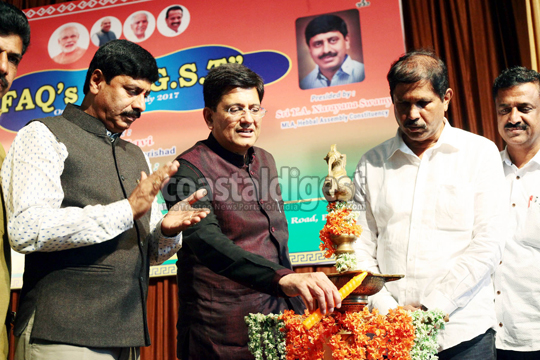
Petrol, diesel may be brought under GST in future: Goyal

DHNS
July 3, 2017

Bengaluru, Jul 3: Union Minister for Energy Piyush Goyal interacted with members of the public on Sunday to clarify their doubts about the newly introduced Goods and Services Tax (GST).

Goyal1

The interactive session was organised by the Byatarayanapura and Hebbal mandals of Bharatiya Janata Party (BJP) at the Sri Ramana Maharshi Heritage Auditorium in Sanjay Nagar.

Addressing the gathering, Goyal said, “GST is a transformative move which will benefit the poor, farmers and the middle-class the most. The credit goes not only to the prime minister but also to the different political parties for supporting it. This is an excellent example of cooperative federalism.”

Goyal and the commissioner for Central GST, Vivek Prakash then answered questions raised by the audience.

A member of the audience asked if a digital advertising company with turnover less than Rs 20 lakh sales would be exempted from GST. Goyal confirmed that it would be, as the exemption is applicable to service providers. He further added that any company which tried to falsely show turnover below the bracket would be caught.

“In GST, there is a reverse charge mechanism. Those who availed of the services will have to pay GST and through that we can know if the service provider is trying to evade tax,” he said.

When asked why petrol and diesel were not included in GST, Goyal said that states could not reach a consensus on this matter and it could be included in the future.

Answering a question on why there were tax rates higher than 28% in some cases, the commissioner said, “In some cases, the tax rate is more than 28% because of cess. This has been included to compensate states if they have a revenue-shortfall due to GST. But this is not a permanent feature and it will be removed later on.”

Goyal2

Comments

Sahil
 - 
Friday, 7 Jul 2017

There are not even 200 people's even they came thinking they will get bottle to drink..God will punish them..

Add new comment

  • Coastaldigest.com reserves the right to delete or block any comments.
  • Coastaldigset.com is not responsible for its readers’ comments.
  • Comments that are abusive, incendiary or irrelevant are strictly prohibited.
  • Please use a genuine email ID and provide your name to avoid reject.
News Network
February 28,2020

Suhaana shuddered with fear as she heard violent banging on her door on Sunday. The atmosphere was charged with communal tension after thousands of ruthless goons supporting contentious Citizens Amendment Act (CAA) launched a bloody onslaught against Muslims in the capital of India.

The family consists of Suhaana (name changed), her partially paralysed husband and two daughters. They are the only Muslim family in Madhuban mohalla of North Ghonda locality in north-east Delhi.

Hearts pounded louder than pounding of the door. Then the banging stopped and noises of men talking loudly came.

"I peeped out from a small window near the kitchen and saw our neighbours standing outside our entrance and arguing with 10-15 unknown people," Suhaana said.

It was the first day of the communal violence, worst in the decades, that fanned out to the entire north-east Delhi over the next three days and claimed at least 42 lives, left over 200 injured and properties worth crores destroyed. The death toll is feared to go up.

Later in the night Suhaana's family moved to one of their Hindu neighbour's house. There are about 30 Hindu households in the mohalla who kept vigil as the atmosphere deteriorated.

The next day, the violence escalated. The neighbours decided to shift Suhaana 's family to Gautampuri for their safety.

Suhaana recounted, "Our neighbours assured us that they are with us but as things were deteriorating, they said they wouldn't be able to protect us if a big mob of hundreds came. They advised us to move to the nearby Gautampuri locality and come back only after things become normal."

Rajkumar Bharadwaj brought the family to Gautampuri in the early hours on February 25.

Anil Gupta, 49, said, "It was tough to rescue them. We were asked by the rioters as to why we were saving the Muslims. But we had to, it is the people of my country who are suffering. It cannot be Hindus or Muslims."

Rajkumar Bharadwaj said, "Their youngest clung to me throughout. After I brought them here at Gautampuri, I felt good. Situation till then was not okay."

On Saturday, some semblance of normalcy returned to parts of north-east Delhi with some people opening their shops amid heavy police presence.

Meanwhile, the morbid sight outside GTB Hospital's mortuary, agonising groans in the hospital wards burnt down houses and shops remind Suhaana and others what they have been spared of.

Comments

Add new comment

  • Coastaldigest.com reserves the right to delete or block any comments.
  • Coastaldigset.com is not responsible for its readers’ comments.
  • Comments that are abusive, incendiary or irrelevant are strictly prohibited.
  • Please use a genuine email ID and provide your name to avoid reject.
Agencies
April 19,2020

French Nobel prize winning scientist Luc Montagnier has sparked a fresh controversy by claiming that the SARS-CoV-2 virus came from a lab, and is the result of an attempt to manufacture a vaccine against the AIDS virus.

In an interview given to French CNews channel and during a podcast by Pourquoi Docteur, professor Montagnier who co-discovered HIV (Human Immunodeficiency Virus) claimed the presence of elements of HIV in the genome of the coronavirus and even elements of the "germ of malaria" are highly suspect, according to a report in Asia Times.

"The Wuhan city laboratory has specialized in these coronaviruses since the early 2000s. They have expertise in this area," he was quoted as saying.

The theory that Covid-19 virus originated in the lab is making rounds for quite some time.

US President Donald Trump last week acknowledged Fox News report that the novel coronavirus may have been accidentally leaked by an intern working at the Wuhan Institute of Virology in China.

The Fox News, in an exclusive report, based on unnamed sources has claimed that though the virus is a naturally occurring strain among bats and not a bioweapon, but it was being studied in Wuhan laboratory.

The initial transmission of the virus was bat-to-human, the news channel said, adding that the "patient zero" worked at the laboratory. The lab employee was accidentally infected before spreading the disease among the common people outside the lab in Wuhan city.

Professor Montagnier was awarded the 2008 Nobel Prize in Medicine for the identification of AIDS virus, with his colleague professor Franeoise Barre-Sinoussi.

His fresh claim on coronavirus, however, received criticism from scientists, including his colleagues.

"Just in case you don't know. Dr Montagnier has been rolling downhill incredibly fast in the last few years. From baselessly defending homeopathy to becoming an antivaxxer. Whatever he says, just don't believe him," tweeted Juan Carlos Gabaldon.

As per a recent Washington Post, two years ago, the US embassy officials in China raised concerns about the insufficient biosafety at the Chinese government's Wuhan Institute of Virology where deadly viruses and infectious diseases are studied.

Though the institute, located quite close to the Wuhan wet market, is China's first biosafety level IV lab, the US state department had warned in 2018 about "serious shortage of appropriately trained technicians and investigators needed to safely operate this high-containment laboratory".

Comments

Add new comment

  • Coastaldigest.com reserves the right to delete or block any comments.
  • Coastaldigset.com is not responsible for its readers’ comments.
  • Comments that are abusive, incendiary or irrelevant are strictly prohibited.
  • Please use a genuine email ID and provide your name to avoid reject.
Agencies
May 8,2020

Washington D.C., May 8: The prime time for brain development in a child's life is the first year, where the infant spends most of the time asleep. It is the time when neural connections form and sensory memories are encoded.

However, when sleep is disrupted, as occurs more often among children with autism, brain development may be affected, too.

New research led by the University of Washington finds that sleep problems in a baby's first 12 months may not only precede an autism diagnosis but also may be associated with altered growth trajectory in a key part of the brain, the hippocampus.

The study, which was published in the American Journal of Psychiatry, researchers report that in a sample of more than 400 taken of 6- to 12-month-old infants, those who were later diagnosed with autism were more likely to have had difficulty falling asleep.

It also states that this sleep difficulty was associated with altered growth trajectories in the hippocampus.

"The hippocampus is critical for learning and memory, and changes in the size of the hippocampus have been associated with poor sleep in adults and older children.

As many as 80 per cent of the children with autism spectrum disorder have sleep problems," said Annette Estes, director of the UW Autism Center and senior author of the study.

"In our clinical experience, parents have a lot of concerns about their children's sleep, and in our work on early autism intervention, we observed that sleep problems were holding children and families back," added Estes, who is also a UW professor of speech and hearing sciences.

"It could be that altered sleep is part-and-parcel of autism for some children. One clue is that behavioural interventions to improve sleep don't work for all children with autism, even when their parents are doing everything just right. This suggests that there may be a biological component to sleep problems for some children with autism," said Estes.

To consider links among sleep, brain development, and autism, researchers at the IBIS Network looked at MRI scans of 432 infants, surveyed parents about sleep patterns, and measured cognitive functioning using a standardized assessment.

At the outset of the study, infants were classified according to their risk for developing autism: Those who were at higher risk of developing autism -- about two-thirds of the study sample -- had an older sibling who had already been diagnosed.

Infant siblings of children with autism have a 20 per cent chance of developing autism spectrum disorder -- a much higher risk than children in the general population.

In the current study, 127 of the 432 infants were identified as "low risk" at the time the MRI scans were taken because they had no family history of autism.

They later evaluated all the participants at 24 months of age to determine whether they had developed autism. Of the roughly 300 children originally considered "high familial risk," 71 were diagnosed with autism spectrum disorder at that age.

Problems with sleep were more common among the infants later diagnosed with an autism spectrum disorder, as were larger hippocampi. No other subcortical brain structures were affected, including the amygdala, which is responsible for certain emotions and aspects of memory, or the thalamus, a signal transmitter from the spinal cord to the cerebral cortex.

The authors note that while parents reported more sleep difficulties among infants who developed autism compared to those who did not, the differences were very subtle and only observed when looking at group averages across hundreds of infants.

Sleep patterns in the first years of life change rapidly as infants transition from sleeping around the clock to a more adult-like sleep/wake cycle. Until further research is completed, Estes said, it is not possible to interpret challenges with sleep as an early sign of increased risk for autism.


Comments

Add new comment

  • Coastaldigest.com reserves the right to delete or block any comments.
  • Coastaldigset.com is not responsible for its readers’ comments.
  • Comments that are abusive, incendiary or irrelevant are strictly prohibited.
  • Please use a genuine email ID and provide your name to avoid reject.