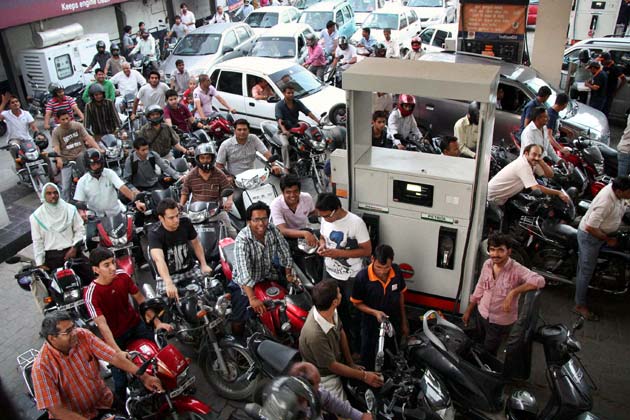
Petrol price may be hiked by Rs 5 per litre in 24-48 hours

September 7, 2012

petrol_fuel_

Petrol_Hike_5rs_l

New Delhi, September 7: A hike of Rs 5 per litre in petrol price is likely to be announced in the next 24 to 48 hours. According to official sources, the Oil Ministry may allow the oil manufacturing companies to announce the hike.

According to Oil Ministry sources, the Prime Minister's Office (PMO) and the Finance Ministry are on board for the price hike.

Sources also said that though the Cabinet note on the same is ready, it is yet to be circulated.

It is also likely that the Oil Ministry will ask the Cabinet to support a steep hike in the prices of diesel and kerosene, said sources.

According the sources, the Oil Ministry also wants a hike in the Kerosene price. However, they said, that it was up to the Cabinet to decide.

Comments

Add new comment

  • Coastaldigest.com reserves the right to delete or block any comments.
  • Coastaldigset.com is not responsible for its readers’ comments.
  • Comments that are abusive, incendiary or irrelevant are strictly prohibited.
  • Please use a genuine email ID and provide your name to avoid reject.
News Network
April 28,2020

New Delhi, Apr 28: With 1,594 new cases of COVID-19 reported in the last 24 hours and 51 deaths, India's total count of coronavirus cases surged to 29,974, said the Union Ministry of Health and Family Welfare on Tuesday.

The total cases are inclusive of 7,026 cured and discharged patients, one migrated and 937 deaths.

At present, there are 22,010 active COVID-19 cases in the country.

Addressing a press conference here, Lav Agarwal, Joint Secretary, Union Health and Family Welfare Ministry, said that in the last 28 days, 17 districts have had no new Covid-19 cases. "This means we need to maintain constant vigil," he added.

Comments

Add new comment

  • Coastaldigest.com reserves the right to delete or block any comments.
  • Coastaldigset.com is not responsible for its readers’ comments.
  • Comments that are abusive, incendiary or irrelevant are strictly prohibited.
  • Please use a genuine email ID and provide your name to avoid reject.
News Network
May 18,2020

Muscat, May 18: An Air India special flight left for Hyderabad with a total of 182 stranded Indians from Oman on Monday.

"IX 818 departed for Hyderabad with total 182 passengers. We again express our gratitude to Omani & Indian authorities and wish all the passengers, safe journey home," Indian embassy in Oman said in a tweet.

Under the Vande Bharat Mission, Air India operated repatriation flight from Oman on Sunday to Kerala. It had brought back 183 Indians.

The phased evacuation is being done under the Centre's 'Vande Bharat' mission whose second phase started from May 16.

In order to facilitate the return of stranded Indian nationals in Oman, the Indian government has decided to operate more special flights to Bangalore, Calicut, Delhi, Kannur, Kochi, and Gaya on May 20, 21, 22 and 23.

Under the second phase, a total of 149 flights, including feeder flights, are expected to be operated to bring back stranded Indians from 40 countries.

Comments

Add new comment

  • Coastaldigest.com reserves the right to delete or block any comments.
  • Coastaldigset.com is not responsible for its readers’ comments.
  • Comments that are abusive, incendiary or irrelevant are strictly prohibited.
  • Please use a genuine email ID and provide your name to avoid reject.
News Network
April 23,2020

Washington, Apr 23: Air pollution over northern India has plummeted to a 20-year-low for this time of the year, according to satellite data published by US space agency National Aeronautics and Space Administration (NASA).
The US space agency's satellite sensors observed aerosol levels at a 20-year low post the countrywide lockdown, implemented to slow the spread of the novel coronavirus.

"We knew we would see changes in atmospheric composition in many places during the lockdown," said Pawan Gupta, a Universities Space Research Association (USRA) scientist at NASA''s Marshall Space Flight Center. "But I have never seen aerosol values so low in the Indo-Gangetic Plain at this time of year," added Mr Gupta.

Acting Assistant Secretary of State for South and Central Asia Alice G Wells tweeted, "These images from NASA were taken each spring starting in 2016 and show a 20-year low in airborne particle levels over India. When India and the world are ready to work and travel again, let's not forget that collaborative action can result in cleaner air."

The data published with maps show aerosol optical depth (AOD) in 2020 compared to the average for 2016-2019. Aerosol optical depth is a measure of how light is absorbed or reflected by airborne particles as it travels through the atmosphere.

If aerosols are concentrated near the surface, an optical depth of 1 or above indicates very hazy conditions. An optical depth, or thickness, of less than 0.1 over the entire atmospheric vertical column is considered "clean." The data were retrieved by the Moderate Resolution Imaging Spectroradiometer (MODIS) on NASA's Terra satellite.

In the first few days of the lockdown, it was difficult to observe a change in the pollution signature. "We saw an aerosol decrease in the first week of the shutdown, but that was due to a combination of rain and the lockdown," said Mr Gupta.

Around March 27, heavy rain poured over vast areas of northern India and helped clear the air of aerosols. Aerosol concentrations usually increase again after such heavy precipitation.

"After the rainfall, I was really impressed that aerosol levels did not go up and return to normal. We saw a gradual decrease and things have been staying at the level we might expect without anthropogenic emissions," Mr Gupta said.

On March 25, the Indian government placed its 1.3 billion citizens under a strict lockdown to reduce the spread of COVID-19. The countrywide mandate decreased activity at factories and severely reduced car, bus, truck and airplane traffic. Every year, aerosols from anthropogenic (human-made) sources contribute to unhealthy levels of air pollution in many Indian cities.

Aerosols are tiny solid and liquid particles suspended in the air that reduce visibility and can damage the human lungs and heart.

In southern India though, the story is a little hazier. Satellite data show aerosol levels have not yet decreased to the same extent. In fact, levels seem to be slightly higher than in the past four years. The reasons are unclear but could be related to recent weather patterns, agricultural fires, winds or other factors.

"This a model scientific experiment," Robert Levy, program leader for NASA's MODIS aerosol products, said about the lockdown and its effects on pollution.

"We have a unique opportunity to learn how the atmosphere reacts to sharp and sudden reductions in emissions from certain sectors. This can help us separate how natural and human sources of aerosols affect the atmosphere," Mr Levy added.


Comments

Add new comment

  • Coastaldigest.com reserves the right to delete or block any comments.
  • Coastaldigset.com is not responsible for its readers’ comments.
  • Comments that are abusive, incendiary or irrelevant are strictly prohibited.
  • Please use a genuine email ID and provide your name to avoid reject.