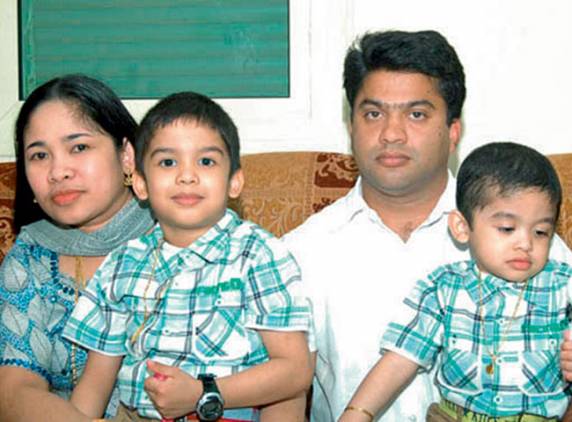
Philippines: Kerala man escapes al Qaeda, to return after 14 month

August 11, 2012

kerala_man

New Delhi, August 11: An Indian escaped from the captivity of an al Qaeda linked terror group after being held captive in the southern Philippines for nearly 14 months.

Biju Kolara Veetil from Calicut was abducted in the Philippines, while visiting his in-laws. In July 2012, he miraculously escaped and is now is now safe in police custody, and is in touch with Indian officials, MEA spokesman Syed Akbaruddin tweeted. Veetil also hopes to head back home soon.

It's a huge relief for Veetil's family, who have been pleading for help from the MEA and defence minister, unable to pay the ransom of $ 7,100. But now they know the wait is just for a few days more.

Veetil was found on the streets of Patikul town, according to Antonio Freyra, police chief of Sulu province. Earlier, Freyera had told reporters that Veetil had been killed by the militant group.

However, Veetil's wife Elena had maintained that her husband was safe in the custody of the Abu Sayyaf Group. Veetil's relatives had approached the external affairs ministry and Defence Minister AK Antony seeking their intervention.

The Abu Sayyaf Group, one of the most violent Islamic separatist groups in the southern Philippines, has been pitching for an independent Islamic state in western Mindanao and the Sulu archipelago in the Philippines.

The group is known for kidnapping foreign nationals and demanding heavy ransom for them.


Comments

Add new comment

  • Coastaldigest.com reserves the right to delete or block any comments.
  • Coastaldigset.com is not responsible for its readers’ comments.
  • Comments that are abusive, incendiary or irrelevant are strictly prohibited.
  • Please use a genuine email ID and provide your name to avoid reject.
News Network
May 28,2020

New Delhi, May 28: The Crime Branch of the Delhi Police will file 12 chargesheets against 536 Tablighi Jamaat members from three countries, officials said on Thursday.

Till now, the police has already filed chargesheets against 374 foreigners from 32 countries.

The officials said the charges against the Tablighi Jamaat members pertain to violation of visa rules, government guidelines regarding the Epidemic Disease Act and acting negligently in a way that was likely to spread infection of disease dangerous to life.

The Tablighi Jamaat, a religious organisation in Nizamuddin in South Delhi, had allegedly organised a congregation in March in violation of mass gatherings.

The Tablighi Jamaat’s Nizamuddin Markaz (centre) had become a coroavirus hotspot in the national capital.

Comments

Add new comment

  • Coastaldigest.com reserves the right to delete or block any comments.
  • Coastaldigset.com is not responsible for its readers’ comments.
  • Comments that are abusive, incendiary or irrelevant are strictly prohibited.
  • Please use a genuine email ID and provide your name to avoid reject.
News Network
April 24,2020

Apr 24: Kerala Chief Minister Pinarayi Vijayan on Friday sought Prime Minister Narendra Modi's intervention in bringing bodies of Keralites who died in the Gulf countries due to non-COVID-19 reasons to the state without any delay for performing last rites in their home towns.

In a letter, he wanted Modi to direct Indian embassies to issue necessary clearances without seeking individual approvals from the Ministry of Home Affairs and avoid any delay so that the remains reach Kerala early. It has been learnt that a 'clearance certificate' from the Indian embassies concerned was required to process the application for bringing home the bodies.

The embassies are insisting on production of no-objection certificate from the Union Ministry of Home Affairs, he said in the letter, a copy of which was released to the media here on Friday. The Centre had already agreed that in case the deaths are not COVID related, such certificates are not necessary.

The bodies are now being brought in the cargo planes as passenger flights are not being operated due to the lockdown. Chief Minister said he had received several grievances from the NRKs in Gulf Cooperation Council (GCC) countries on the delay in bringing home the bodies of those who died there. "They are already under tremendous stress and anxiety due to the lockdown imposed in those countries and the consequent stoppage of international flights", Vijayan said.

Comments

Add new comment

  • Coastaldigest.com reserves the right to delete or block any comments.
  • Coastaldigset.com is not responsible for its readers’ comments.
  • Comments that are abusive, incendiary or irrelevant are strictly prohibited.
  • Please use a genuine email ID and provide your name to avoid reject.
News Network
February 19,2020

New Delhi, Feb 19: India will switch to the world's cleanest petrol and diesel from April 1 as it leapfrogs straight to Euro-VI emission compliant fuels from Euro-IV grades now - a feat achieved in just three years and not seen in any of the large economies around the globe.

India will join the select league of nations using petrol and diesel containing just 10 parts per million of sulphur as it looks to cut vehicular emissions that are said to be one of the reasons for the choking pollution in major cities.

Sanjiv Singh, Chairman of Indian Oil Corp (IOC) - the firm that controls roughly half of the country's fuel market, said almost all refineries began producing ultra-low sulphur BS-VI (equivalent to Euro-VI grade) petrol and diesel by the end of 2019 and oil companies have now undertaken the tedious task of replacing every drop of fuel in the country with the new one.

"We are absolutely on track for supplying BS-VI fuel from April 1. Almost all refineries have begun supplying BS-VI fuel and the same has reached storage depots across the country," he said.

From storage depots, the fuel has started travelling to petrol pumps and in the next few weeks all of them will only have BS-VI grade petrol and diesel, he said. "We are 100 per cent confident that fuel that will flow from nozzles at all the petrol pumps in the country on April 1 will be BS-VI emission compliant fuel."

India adopted Euro-III equivalent (or Bharat Stage-III) fuel with a sulphur content of 350 ppm in 2010 and then took seven years to move to BS-IV that had a sulphur content of 50 ppm. From BS-IV to BS-VI it took just three years.

"It was a conscious decision to leapfrog to BS-VI as first upgrading to BS-V and then shifting to BS-VI would have prolonged the journey to 4 to 6 years. Besides, oil refineries, as well as automobile manufacturers, would have had to make investments twice - first to producing BS-V grade fuel and engines and then BS-VI ones," he said.

State-owned oil refineries spent about Rs 35,000 crore to upgrade plants that could produce ultra-low sulphur fuel. This investment is on top of Rs 60,000 crore they spent on refinery upgrades in the previous switchovers.

BS-VI has a sulphur content of just 10 ppm and emission standards are as good as CNG.

Originally, Delhi and its adjoining towns were to have BS-VI fuel supplies by April 2019 and the rest of the country was to get same supplies from April 2020.

But oil marketing companies switched over to supply of BS-VI grade fuels in the national capital territory of Delhi on April 1, 2018.

The supply of BS-VI fuels was further extended to four contiguous districts of Rajasthan and eight of Uttar Pradesh in the National Capital Region (NCR) on April 1, 2019, together with the city of Agra.

BS-VI grade fuels were made available in 7 districts of Haryana from October 1, 2019.

Singh said the new fuel will result in a reduction in NOx in BS-VI compliant vehicles by 25 per cent in petrol cars and by 70 per cent in diesel cars.

The switchover, he said, is a tedious task as every drop of old, higher-sulphur content fuel has to be flushed out in depots, pipelines and tanks before being replaced by BS-VI.

"We are confident of disruption-free switchover to BS-VI supplies across the country," he said. "What we will be supplying is the best quality available anywhere in the world. You don't have any better fuel that is supplied in any part of the world. Perhaps our BS-VI fuel will be better than equivalent fuel in some parts of the US and Europe."

India adopted a fuel upgradation programme in the early 1990s. Low lead gasoline (petrol) was introduced in 1994 in Delhi, Mumbai, Kolkata and Chennai. On February 1, 2000, unleaded gasoline was mandated nationwide.

Similarly, BS-2000 (Euro-I equivalent, BS-1) vehicle emission norms were introduced for new vehicles from April 2000. BS-II (Euro-II equivalent) emission norms for new cars were introduced in Delhi from 2000 and extended to the other metro cities in 2001.

Benzene limits have been reduced progressively from 5 per cent in 2000 to 1 per cent nationwide. Lead content in gasoline was removed in phases and only unleaded gasoline is being produced and sold from February 1, 2000.

The octane number of gasoline signifies the improved performance of the engine. Loss in octane number due to phasing out of lead was made up by installing new facilities in the refinery and changes in refinery operation. RON (Research Octane Number) of gasoline for BS-2000 spec was increased to 88. This has over time been increased to 91.

Singh said sulphur reduction will reduce Particulate Matter (PM) emissions even in the in-use older generation diesel vehicles.


Comments

Add new comment

  • Coastaldigest.com reserves the right to delete or block any comments.
  • Coastaldigset.com is not responsible for its readers’ comments.
  • Comments that are abusive, incendiary or irrelevant are strictly prohibited.
  • Please use a genuine email ID and provide your name to avoid reject.