



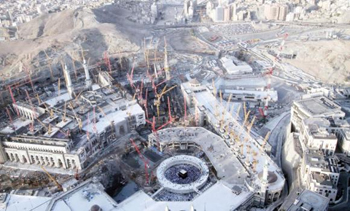
Pilgrims in awe of massive expansion work in Makkah

February 28, 2014

Pilgrims_in_aweMakkah, Feb 28: Forty-five-year-old Syed Laeequddin Quadri, from Maharashtra, India, was standing in quiet contemplation straining his head to look at the golden crescent atop the majestic Makkah Clock Tower.

“That is unbelievable,” he told Arab News after Dhuhr prayers on Thursday. “Being a construction expert, I can imagine how much steel and concrete must have been poured into this gigantic project.”

Quadri is in the Kingdom on Umrah with his wife and four children. He is very familiar with the country having worked for the Saudi Binladin Group’s Operations and Maintenance Division in the early 1990s.

“I left the Kingdom for good 15 years ago,” he said. “I remember coming to the Holy Mosque for Umrah for the first time in 1991 with a friend. There was no Clock Tower, no Dar Al-Tawheed building,” he reminisced. “We were dropped by the cabbie right in front of the King Abdul Aziz Gate.”

Pointing at the sprawling marble-topped courtyard, he said: “This was not there.”

There was always construction activity in Makkah, he says. “In those days, you would always see earth-moving equipment and cranes at work on different projects,” he said.

However, the skyline was not dotted with the massive cranes as it is now. “Wherever you cast your eye from the Grand Mosque’s courtyard, you can see hundreds of red- and yellow-colored cranes, positioned at right angles,” said Quadri.

“We used to dine at Delhi Darbar Restaurant near the SAPTCO bus stop,” he said. “That is all gone. What used to be old buildings along Ibrahim Khalil Street housing pilgrims from India and Pakistan are all gone and instead we have the Jabal Omar Project. The mountain or the hillock is gone.”

On both sides of Ibrahim Khalil Street frenetic construction activity is going on, with the ground being leveled as part of the Grand Mosque expansion project.

According to reports in the local media, Makkah Hilton will no longer be where it is now. It will be shifted across the street. This is also the case with the Dar Al-Tawheed Intercontinental Hotel.

The Haram expansion project is being described as the biggest in Islam’s history. Once complete, it will significantly facilitate the journey of faith for millions of pilgrims.

“Every time I circumambulate the Holy Kaaba, my hands go up in prayer for the Saudi leadership for everything they’ve done and are doing to make Umrah and Haj comfortable,” said Quadri.

“When I came from Jeddah I saw mountains being cut away to expand the multi-lane highway. My eyes went moist. King Abdullah has excelled as the custodian of the holy mosques.”

Fifty-two-year-old Mustafa Anwar, from Alexandria, Egypt, was equally impressed.

“The expansion of the Holy Mosque symbolizes the rising tide of Islam,” he told Arab News. “I remember only a very few people from my country would come for Umrah 20 years ago,” he said. “That is not the case now, you have to apply months in advance with a travel agent because hundreds of thousands of people have the resources to undertake Umrah.”

Anwar said this is happening with Muslims all over the world. “More and more people are coming to perform Umrah and Haj, and naturally Saudi Arabia wants to provide the best of the best for them. And they are, much to the appreciation and wonderment of the pilgrims. Naturally, the Saudi leadership is showered with praise for taking such meticulous care of the Holy Mosque.”

Comments

Add new comment

  • Coastaldigest.com reserves the right to delete or block any comments.
  • Coastaldigset.com is not responsible for its readers’ comments.
  • Comments that are abusive, incendiary or irrelevant are strictly prohibited.
  • Please use a genuine email ID and provide your name to avoid reject.
Agencies
April 27,2020

Riyad, Apr 27: The Saudi-led Arab Coalition supporting Yemen’s UN-recognized government on Monday urged all parties to end any escalation of hostilities and return to the status that existed before the Southern Transitional Council (STC) declared self-rule.

In a statement carried by the Saudi Press Agency (SPA), the coalition emphasized “the need to cancel any step that violates the Riyadh agreement and work to accelerate its implementation.” 

On Sunday, the United Arab Emirates-backed STC scrapped a peace deal with the internationally recognized government of President Abed Rabbo Mansour Hadi.

Accusing the government of corruption and mismanagement, the separatists said they would “self-govern” the key southern port city of Aden and other southern provinces.

Yemen’s Foreign Minister Mohammed Al-Hadhrami described the move as a “resumption of its (STC’s) armed insurgency and rejection and complete withdrawal from the Riyadh agreement.” 

Authorities in Yemen’s southern provinces of Hadramawt, Abyan, Shabwa, Al-Mahra and the remote island of Socotra also rejected the separatist group’s claim to self-rule.

The government said local and security authorities in the five provinces dismissed the move as a “clear and definite coup.” 

Some of the provinces issued their own statements condemning it.

The coalition appealed to all parties to “give priority to the interests of the Yemeni people over any other interests”. 

It also urged the parties involved not to lose their focus on working to achieve the goal of restoring the state, ending the Houthi “coup” and “countering terrorist organizations”.

“The Coalition has and will continue to undertake practical and systematic steps to implement the Riyadh Agreement between the parties to unite Yemeni ranks, restore state institutions and combat the scourge of terrorism,” the statement said. “The responsibility rests with the signatories to the Agreement to undertake national steps toward implementing its provisions, which were signed and agreed upon with a time matrix for implementation.”

The STC has been part of the coalition-backed forces fighting the Iran-backed Houthi militia, which seized control of the Yemeni capital Sanaa and other provinces in 2014.

The Houthi “coup” has led to the formation of the Saudi-led coalition, which had since driven away the Houthis from the south and other provinces. President Hadi’s government has made Aden as its temporary seat.

Comments

Add new comment

  • Coastaldigest.com reserves the right to delete or block any comments.
  • Coastaldigset.com is not responsible for its readers’ comments.
  • Comments that are abusive, incendiary or irrelevant are strictly prohibited.
  • Please use a genuine email ID and provide your name to avoid reject.
News Network
May 20,2020

Cairo, May 20: A senior Kuwaiti lawmaker has called for imposing a tax on expatriates’ remittances to shore up the country’s finances.

MP Khalil Al Saleh, the head of the parliament’s Human Resources Committee, has presented a draft law on the proposed tax to the legislature.

“Imposing fees on expatriates’ transfers will have a role in improving the state's revenues and diversify sources of income,” he told Al Rai newspaper.

Migrant workers transfer about 4.2 billion dinars annually from Kuwait, he added, citing figures from Kuwait’s Central Bank.

“This system is in effect in most countries of the world and in more than one Gulf country. Expats there have not objected to it. Allowing this money to exit the country is very dangerous and has a direct effect on economy,” MP Al Saleh said.

“We do not target brotherly expats because imposing symbolic fees on financial transfers will not affect their money, but will have a positive effect on the state’s sources,” he said. “This has become a necessity after the money transferred outside Kuwait has reached 4.2 billion dinars annually without the state [Kuwait] making any benefit from this.”

Foreign workers make up 3.3 million of Kuwait’s 4.6 million population.

Several Kuwaiti public figures have recently pushed for redrawing the demographic imbalance in the country, accusing expatriates of straining health facilities and increasing the Covid-19 threat.

Comments

Add new comment

  • Coastaldigest.com reserves the right to delete or block any comments.
  • Coastaldigset.com is not responsible for its readers’ comments.
  • Comments that are abusive, incendiary or irrelevant are strictly prohibited.
  • Please use a genuine email ID and provide your name to avoid reject.
Agencies
May 28,2020

Sharjah, May 28: The Ministry of Interior has warned the public against visiting wadis during bad weather conditions, including rainy seasons, to avoid the risk of getting caught in flash floods that could endanger their lives.

A video posted on its official Instagram account depicted several such incidents involving cars being swept away by floods.

The warning comes after four people were found dead this week in Sharjah's Wadi Al Helo, an area hit by floods during heavy rains that lashed the emirate, authorities said.

The National Search and Rescue Centre (NSRC) found the bodies as it conducted an operation to look for seven people who were reported missing amid the unstable weather conditions.

In a separate incident yesterday, 20 passengers of a bus that got stuck in Wadi Hatta's Umm Al Nosor area in Dubai were also rescued by police after their vehicle was swept away by floods.

The ministry urged the public to follow the directives issued for their own safety.

Comments

Add new comment

  • Coastaldigest.com reserves the right to delete or block any comments.
  • Coastaldigset.com is not responsible for its readers’ comments.
  • Comments that are abusive, incendiary or irrelevant are strictly prohibited.
  • Please use a genuine email ID and provide your name to avoid reject.