



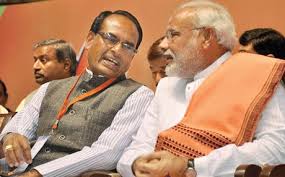
PM candidate: A quiet alternative emerges within BJP

December 22, 2013
Bhopal: Five months before next general elections are due, there is already an air of victory around Narendra Modi as he strides from one jam-packed rally to the next. And yet, a regional leader from his party - Bharatiya Janata party - is quietly emerging as an alternative to lead the country.

chauhanBJP's candidate for prime minister's post, Modi is being projected as the man to beat the ruling Congress party, stumbles towards a vote that opinion polls show it will lose.

Modi's party is tipped to win the election but it may not get an outright majority, and he may be unacceptable to potential coalition partners.

Ever since a 2002 spasm of Gujarat riots, Modi has been unable to shake off allegations that he carries a deep-seated bias against Muslims, a community that makes up 13% of the population.

Shivraj Singh Chouhan, a softly spoken and unassuming leader of the centre-right BJP, could be a more acceptable figure for would-be coalition allies.

This month, Chouhan notched up a thumping election victory in Madhya Pradesh, a sprawling central state with a population larger than that of France, becoming its chief minister for a third time.

"Shivraj Chouhan is no threat to Modi, he is not a challenger, but his huge victory raises the stakes," said Girija Shankar, a political consultant with close ties to the Madhya Pradesh administration.

"On the scale of electability and performance, the message is - he is not any weaker than Modi."

Congress did something similar after elections 10 years ago - after wresting power from the BJP, its leader Sonia Gandhi declined the prime ministership. By naming unassuming technocrat Manmohan Singh as prime minister, she denied the opposition any chance of using her foreign roots to attack the government.

A farmer-turned-politician, Chouhan is similarly far less divisive than Modi. There are other BJP leaders waiting in the wings for the premiership if minor parties that are expected to hold the key to power after the election insist on a prime minister other than Modi as the price for their support.

Among them are Lal Krishna Advani, a veteran of the party who is still seen as a contender despite his 86 years, as well as former government ministers Sushma Swaraj and Arun Jaitley.

All three are virtually household names across India, and Chouhan - a former parliament backbencher - has a far lower profile.

Earning his spurs

Chouhan has long been an outsider among the political elite of New Delhi. When he was first elected to Parliament in 1991 he didn't have a sweater to ward against the capital's winter chill, recalls a former associate Anurag Pateriya, who picked up a cheap one from a street market before they boarded the train.

Chouhan declined requests to be interviewed for this report. Swimming below the national radar, he has transformed  Madhya Pradesh from a poverty-blighted backwater, unleashing average annual economic growth of 10% over the past five years on the back of an unprecedented agriculture boom.

The explosion in farm output - agricultural growth in the state was 18% last year, the country's highest - has been fed by interest-free loans to farmers, a trebling of irrigation cover and a dramatic improvement in electricity supplies.

Out on a modern four-lane highway from the state capital Bhopal to the commercial city of Indore, the rural prosperity is hard to miss.

Fields upon fields of soybeans, mustard and wheat stretch out, broken only by factories starting to come up on cleared land.

Children in uniforms scurry to school on bicycles provided by the state government, pedalling along new roads that are linked to remote villages. They will all be given a free lunch.

Nearby, expectant and new mothers collect free packets of soya, a mixture of rice and lentils and sweets, a Chouhan initiative to lift the state's infant and maternal mortality rates up to the national average.

As a consequence of our pro-poor policies, we subsidise agriculture," said Manoj Srivastava, principal secretary to Chouhan, pointing out that 80% of the state's population is dependent on farming. "We make no bones about it - WTO or no - we are unabashedly doing it."

Chouhan has also introduced tax-friendly policies to attract industry to his state. Along the state highway, Indian firm Deepak Fastners is building Asia's largest plant to manufacture specialised nuts and bolts for car engines and aircraft. The first phase of the project is expected to cost some $38 million.

A numbers game

Madhya Pradesh may still lag behind "vibrant" Gujarat, the neighbouring state run by Modi and a darling of investors. But unlike his more famous colleague, Chouhan has walked a fine line between a secular image and sticking to the BJP's Hindu nationalist roots.

As assistants scurried about the chief minister's imposing colonial-era bungalow before his inauguration last week, Chouhan told them that a congregation of Islamic scholars was important for everyone, said a top aide, who asked not to be identified.

That inclusive approach has won Chouhan support from a fair sprinkling of Muslims, who have traditionally shunned his party.

For now, Modi is on a roll, tapping into public anger with the Congress Party after years of corruption scandals, stubborn inflation and dwindling economic growth.

But, privately, party leaders concede that the BJP may not be able to form a government with Modi as prime minister if it wins less than 180 of the 543 elected seats in the lower house of Parliament. If it falls short of that number, it might have to ditch him and find another candidate.

To rule, a party needs the support of 272 members. Opinion polls so far have forecast the BJP will win around 160 seats, which means it may need to join hands with a cluster of smaller parties to reach the halfway mark.

The BJP will need support from regional parties in the south and east that may be reluctant to associate themselves with the polarising Modi, fearing a backlash from Muslims in their states. One ally in the heartland state of Bihar cut ties with the BJP this year after Modi was elevated to a national role, and the party has yet to find a substitute.

For the moment, Chouhan's camp is quietly biding its time. "We want to stay below the national radar, we don't have extra-territorial ambitions," said the aide. "But people in the party, those who have tensions with Modi, may try to push him forward."

Comments

Add new comment

  • Coastaldigest.com reserves the right to delete or block any comments.
  • Coastaldigset.com is not responsible for its readers’ comments.
  • Comments that are abusive, incendiary or irrelevant are strictly prohibited.
  • Please use a genuine email ID and provide your name to avoid reject.
News Network
June 18,2020

Beijing, Jun 18:  Besides washing hands and wearing masks, it is also important to close the toilet lid before flushing to contain the spread of COVID-19, as per a new study.

According to a new study cited by The Washington Post, scientists who simulated toilet water and airflows, have found that flushing a toilet can generate a plume of virus-containing aerosol particles that is widespread and can linger in the air long enough to be inhaled by others. The novel coronavirus has been found in the faeces of COVID-19 patients, but it remains unknown whether such clouds could contain enough virus to infect a person.

"Flushing will lift the virus up from the toilet bowl," co-author Ji-Xiang Wang, who researches fluids at Yangzhou University in Yangzhou, China, said in an email. Wang stressed that bathroom users "need to close the lid first and then trigger the flushing process" and wash hands properly if the closure is not possible. As one flushes the toilet with the lids open, bits of faecal matter swish around so violently that they can be propelled into the air, become aerosolised and then settle on the surroundings.

Experts call it the "toilet plume".Age-old studies have been made to understand the potential for airborne transmission of infectious disease via sewage, and the toilet plume's role. Scientists who have seeded toilet bowls with bacteria and viruses have found contamination of seats, flush handles, bathroom floors and nearby surfaces. This is one reason we are told to wash our hands after visiting the toilet. Public bathrooms are well known to contribute to the spread of viruses that transmit via ingestion, such as the noroviruses that haunt cruise ships. However, their role in the transmission of respiratory viruses has not been established, said Charles P Gerba, a microbiologist at the University of Arizona."The risk is not zero, but how great a risk it is, we do not know. The big unknown is how much virus is infectious in the toilet when you flush it ... and how much virus does it take to cause an infection," said Gerba, who has studied the intersection of toilets and infectious disease for 45 years.

A study published in March in the journal Gastroenterology found significant amounts of coronavirus in the stool of patients and determined that viral RNA lasted in faeces even after the virus cleared from the patients` respiratory tracts. While another study in the journal Lancet found coronavirus in faeces up to a month after the illness had passed.

Scientists around the world are now studying sewage to track the spread of the virus. According to the researchers, the presence of the virus in excrement and the gastrointestinal tract raises the prospect of transmission via toilets, because many COVID-19 patients experience diarrhoea or vomiting.

A study of air samples in two hospitals in Wuhan, China found that although coronavirus aerosols in isolation wards and ventilated patient rooms were very low, "it was higher in the toilet areas used by the patients".The Centers for Disease Control and Prevention (CDC) says it remains "unclear whether the virus found in faeces may be capable of causing COVID-19," and "there has not been any confirmed report of the virus spreading from faeces to a person".For now, the CDC characterises the risk as low based on observations from previous outbreaks of other coronaviruses such as severe acute respiratory syndrome (SARS) and the Middle East respiratory syndrome (MERS). Wang decided to use computer models to simulate toilet plumes while isolating at home, as per Chinese government orders and thinking about how a fluids researcher "could contribute to the global fight against the virus".

Published in the journal Physics of Fluids, the study found that flushing of both single-inlet toilets, which push water into the bowl from one port, and annular-inlet toilets, which pour water into the bowl from the rim's surrounding edge with even greater energy, results in "massive upward transport of virus".

Particles can reach heights of more than three feet and float in the air for more than a minute, it found. The paper recommends not just lid-closing and hand-washing, it urges manufacturers to produce toilets that close and self-clean automatically. It also suggests that toilet-users should wipe down the seat. Gerba, however, said seats should not be a major concern.

Research has found that public and household toilet seats are typically the cleanest surfaces in restrooms, he said, probably because so many people already wipe them off before using them. Also, he said of SARS-CoV-2, the virus that causes COVID-19, "I don't think it's butt-borne, so I don`t think you have to worry."Gerba, who has been studying coronavirus transmission for two decades to investigate the role of a toilet flushing in a SARS outbreak stresses "flush and run" when using a public toilet without a lid. Gerba also said that people should wash hands well post-flushing and use hand sanitiser after leaving the restroom. "Choose well-ventilated bathrooms if possible and do not hang around the restroom in any case," added Gerba.

Comments

Add new comment

  • Coastaldigest.com reserves the right to delete or block any comments.
  • Coastaldigset.com is not responsible for its readers’ comments.
  • Comments that are abusive, incendiary or irrelevant are strictly prohibited.
  • Please use a genuine email ID and provide your name to avoid reject.
Agencies
January 12,2020

Washington D.C., Jan 12: A recent study has claimed that people end up wasting almost an entire day when they take a vacation.

This can happen while standing in a queue or searching for places to visit, people do not keep a count of the time they have actually utilised during the trip. As a result, they end up doing much lesser activities than they originally had planned.

According to a recent report in Fox News, the study has also shared the fact that people try to justify time waste with planning and scheduling activities whereas the truth is that these things can be done well ahead to save time during the trip.

The average time waste according to the study commissioned by Sykes Holiday Cottages also said the people taking a seven days' trip waste a minimum of 17-and-a-half hours to figure out various factors.

But there are other causes involved as well. When one visits any crowded location, the real-time spent to enjoy the location is lesser than the time spent on reaching and trying to get involved. For instance, if one visits an amusement park, the activities take lesser time than the preparatory and other phases.

Comments

Add new comment

  • Coastaldigest.com reserves the right to delete or block any comments.
  • Coastaldigset.com is not responsible for its readers’ comments.
  • Comments that are abusive, incendiary or irrelevant are strictly prohibited.
  • Please use a genuine email ID and provide your name to avoid reject.
Agencies
March 10,2020

New Delhi, Mar 10: Crisis-hit Yes Bank on Tuesday said that it has enabled inward IMPS and NEFT services.

The move allows people to send money from other bank accounts to their Yes Bank account through IMPS (Immediate Payment Service) and NEFT (National Electronic Funds Transfer) mode.

In a tweet, the bank also said that Yes Bank customers can pay their credit card dues and loan obligations from other bank accounts.

"Inward IMPS/NEFT services have now been enabled. You can make payments towards YES BANK Credit Card dues and loan obligations from other bank accounts. Thank you for your co-operation. @RBIA @FinMinIndia," said tweet.

Last week Yes Bank was placed under moratorium and a withdrawal cap of Rs 50,000 was imposed till April 3.

The administrator of Yes Bank, Prashant Kumar and Rajnish Kumar, the Chairman of the State Bank of India are hopeful that moratorium would be lifted within a week.

As per the Reserve Bank of India (RBI) draft reconstruction scheme for the crisis-hit private lender, the SBI will take up 49 per cent in the bank by investing Rs 2,450 crore.

The new board of directors will stand constituted from the appointed date. It will comprise a CEO and MD, non-executive chairman and non-executive directors. The SBI will have nominee directors appointed on the board of the reconstructed bank.

The RBI may appoint additional directors to the board, who shall continue in office for one year, or until an alternate board is constituted by Yes Bank.

The SBI will not reduce its holding below 26 per cent before completion of three years from the date of infusion of the capital.

Comments

Add new comment

  • Coastaldigest.com reserves the right to delete or block any comments.
  • Coastaldigset.com is not responsible for its readers’ comments.
  • Comments that are abusive, incendiary or irrelevant are strictly prohibited.
  • Please use a genuine email ID and provide your name to avoid reject.