



PM launches Jan Dhan scheme to combat financial untouchability

August 28, 2014

New Delhi, Aug 28: Prime Minister Narendra Modi today launched his government's mega scheme 'Jan Dhan Yojana', declaring that it was aimed at eradicating financial untouchability by providing bank accounts to the poor.jan dhan pm
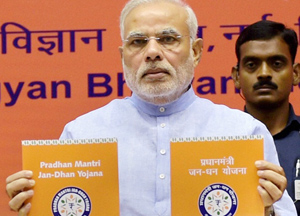
On the inaugural day, a record 1.5 crore bank accounts were opened across the country, the largest such exercise on a single day possibly anywhere in the world.

Unveiling the scheme within 100 days of forming the new government, Modi said, it will cover 7.5 crore people by January 26, 2015, who will be provided zero-balance bank account with RuPay debit card, life insurance cover of Rs 30,000 in addition to accidental insurance cover of Rs 1 lakh.

Later the account holders will be provided an overdraft facility of up to Rs 5,000.

"If Mahatma Gandhi worked to remove social untouchability, if we want to get rid of poverty, then we have to first get rid of financial untouchability. We have to connect every person with the financial system. And for that this programme has been given impetus," he said, adding, "when a bank account is opened, it's a step towards joining economic mainstream."

Modi recalled the bank nationalisation of 1969 with the avowed objective of spreading the reach of financial system to the doorsteps of poor. "But I regret to say that after 68 years of independence, not even 68 per cent of population is covered by the banking system," he said.

The scheme was simultaneously launched at multiple places by 20 Chief Ministers, several Union Ministers, including Information Minister Prakash Javadekar at Pune, Law Minister Ravi Shankar Prasad at Chennai, External Affairs Minister Sushma Swaraj at Bhopal, Home Minister Rajnath Singh at Lucknow and HRD Minister Smriti Irani at Surat.

There were in all 600 programmes and 77,852 camps were organised on the opening day to open bank accounts.

Modi said history has been created in the banking system with opening of over 1.5 crore account in a day. Besides, a record has been created by providing 1.5 crore accidental insurance covers of Rs 1 lakh.

The Prime Minister described the occasion as a festival to celebrate the liberation of the poor from a poisonous cycle ("Vish-chakra se gareebon ki aazaadi ka parv").

"Banks have assured me they will do this work before January 26. Those who oppen accounts by January 26, 2015 over and above the the Rs 1 lakh accident, they will be given life insurance cover of Rs 30,000. This will help the poor family," he said.

In the third phase, he said, these account holders would also be provided micro-pension facility.

"I believe when a person opens a bank account then he or she takes the first step to get connected with the economic system. Today the 1.5 crore family who got connected with the economic system this will give a boost to the economy," he said.

Going forward, he can avail Rs 5,000 loan from the bank, the Prime Minister said, adding, this facility would be available after six months of opening of the bank account.

Expressing satisfaction at a number of records being broken today, the Prime Minister said the nationwide success of the enrolment drive today would give confidence not just to the officials of the Department of Financial Services and banking sectors, but also to officers across the Union Government, that they can successfully achieve the goals that they set for themselves.

"Never before would insurance companies have issued 1.5 lakh accident insurance policies in a single day. Never before in economic history would 1.5 lakh bank accounts have been opened in a single day.

"Never before has the Government of India organised a programme of such scale – over 77,000 locations – with the participation of so many Chief Ministers, Union Ministers, Government and bank officials," the Prime Minister said.

Modi said this mission would also help in fighting corruption by plugging leakages in the government subsidy scheme, he said.

He further said it is easy for the rich to get a loan at low interest rates but the poor are forced to seek loans from money-lenders at five times the rate charged to the rich.

"Is it not the responsibility of the banking industry to provide banking access to the poor?" the Prime Minister asked.

The Prime Minister illustrated his point through the example of a mother saving money and being forced to hide it somewhere within the house. He said the bank officials who have opened an account for such a mother today, would get blessings.

He said a breakthrough was required to overcome the vicious cycle of poverty and debt, and that breakthrough had been achieved today.

He said there were similarities between the poor getting access to mobile telephones, and getting access to debit cards. They both had the effect of instilling confidence and pride among the poor, he added.

Now, the poor would be able to do normal bank transactions through non-smart phone as well because of introduction of new technology introduced by National Payments Corporation of India (NPCI).

A person can transfer funds, check balance through a normal phone. However, this facility was limited only to smart phones so far.

While the existing banking network would be geared up to open bank accounts of the uncovered households in both rural and urban areas, the banking sector would be expanding itself to set up additional 50,000 Business correspondents, more than 7,000 branches and more than 20,000 new ATMs in the first phase, he said

The Prime Minister said with the launch of this mission, there has been transformation. Now the bank is coming to one's doorstep for opening of bank account instead of closing of account.

Narrating his personal account, the Prime Minister said he got a bank account opened in his school with Dena Bank which remained inactive for 20 years as he had little money to deposit in the account.

So, the bank officials kept making rounds of his house to get the account closed as they had to carry out operational procedures year after year, he added.

Meanwhile, Finance Minister Arun Jaitley said around 58 per cent population in the country have bank accounts.

"In simple words it means still there are 10 crore families that are away from banking services as they do not have access to banking services, they are also deprived of means of savings," he said.

The ultimate motive of this scheme is that no family should be deprived of this service, he added.

The Finance Minister said mobile banking for the poor would be available through National Unified USSD Platform (NUUP) for which all banks and mobile companies have come together.

Normal bank transaction can be done through any phone across the country, he added.

Comments

Add new comment

  • Coastaldigest.com reserves the right to delete or block any comments.
  • Coastaldigset.com is not responsible for its readers’ comments.
  • Comments that are abusive, incendiary or irrelevant are strictly prohibited.
  • Please use a genuine email ID and provide your name to avoid reject.
News Network
January 17,2020

Mumbai, Jan 17: A 68-year-old convict of the 1993 Mumbai serial blasts case, Jalees Ansari, went missing on Thursday morning while being on parole, officials said.

Ansari, a resident of Mominpura in Agripada here who is serving a life term, is suspected to be involved in many bomb blast cases across the country, an official said.

He was on parole for 21 days from the Ajmer Central Prison, Rajasthan, and was expected to surrender before prison authorities on Friday, he said.

During the parole period, he was ordered to visit the Agripada Police Station everyday between 10.30 am and 12 pm to mark his attendance, he said.

However, Ansari did not visit the police station on Thursday during the designated time, the official said.

In the afternoon, his 35-year-old son Jaid Ansari approached the police station with a complaint about his “missing” father, he said.

According to the complaint, Jalees Ansari woke up in the early hoursand told family members he is going to offer namaz, but did not return home.

On his complaint, the Agripada Police registered a missing case, he said.

The Crime Branch of the Mumbai Police and the Maharashtra ATS have launched a massive manhunt to trace him, he said.

Jalees, who is known as Doctor Bomb, was allegedly connected with terror outfits like SIMI and Indian Mujahidin and taught terror groups how to make bombs, he said.

He was also questioned by the NIA in 2011 in connection with the 2008 bomb blast in Mumbai, he said.

Comments

Add new comment

  • Coastaldigest.com reserves the right to delete or block any comments.
  • Coastaldigset.com is not responsible for its readers’ comments.
  • Comments that are abusive, incendiary or irrelevant are strictly prohibited.
  • Please use a genuine email ID and provide your name to avoid reject.
News Network
May 15,2020

New Delhi, May 15: A group of doctors from the AIIMS, Raipur has recommended restrictions on the use of mobile phones in healthcare institutions amid the COVID-19 pandemic, warning that such devices can be a potential carrier of the virus and lead to infection among healthcare workers.

In a commentary published in the BMJ Global Health journal, the doctors stated that mobile phone surfaces are a peculiar 'high-risk' surface, which can directly come in contact with the face or mouth, even if hands are properly washed and one study indicates that some healthcare workers use phones every 15 minutes to two hours.

Though there have been many significant guidelines from various health organisations like the WHO and CDC focusing on prevention and control of disease, the commentary highlighted "there is no mention of or focus on mobile phones in these guidelines, including the WHO infection control and prevention guidelines, which recommends the use of handwashing".

In healthcare facilities, phones are used to communicate with other health care workers, look up recent medical guidelines, research drug interactions, understand adverse events and side effects, conduct telemedicine appointments and track patients among others, stated the document.

The document has been authored by Dr Vineet Kumar Pathak, Dr Sunil Kumar Panigrahi, Dr M Mohan Kumar, Dr Utsav Raj and Dr Karpaga Priya P from the Department of Community and Family Medicine.

"In their tendency to come in direct contact with the face, nose or eyes in healthcare settings, mobile phones are perhaps second only to masks, caps or goggles," the authors said.

"However, they are neither disposable nor washable like these other three, thus warranting disinfection. Mobile phones can effectively negate hand hygiene... There is growing evidence that mobile phones are a potential vector for pathogenic organisms," they said.

It is the need of the hour to address proper hygienic use of mobile phones in healthcare settings. In a study in India, almost 100 per cent of health workers of a tertiary care hospital used mobile phones in the hospital, but only 10 per cent of them had at any time wiped their mobile phones clean, the commentary published on April 22 said.

"The safest thing to do is to consider your phone as an extension of your hand, so remember you are transferring whatever is on your phone to your hand," Dr Pathak said.

Amidst the ongoing pandemic, two biggest mobile phone companies have uploaded their user support guidelines, saying that 70 pc isopropyl alcohol or Clorox Disinfecting Wipes can be used to gently wipe the exterior surface of phones in switched-off mode.

However, in doing so, the use of bleach or entry of moisture through any of the openings must be avoided, and any harsh chemical may damage the oleophobic screen, leading to damage in the touch screen sensitivity of the phone, the article stated.

Mobile phones are one of the most highly touched surfaces according to the Centers for Disease Control and Prevention (CDC), along with counters, tabletops, doorknobs, bathroom fixtures, toilets, keyboards, tablets and bedside tables.

The doctors recommended restriction on mobile phone usage in healthcare settings like hospital wards, ICUs and operation theatres, while advocating the use of headphones to prevent contact with the face while talking.

There should be no sharing of mobile phones, headphones or headsets of any kind. In addition, where available, the use of interdepartmental intercom facility may be promoted.

"Although hand hygiene and mobile phone use by a person are not mutually exclusive, it is high time to acknowledge the potential role of mobile phones in disease transmission cascade and to take evidence-based appropriate actions. This is especially important, given the ongoing COVID-19 pandemic," the authors said.

They said it is necessary for government agencies and the WHO to generate public awareness and to formulate suitable information, education and communication material on mobile phone hygiene, especially in healthcare settings.

AIIMS, New Delhi, Resident Doctors' Association (RDA) General Secretary, Dr Srinivas Rajkumar T said even outside health care settings, people should pay special attention to the usage of mobile phones as they carry them to all places.

"Phone and computer peripherals like keyboard, mouse, etc. should be covered with transparent plastic covers which can be cleaned without interfering with their function. Cleaning hands by soap or alcohol-based hand sanitizer before and after contact with phone and between contact with other surfaces can decrease the risk of potential transmission.

"Using a handsfree headset, dedicated operator/assistant per ward handling the communication via common line in hospitals while on duty can enable communication without compromising safety," Dr Srinivas said.

Comments

Add new comment

  • Coastaldigest.com reserves the right to delete or block any comments.
  • Coastaldigset.com is not responsible for its readers’ comments.
  • Comments that are abusive, incendiary or irrelevant are strictly prohibited.
  • Please use a genuine email ID and provide your name to avoid reject.
News Network
May 17,2020

New Delhi, May 17: Spelling out the government’s fourth tranche of initiatives towards achieving Prime Minister Narendra Modi’s vision of ‘Atmanirbhar Bharat’, Union Finance Minister Nirmala Sitharaman on Saturday announced significant structural reforms in eight sectors of the economy — coal, minerals, defense production, aviation, power distribution in Union territories, space and atomic energy.

Addressing her fourth and the second-last press conference, Sitharaman said crucial sectors such as coal production and exploration, defence production and space would see an increased participation from private entities.

Coal sector:

In the realm of coal exploration, the government has decided to liberalise the entry norms for private entities, which would mean that any interested party could bid for a coal block and sell it in the open market. The minister said that the government would do away with all the eligibility conditions at the time of bidding for a coal block, except requiring an “upfront payment with a ceiling.”

Nearly 50 coal blocks would be offered to private players immediately, revealed Sitharaman.

She further said that Rs 50,000 crore would be spent by Centre in creating ‘coal evacuation’ infrastructure, which would expedite the transport of mined product to the destination.

Defence sector:

In defence production, Sitharaman revealed that the government would raise the foreign direct investment (FDI) limit in the sector from current 49 per cent to 74 per cent. Further, the government would also work towards corporatising the ordnance factory boards. “Corporatising doesn’t amount to privatization,” added Sitharaman.

In a bid to boost indigenous production of defence products and gave an impetus to Make in India, Sitharaman said that the government was in a process of notifying a list of weapons/platforms for an import ban with year-wise timelines.

These decisions would also help in reducing huge import bills, the finance minister said.

Privatisation of electricity:

In another announcement that could have an effect on electricity charges in the union territories, Union Finance Minister Nirmala Sitharaman announced on Saturday that power departments and utilities in all the centrally administered territories would be privatised.

Sitharaman said that the proposed move would lead to better service to consumers and improvement in operational and financial efficiency in distribution.

The finance minister said that decision was guided by 'sub-optimal' utilisation of performance of power distribution and supply'.

She said that the move to that effect would provide a model for emulation by other utilities across the country, in what could be an indicator of what's in the pipeline for utilities in other states as well.

Sitharaman said that the privation reform was in line with the tariff policy reforms and would help in enhancing consumer rights, promote industry and improve the overall sustainability of the sector.

Space sector:

Sitharaman also announced the opening up of the space exploration sector for private players. Till date, the government-run Indian Space Research Organisation (ISRO) has held a monopoly on all activities concerning space exploration and satellite launches.

The Indian private sector will be a co-traveller in India's space sector journey, said Sitharaman, while announcing a series of structural reforms in eight crucial areas of the economy. The Union Finance Minister was addressing her fourth press conference in as many days, as a follow-up towards realising Prime Minister Narendra Modi's vision of 'atmanirbhar Bharat', which was spelled out in his video address on May 12.

Sitharaman said that the reforms in the space sector will provide a level-playing field for private companies in satellite launches and space-based services.

She said that the private sector would be allowed to use ISRO facilities and other assets to improve their capacities. Stating that the government would provide predictable policy and regulatory environment to private players, Sitharaman also disclosed that future projects for planetary exploration and outer space travel among others would be opened up for private entities.

Comments

Add new comment

  • Coastaldigest.com reserves the right to delete or block any comments.
  • Coastaldigset.com is not responsible for its readers’ comments.
  • Comments that are abusive, incendiary or irrelevant are strictly prohibited.
  • Please use a genuine email ID and provide your name to avoid reject.