



PM launches Jan Dhan scheme to combat financial untouchability

August 28, 2014

New Delhi, Aug 28: Prime Minister Narendra Modi today launched his government's mega scheme 'Jan Dhan Yojana', declaring that it was aimed at eradicating financial untouchability by providing bank accounts to the poor.jan dhan pm
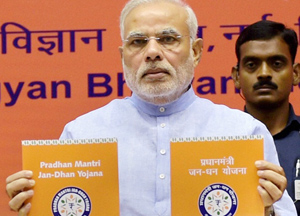
On the inaugural day, a record 1.5 crore bank accounts were opened across the country, the largest such exercise on a single day possibly anywhere in the world.

Unveiling the scheme within 100 days of forming the new government, Modi said, it will cover 7.5 crore people by January 26, 2015, who will be provided zero-balance bank account with RuPay debit card, life insurance cover of Rs 30,000 in addition to accidental insurance cover of Rs 1 lakh.

Later the account holders will be provided an overdraft facility of up to Rs 5,000.

"If Mahatma Gandhi worked to remove social untouchability, if we want to get rid of poverty, then we have to first get rid of financial untouchability. We have to connect every person with the financial system. And for that this programme has been given impetus," he said, adding, "when a bank account is opened, it's a step towards joining economic mainstream."

Modi recalled the bank nationalisation of 1969 with the avowed objective of spreading the reach of financial system to the doorsteps of poor. "But I regret to say that after 68 years of independence, not even 68 per cent of population is covered by the banking system," he said.

The scheme was simultaneously launched at multiple places by 20 Chief Ministers, several Union Ministers, including Information Minister Prakash Javadekar at Pune, Law Minister Ravi Shankar Prasad at Chennai, External Affairs Minister Sushma Swaraj at Bhopal, Home Minister Rajnath Singh at Lucknow and HRD Minister Smriti Irani at Surat.

There were in all 600 programmes and 77,852 camps were organised on the opening day to open bank accounts.

Modi said history has been created in the banking system with opening of over 1.5 crore account in a day. Besides, a record has been created by providing 1.5 crore accidental insurance covers of Rs 1 lakh.

The Prime Minister described the occasion as a festival to celebrate the liberation of the poor from a poisonous cycle ("Vish-chakra se gareebon ki aazaadi ka parv").

"Banks have assured me they will do this work before January 26. Those who oppen accounts by January 26, 2015 over and above the the Rs 1 lakh accident, they will be given life insurance cover of Rs 30,000. This will help the poor family," he said.

In the third phase, he said, these account holders would also be provided micro-pension facility.

"I believe when a person opens a bank account then he or she takes the first step to get connected with the economic system. Today the 1.5 crore family who got connected with the economic system this will give a boost to the economy," he said.

Going forward, he can avail Rs 5,000 loan from the bank, the Prime Minister said, adding, this facility would be available after six months of opening of the bank account.

Expressing satisfaction at a number of records being broken today, the Prime Minister said the nationwide success of the enrolment drive today would give confidence not just to the officials of the Department of Financial Services and banking sectors, but also to officers across the Union Government, that they can successfully achieve the goals that they set for themselves.

"Never before would insurance companies have issued 1.5 lakh accident insurance policies in a single day. Never before in economic history would 1.5 lakh bank accounts have been opened in a single day.

"Never before has the Government of India organised a programme of such scale – over 77,000 locations – with the participation of so many Chief Ministers, Union Ministers, Government and bank officials," the Prime Minister said.

Modi said this mission would also help in fighting corruption by plugging leakages in the government subsidy scheme, he said.

He further said it is easy for the rich to get a loan at low interest rates but the poor are forced to seek loans from money-lenders at five times the rate charged to the rich.

"Is it not the responsibility of the banking industry to provide banking access to the poor?" the Prime Minister asked.

The Prime Minister illustrated his point through the example of a mother saving money and being forced to hide it somewhere within the house. He said the bank officials who have opened an account for such a mother today, would get blessings.

He said a breakthrough was required to overcome the vicious cycle of poverty and debt, and that breakthrough had been achieved today.

He said there were similarities between the poor getting access to mobile telephones, and getting access to debit cards. They both had the effect of instilling confidence and pride among the poor, he added.

Now, the poor would be able to do normal bank transactions through non-smart phone as well because of introduction of new technology introduced by National Payments Corporation of India (NPCI).

A person can transfer funds, check balance through a normal phone. However, this facility was limited only to smart phones so far.

While the existing banking network would be geared up to open bank accounts of the uncovered households in both rural and urban areas, the banking sector would be expanding itself to set up additional 50,000 Business correspondents, more than 7,000 branches and more than 20,000 new ATMs in the first phase, he said

The Prime Minister said with the launch of this mission, there has been transformation. Now the bank is coming to one's doorstep for opening of bank account instead of closing of account.

Narrating his personal account, the Prime Minister said he got a bank account opened in his school with Dena Bank which remained inactive for 20 years as he had little money to deposit in the account.

So, the bank officials kept making rounds of his house to get the account closed as they had to carry out operational procedures year after year, he added.

Meanwhile, Finance Minister Arun Jaitley said around 58 per cent population in the country have bank accounts.

"In simple words it means still there are 10 crore families that are away from banking services as they do not have access to banking services, they are also deprived of means of savings," he said.

The ultimate motive of this scheme is that no family should be deprived of this service, he added.

The Finance Minister said mobile banking for the poor would be available through National Unified USSD Platform (NUUP) for which all banks and mobile companies have come together.

Normal bank transaction can be done through any phone across the country, he added.

Comments

Add new comment

  • Coastaldigest.com reserves the right to delete or block any comments.
  • Coastaldigset.com is not responsible for its readers’ comments.
  • Comments that are abusive, incendiary or irrelevant are strictly prohibited.
  • Please use a genuine email ID and provide your name to avoid reject.
Agencies
May 31,2020

New Delhi, May 31: A low pressure area formed over Arabian sea and Lakshadweep is likely to intensify further into a cyclonic storm and reach coastal states of Maharashtra and Gujarat next week, the Indian Meteorological Department (IMD) said on Sunday.

Sunitha Devi, in charge of cyclones at IMD, said, "A low pressure area has formed over southeast and adjoining east central Arabian sea and Lakshadweep area. It is very likely to concentrate into a depression during the next 24 hours and intensify further into a cyclonic storm during subsequent 24 hours."

She added, "It is likely to move nearly northwards and reach near north Maharashtra and Gujarat coasts by 3rd June."

A low pressure area and a depression are the first two levels on the IMD's eight-category scale used to classify cyclones based on their intensity.

The weather bureau said that the sea condition will be very rough and advised fishermen not to venture into the sea till June 4.

It has forecast heavy to very heavy rainfall over south coastal Maharashtra for June 2-4, on north coast on June 2-3 and in Gujarat, Daman and Diu and Dadar and Nagar Haveli on June 3-5.

IMD said that under the influence of likely formation of a low pressure system over Arabian Sea, conditions will become favourable from June 1 for onset of monsoon over Kerala.

The arrival date for monsoon in Kerala is around June 1 every year and in Maharashtra around June 10.

On Saturday, a private forecasting agency claimed that monsoon has already hit Kerala, but the assertions were quickly rebutted by the Ministry of Earth Sciences.

"The news about monsoon onset over Kerala in Social Media is not correct. Monsoon has not arrived over Kerala. The greatest enemy of knowledge is not ignorance, it is the illusion of knowledge a"Stephen Hawking," saidAMadhavan Rajeevan, Secretary, Ministry of Earth Sciences.

Kuldeep Srivastava, the head of IMD's Regional Weather Forecasting Centre said that the formation of a low pressure system in Arabian sea and its movement towards Gujarat coast will bring moisture to Delhi-NCR and North West India from June 3.

Two storms are forming over the Arabian Sea, one lies off the African coast and is likely to move over Oman and Yemen, while the other is placed close to India.

The development comes almost ten days after 'Amphan' pummeled four districts of Bengal in the fiercest cyclone in the region in a century, that left 86 people dead and rendered ten million people homeless.

Comments

kushal kumar
 - 
Monday, 1 Jun 2020

                      According  to  IMD  alert  appeared  in  some  newspapers  on  31  May  2020  ,  a  cyclonic  storm  is  brewing  in  the  Arabian  Sea  ,  which  is  likely  to  reach  coastal  districts  of  Gujarat  and  Maharashtra  by  3  June.  It  is  expected  that  the  these  States  would  take  more  care  and  appropriate  strategy  well  in  time  to  combat  the  likely  danger  to  the  coastal  districts  from  cyclonic  storm  designated  as   ‘Nisarga’.  In  this  context  ,  it  may  be  apt  to  refer  readers  to  this  Vedic  astrology  writer’s  predictive  alerts  in  article  -  “  Predictions  for  coming  year  2020  by  kushal  kumar”  -   published  last  year  2019   on  10 October   at   theindiapost.com/articles/predictions-for-coming-year-2020-by-kushal-kumar/.  The  related  text   of  the  predictive  alert   reads  as  follows  in  the  said  article  :-

“  The  next  three  months  from  April  to  June  2020  ,  appears  to  be  a  period  of  time  testing  ‘patience’   and  ‘ perseverance’   ,  introducing  several  parts  of  the  country  to  worrisome  concerns.  Coastal  States  of  India  ,  particularly  those  in  the  southern  part  ,  may  be  called  upon  to  take  more  care  and  appropriate  strategy  against  likely  cyclones  ,  storms  ,  floods  ,  coming  of  danger  via  sea  ,  landslide  and  damage  to  crops   during  April-June  in  2020.  Such  dates  of   month  of  May  as   6 , 7 ,  13 to 16  ,  25  and 26  may  be  watched  with  care.  Similarly  ,  the  dates  3 , 4 ,  11 to 13  ,  21 ,  22  and  26  in  June  2020  may  be  watched  with  care.  Coastal  States /UTs   such  as  Gujarat  ,  some  parts  of  Maharashtra  ……………………………………look  to  be  vulnerable.  It  may  be  apt  for  them  to  take  necessary  precautions  during  May-June ,  2020”. 

                    The  aforesaid  details  suggest  that  the  predictive  alert  of  this  writer   published  last  year  2019  on  10 October  ,  is  coinciding  with  the  alert  of  IMD  appeared  near  about  31 May  ,  2020. 

Kushal  kumar  ,

202- GH28 ,  Mansarovar  Apartments  ,

Sector 20  ,  Panchkula -134116  ,  Haryana.

1 June  ,  2020. 

Add new comment

  • Coastaldigest.com reserves the right to delete or block any comments.
  • Coastaldigset.com is not responsible for its readers’ comments.
  • Comments that are abusive, incendiary or irrelevant are strictly prohibited.
  • Please use a genuine email ID and provide your name to avoid reject.
News Network
February 1,2020

New Delhi, Feb 1: Prime Minister Narendra Modi on Saturday greeted the Indian Coast Guard on its raising day, appreciating its efforts to keep the country's coasts safe.

The Coast Guard came into being in 1977.

"Greetings to the Indian Coast Guard on their foundation day. Our Coast Guard has made a mark due to their remarkable efforts to keep our coasts safe," Modi tweeted.

The prime minister said the force's "concern towards the marine ecosystem is also noteworthy".

Comments

Add new comment

  • Coastaldigest.com reserves the right to delete or block any comments.
  • Coastaldigset.com is not responsible for its readers’ comments.
  • Comments that are abusive, incendiary or irrelevant are strictly prohibited.
  • Please use a genuine email ID and provide your name to avoid reject.
News Network
May 20,2020

May 20: Prime Minister K P Sharma Oli on Tuesday asserted that Lipulekh, Kalapani and Limpiyadhura belong to Nepal and vowed to "reclaim" them from India through political and diplomatic efforts, as his Cabinet endorsed a new political map showing the three areas as Nepalese territory.

Addressing Parliament, Oli said the territories belong to Nepal “but India has made it a disputed area by keeping its Army there”. “Nepalis were blocked from going there after India stationed its Army,” he said.

“India has deployed its troops in Kalapani since 1962 and our rulers in the past hesitated to raise the issue,” he said, asserting, “We will reclaim and get them back.”

The prime minister asserted that the Nepal government will make political and diplomatic efforts to reclaim the territory.

Oli also expressed the hope that India will “follow the path of truth, shown by Satya Meva Jayate, which is mentioned in the Ashoka Chakra, the national symbol of India”.

The prime minister’s remarks came a day after the Cabinet headed by him endorsed a new political map showing Lipulekh, Kalapani and Limpiyadhura under Nepal’s territory.

Foreign Minister Pradeep Kumar Gyawali said the official map of Nepal will soon be made public by the Ministry of Land Management. The move announced by Gyawali came weeks after he said that efforts were on to resolve the border issue with India through diplomatic initiatives.

Nepal''s ruling Nepal Communist Party lawmakers have also tabled a special resolution in Parliament demanding return of Kalapani, Limpiyadhura and Lipulekh to Nepal.

The Lipulekh pass is a far western point near Kalapani, a disputed border area between Nepal and India. Both India and Nepal claim Kalapani as an integral part of their territory - India as part of Uttarakhand’s Pithoragarh district and Nepal as part of Dharchula district.

Gyawali last week summoned the Indian Ambassador Vinay Mohan Kwatra and handed over a diplomatic note to him to protest against the construction of a key road connecting the Lipulekh pass with Dharchula in Uttarakhand.

India has said that the recently-inaugurated road section in Pithoragarh district in Uttarakhand lies completely within its territory. Indian Army chief Gen MM Naravane last week said that there were reasons to believe that Nepal objected to India''s newly-inaugurated road linking Lipulekh Pass with Dharchula in Uttarakhand at the behest of "someone else", in an apparent reference to a possible role by China on the matter.

He said there was no dispute whatsoever between India and Nepal in the area and road laid was very much within the Indian side.

The 80-KM-long strategically crucial road at a height of 17,000 KM along the border with China in Uttarakhand was thrown open by Defence Minister Rajnath Singh earlier this month.

Nepal has raised objection to the inauguration of the road, saying the "unilateral act" was against the understanding reached between the two countries on resolving the border issues. China on Tuesday said the Kalapani border issue is between India and Nepal as it hoped that the two neighbours could refrain from "unilateral actions" and properly resolve their disputes through friendly consultations.

After the endorsement of Nepal’s new map senior ruling party leader and member of Nepal Communist Party Standing Committee Ganesh Shah said the new move may escalate unnecessary tension between Nepal and India at a time when the country is fighting the coronavirus.

"The Nepal government should soon start a dialogue with India to resolve the matter through political and diplomatic moves," he said.

The new map includes 335-km land area including Limpiyadhura in the Nepalese territory.

The new map was drawn on the basis of the Sugauli Treaty of 1816 signed between Nepal and then the British India government and other relevant documents, which suggests Limpiyadhura, from where the Kali river originated, is Nepal''s border with India, The Kathmandu Post quoted an official at the Ministry of Land Reform and Management as saying.

India and Nepal are at a row after the Indian side issued a new political map incorporating Kalapani and Lipulekh on its side of the border in October last year.

The tension further escalated after India inaugurated the road link connecting Kailash Mansarovar, a holy pilgrimage site situated at Tibet, China, that passes through the territory belonging to Nepal.

Comments

Add new comment

  • Coastaldigest.com reserves the right to delete or block any comments.
  • Coastaldigset.com is not responsible for its readers’ comments.
  • Comments that are abusive, incendiary or irrelevant are strictly prohibited.
  • Please use a genuine email ID and provide your name to avoid reject.