



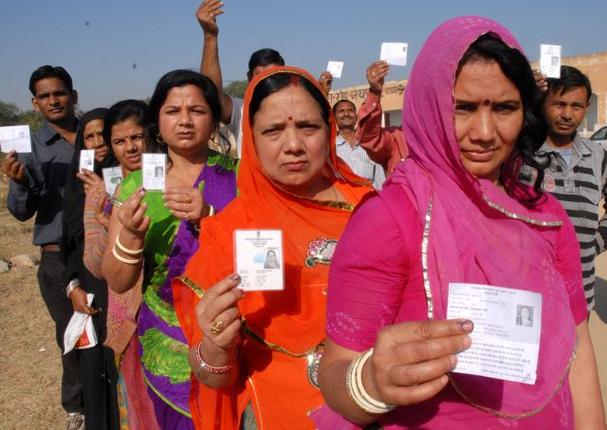
Polling begins in Rajasthan

December 1, 2013

rajastan

Jaipur, Dec 1: Polling began on Sunday in 199 Assembly seats in Rajasthan to decide the fate of 2,087 candidates including Chief Minister Ashok Gehlot and BJP’s Chief Ministerial nominee Vasundhara Raje.

Over 4.08 crore voters are eligible to exercise their franchise in 47,223 polling booths. Polling will take place between 0800 hours and 1700 hours.

Of the 200 Assembly seats, polling has been adjourned in Churu constituency, where nine people were in the fray, to December 13, following the death of BSP candidate Jagdish Meghwal.

There are 166 women and one eunuch candidate contesting the polls.

Mr. Gehlot, Ms. Raje and BJP leader Gulab Chand Kataria cast their votes in their respective constituencies.

At many polling booths in Sanager and Malviya Nagar Assembly seats of Jaipur, voters were seen approaching poll booths while on their morning walk.

Congress and BJP have fielded 200 candidates each, BSP 195, CPI(M) 38, CPI 23, NCP 16, other parties 666 and Independents 758 (including Churu constituency).

Police control room said, “Voting began peacefully and there is no report of any untoward incident.”

Of the 4.08 crore-strong electorate, 1.92 crore are women. The results will be declared on December 8.

Mr. Gehlot is contesting from his home turf of Sardarpura seat in Jodhpur district against BJP’s Rajput candidate Shambhu Singh Khetasar while Congress’ woman NSUI leader and former MLA Meenakshi Chandrawat is fighting against Ms. Raje from the Jhalarapatan seat in Jhalawar district.

Mr. Gehlot along with his wife Sunita, son Vaibhav and daughter-in-law imanshi cast their votes at Vardhman Jain upper primary school in Mahamandir area of Jodhpur.

He, while expressing confidence of retaining power for second consecutive term, rejected any impact of BJP Prime ministerial candidate Narendra Modi on the elections.

“There is a wave in favour of Congress. Ours campaigning was a positive one and we did not touch a low like BJP leaders. We gave positive message to the people and they will vote for development and works done by our government,” he told reporters.

Asked who will become the next chief minister if the party is voted to power, he said it would be decided by the party high command.

2 booth capturing bids foiled

Two alleged booth capturing bids were foiled in Rajasthan’s Bhratpur district during the State Assembly elections on Sunday.

“Several people tried to storm into a polling station for suspected booth capturing in Dhabak area in Nagar constituency but were pushed outside,” Bharatpur District Collector Neeraj K. Pawan told PTI.

“Sector magistrate informed me that he was threatened by a MLA and her supporters. Additional force was rushed to the area immediately and the situation is under control,” he said, adding, that the polling remained unaffected.

In Mawai area, some people also tried to capture a booth but the situation was soon brought under control, sources said.

Comments

Add new comment

  • Coastaldigest.com reserves the right to delete or block any comments.
  • Coastaldigset.com is not responsible for its readers’ comments.
  • Comments that are abusive, incendiary or irrelevant are strictly prohibited.
  • Please use a genuine email ID and provide your name to avoid reject.
News Network
June 27,2020

New Delhi, Jun 27: Delhi Environment Minister Gopal Rai on Saturday called an emergency meeting here to discuss the situation following a locust attack in neighbouring Gurugram.

The minister also directed the administration to be alert, an official said.

"After the emergency meeting, an advisory will be issued on steps to be taken to deal with the situation," Rai told PTI.

He asked the officials of the Agriculture department to make field visits to areas close to Gurugram.

The development secretary, divisional commissioner, director, Agriculture department, and the district magistrates of South Delhi and West Delhi will attend the meeting, the official said.

Earlier in the day, the skies over many parts of Gurugram turned dark as swarms of locusts descended on the town.

However, the migratory pests are likely to spare the national capital for now, officials said.

The swarms of locusts, spread across two kilometres, moved from west to east. They entered Gurugram around 11.30 am, K L Gurjar of the Locust Warning Organisation, Ministry of Agriculture, told PTI.

The pests, he said, were headed towards Faridabad and Palwal in Haryana.

Alarmed at the invasion of the locusts, which settled on trees, rooftops and plants, many residents of Gurugram shared videos from their high-rise perches.

In May, India battled a devastating desert locust outbreak. The crop-destroying swarms first attacked Rajasthan and then spread to Punjab, Gujarat, Maharashtra and Madhya Pradesh.

According to experts, broadly four species of locusts are found in India – desert locust, migratory locust, Bombay locust and tree locust. The desert locust is considered the most destructive.

It multiplies very rapidly and is capable of covering 150 kilometers in a day.

This insect, a type of a grasshopper, can eat more than its body weight. A one square kilometer of locust swarm containing around 40 million locusts can in a day eat as much food as 35,000 people.

Experts blame the growing menace of desert locusts on climate change. They say breeding of locusts is directly related to soil moisture and food availability.

Comments

Add new comment

  • Coastaldigest.com reserves the right to delete or block any comments.
  • Coastaldigset.com is not responsible for its readers’ comments.
  • Comments that are abusive, incendiary or irrelevant are strictly prohibited.
  • Please use a genuine email ID and provide your name to avoid reject.
Agencies
July 30,2020

New Delhi, Jul 30: Even as COVID-19 cases continue to surge in various parts of India, more than 1 million people have recovered and discharged till now, informed Rajesh Bhushan, Secretary, Ministry of Health, here on Thursday.

"More than 1 million people have recovered from COVID-19 in the country. This landmark recovery has been achieved because of the selfless work and dedication of our doctors, nurses and frontline workers," Bhushan said at a press conference.

Giving the number of cured persons, Bhushan said, "More than 1,020,000 patients have recovered. They have been discharged. It is a great achievement."

He said, "The recovery rate has shown positive trends. It was 7.85 per cent in April and today it is 64.4 per cent, which is another heartening news which tells us that whatever battle is put by the Union government in collaboration with state governments is showing results."

"Sixteen states of the country have a recovery rate that is more than the national average. Of these, Delhi has a recovery rate of 88 per cent, Ladakh 80 per cent, Haryana 78 per cent, Assam 76 per cent, Telangana 74 per cent, Tamil Nadu & Gujarat 73 per cent, Rajasthan 70 per cent, Madhya Pradesh 69 per cent and Goa 68 per cent," Bhushan said.

He said effective clinical management lead to a decrease in case fatality rate. In June it was 3.33 per cent and now 2.21 per cent.

Bhushan said the case fatality rate in India today is 2.21 per cent and it's among the lowest in the world. Twenty-four states and Union Territories have lesser fatality rate than that of the country.

Herd immunity in a country of the size and population of India can not be a strategic option. It can only be achieved through immunisation.

"Over 18,190,000 tests have been conducted in the country including RT-PCR and rapid antigen tests. There has been a week-on-week increase in average tests per day. India is conducting 324 test per 10 lakhs population per day," Bhushan said.

He added, three vaccine candidates, are in phase 3 clinical trial. These three are in the US, UK and China. In India, two indigenously developed vaccine candidates are in phase I and II of clinical trials. 

Trial of the first vaccine involves 1,150 subjects at eight sites, second on 1,000 subjects at five sites.

Comments

Add new comment

  • Coastaldigest.com reserves the right to delete or block any comments.
  • Coastaldigset.com is not responsible for its readers’ comments.
  • Comments that are abusive, incendiary or irrelevant are strictly prohibited.
  • Please use a genuine email ID and provide your name to avoid reject.
News Network
April 23,2020

Washington, Apr 23: Air pollution over northern India has plummeted to a 20-year-low for this time of the year, according to satellite data published by US space agency National Aeronautics and Space Administration (NASA).
The US space agency's satellite sensors observed aerosol levels at a 20-year low post the countrywide lockdown, implemented to slow the spread of the novel coronavirus.

"We knew we would see changes in atmospheric composition in many places during the lockdown," said Pawan Gupta, a Universities Space Research Association (USRA) scientist at NASA''s Marshall Space Flight Center. "But I have never seen aerosol values so low in the Indo-Gangetic Plain at this time of year," added Mr Gupta.

Acting Assistant Secretary of State for South and Central Asia Alice G Wells tweeted, "These images from NASA were taken each spring starting in 2016 and show a 20-year low in airborne particle levels over India. When India and the world are ready to work and travel again, let's not forget that collaborative action can result in cleaner air."

The data published with maps show aerosol optical depth (AOD) in 2020 compared to the average for 2016-2019. Aerosol optical depth is a measure of how light is absorbed or reflected by airborne particles as it travels through the atmosphere.

If aerosols are concentrated near the surface, an optical depth of 1 or above indicates very hazy conditions. An optical depth, or thickness, of less than 0.1 over the entire atmospheric vertical column is considered "clean." The data were retrieved by the Moderate Resolution Imaging Spectroradiometer (MODIS) on NASA's Terra satellite.

In the first few days of the lockdown, it was difficult to observe a change in the pollution signature. "We saw an aerosol decrease in the first week of the shutdown, but that was due to a combination of rain and the lockdown," said Mr Gupta.

Around March 27, heavy rain poured over vast areas of northern India and helped clear the air of aerosols. Aerosol concentrations usually increase again after such heavy precipitation.

"After the rainfall, I was really impressed that aerosol levels did not go up and return to normal. We saw a gradual decrease and things have been staying at the level we might expect without anthropogenic emissions," Mr Gupta said.

On March 25, the Indian government placed its 1.3 billion citizens under a strict lockdown to reduce the spread of COVID-19. The countrywide mandate decreased activity at factories and severely reduced car, bus, truck and airplane traffic. Every year, aerosols from anthropogenic (human-made) sources contribute to unhealthy levels of air pollution in many Indian cities.

Aerosols are tiny solid and liquid particles suspended in the air that reduce visibility and can damage the human lungs and heart.

In southern India though, the story is a little hazier. Satellite data show aerosol levels have not yet decreased to the same extent. In fact, levels seem to be slightly higher than in the past four years. The reasons are unclear but could be related to recent weather patterns, agricultural fires, winds or other factors.

"This a model scientific experiment," Robert Levy, program leader for NASA's MODIS aerosol products, said about the lockdown and its effects on pollution.

"We have a unique opportunity to learn how the atmosphere reacts to sharp and sudden reductions in emissions from certain sectors. This can help us separate how natural and human sources of aerosols affect the atmosphere," Mr Levy added.

Comments

Add new comment

  • Coastaldigest.com reserves the right to delete or block any comments.
  • Coastaldigset.com is not responsible for its readers’ comments.
  • Comments that are abusive, incendiary or irrelevant are strictly prohibited.
  • Please use a genuine email ID and provide your name to avoid reject.