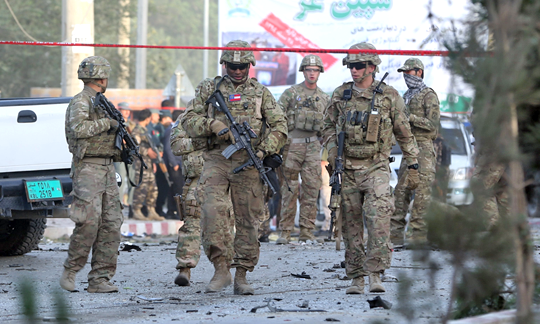
Powerful Blast Targets Foreign Forces In Kabul: At Least 8 Killed

May 3, 2017

Kabul, May 3: A powerful blast targeting a convoy of foreign forces near the US embassy in Kabul killed at least eight people and wounded 25 Wednesday, mainly civilians, officials said, the latest attack in the Afghan capital.

afghaan

Interior ministry spokesman Najib Danish confirmed the toll from the attack, which came during the busy morning rush hour, telling AFP: "Unfortunately most of (the victims) are civilians."

"We are still checking the nature of the explosion, but I confirm a convoy of foreign forces was passing by when the explosion happened," he said.

Witnesses and social media images showed the foreign troops were travelling in the armoured personnel carriers that are standard for international forces moving around Kabul.

One security source told AFP the blast came when a white Toyota Corolla exploded as the convoy drove by. It was not immediately clear if it was a car bomb or a suicide attack.

No group has yet claimed responsibility for the attack, which came days after the Taliban launched their so-called "spring offensive", in which they vowed to target international troops.

The annual offensive normally marks the start of the "fighting season", though this winter the Taliban continued to battle government forces.

Pentagon chief Jim Mattis, who visited Kabul last month as the US seeks to craft a new strategy in Afghanistan, warned of "another tough year" in the war-torn country for both foreign troops and local forces.

He would not be drawn, however, on recent calls by NATO commander in Afghanistan General John Nicholson for a "few thousand" more troops to break the "stalemate" against the insurgents.

The Afghan conflict is the longest in US history -- US-led NATO troops have been at war there since 2001, after the ousting of the Taliban regime for refusing to hand over Osama bin Laden following the 9/11 attacks in the United States.

The US has around 8,400 troops in the country with about another 5,000 from NATO allies.

A recent UN report showed that Kabul province had the highest number of civilian casualties in the first quarter of the year due to attacks in the capital.

The body had called on all groups to "take every measure possible to prevent unnecessary and unacceptable harm to Afghan civilians"

Comments

Add new comment

  • Coastaldigest.com reserves the right to delete or block any comments.
  • Coastaldigset.com is not responsible for its readers’ comments.
  • Comments that are abusive, incendiary or irrelevant are strictly prohibited.
  • Please use a genuine email ID and provide your name to avoid reject.
News Network
January 7,2020

Dubai/Washington, Jan 7: Iran's Supreme Leader Ayatollah Ali Khamenei wept in grief with hundreds of thousands of mourners thronging Tehran's streets on Monday for the funeral of military commander Qassem Soleimani, killed by a U.S. drone on U.S. President Donald Trump's orders.

The coffins of General Qassem Soleimani and Iraqi militia leader Abu Mahdi al-Muhandis, who also died in Friday's attack in Baghdad, were draped in their national flags and passed from hand to hand over the heads of mourners in central Tehran.

Responding to Trump's threats to hit 52 Iranian sites if Tehran retaliates for the drone strike, Iran's President Hassan Rouhani pointedly wrote on Twitter: "Never threaten the Iranian nation." And Soleimani's successor vowed to expel U.S. forces from the Middle East in revenge.

Khamenei, 80, led prayers at the funeral, pausing as his voice cracked with emotion. Soleimani, 62, was a national hero in Iran, even to many who do not consider themselves supporters of Iran's clerical rulers.

Aerial footage showed people, many clad in black, packing thoroughfares and side streets in the Iranian capital, chanting "Death to America!" - a show of national unity after anti-government protests in November in which many demonstrators were killed.

The crowd, which state media said numbered in the millions, recalled the masses of people that gathered in 1989 for the funeral of the Islamic Republic's founder, Ayatollah Ruhollah Khomeini. Soleimani, architect of Iran's drive to extend its influence across the Middle East, was widely seen as Iran's second most powerful figure behind Khamenei.

His killing of Soleimani has prompted concern around the world that a broader regional conflict could flare.

Trump on Saturday vowed to strike 52 Iranian targets, including cultural sites, if Iran retaliates with attacks on Americans or U.S. assets, and stood by his threat on Sunday, though American officials sought to downplay his reference to cultural targets. The 52 figure, Trump noted, matched the number of U.S. Embassy hostages held for 444 days after the 1979 Iranian Revolution.

Rouhani, regarded as a moderate, responded to Trump on Twitter.

"Those who refer to the number 52 should also remember the number 290. #IR655," Rouhani wrote, referring to the 1988 shooting down of an Iranian airline by a U.S. warship in which 290 were killed.

Trump also took to Twitter to reiterate the White House stance that "Iran will never have a nuclear weapon" but gave no other details.

'ACTIONS WILL BE TAKEN'

General Esmail Ghaani, Soleimani's successor as commander of the Quds Force, the elite unit of Iran's Revolutionary Guards charged with overseas operations, promised to "continue martyr Soleimani's cause as firmly as before with the help of God, and in return for his martyrdom we aim to rid the region of America."

"God the Almighty has promised to take martyr Soleimani's revenge," he told state television. "Certainly, actions will be taken."

Other political and military leaders have made similar, unspecific threats. Iran, which lies at the mouth of the key Gulf oil shipping route, has a range of proxy forces in the region through which it could act.

Iran's demand for U.S. forces to withdraw from the region gained traction on Sunday when Iraq's parliament passed a resolution calling for all foreign troops to leave the country.

Iraqi caretaker Prime Minister Abdel Abdul Mahdi told the U.S. ambassador to Baghdad on Monday that both nations needed to implement the resolution, the premier's office said in a statement. It did not give a timeline.

The United States has about 5,000 troops in Iraq.

Soleimani built a network of proxy militia that formed a crescent of influence - and a direct challenge to the United States and its regional allies led by Saudi Arabia - stretching from Lebanon through Syria and Iraq to Iran. Outside the crescent, Iran nurtured allied Palestinian and Yemeni groups.

He notably mobilised Shi'ite Muslim militia forces in Iraq that helped to crush ISIS, the Sunni militant group that had seized control of swathes of Syria and Iraq in 2014.

Washington, however, blames Soleimani for attacks on U.S. forces and their allies.

The funeral moves to Soleimani's southern home city of Kerman on Tuesday. Zeinab Soleimani, his daughter, told mourners in Tehran that the United States would face a "dark day" for her father's death, adding, "Crazy Trump, don't think that everything is over with my father's martyrdom."

NUCLEAR DEAL

Iran stoked tensions on Sunday by dropping all limitations on its uranium enrichment, another step back from commitments under a landmark deal with major powers in 2015 to curtail its nuclear programme that Trump abandoned in 2018.

In response, European signatories may launch a dispute resolution process against Iran this week that could lead to a renewal of the United Nations sanctions that were lifted as part of the deal, European diplomats said on Monday.

Diplomats said France, Britain and Germany could make a decision ahead of an EU foreign ministers' meeting on Friday that would assess whether there were any ways to salvage the deal.

After quitting the deal, the United States imposed new sanctions on Iran, saying it wanted to halt Iranian oil exports, the main source of government revenues. Iran's economy has been in freefall as the currency has plunged.

Trump adviser Kellyanne Conway said on Monday that he was still confident he could renegotiate a new nuclear agreement "if Iran wants to start behaving like a normal country."

Tehran has said Washington must return to the existing nuclear pact and lift sanctions before any talks can take place.

The United States advised American citizens in Israel and the Palestinian territories to be vigilant, citing the risk of rocket fire amid heightened tensions. As a U.S. ally against Iran, Israel is concerned about possible rocket attacks from Gaza, ruled by Iranian-backed Palestinian Islamists, or major Iran proxy Hezbollah in Lebanon.

Democratic critics of Trump have said the Republican president was reckless in authorising the strike, with some saying his threat to hit cultural sites amounted to a vow to commit war crimes. Trump also threatened sanctions against Iraq and said Baghdad would have to pay Washington for an air base in Iraq if U.S. troops were required to leave.


Comments

Add new comment

  • Coastaldigest.com reserves the right to delete or block any comments.
  • Coastaldigset.com is not responsible for its readers’ comments.
  • Comments that are abusive, incendiary or irrelevant are strictly prohibited.
  • Please use a genuine email ID and provide your name to avoid reject.
June 25,2020

Islamabad, Jun 25: The coronavirus cases in Pakistan crossed the 192,000-mark after 4,044 new Covid-19 infections were detected in the last 24 hours, the health ministry said on Thursday.

According to the Ministry of National Health Services, 148 more people died due to the deadly virus in the country, taking the death toll to 3,903.

With the detection of 4,044 new cases in the last 24 hours, the coronavirus tally in the country now stands at 192,970, it said.

Sindh reported a maximum number of 74,070 infections, followed by 71,191 in Punjab, 23,887 in Khyber-Pakhtunkhwa, 11,710 in Islamabad, 9,817 in Balochistan, 1,365 in Gilgit-Baltistan and 930 in Pakistan-occupied Kashmir.

A total of 81,307 patients have recovered so far from the disease.

Health authorities have so far conducted 1,171,976 coronavirus tests, including 21,835 in the last 24 hours.

Comments

Add new comment

  • Coastaldigest.com reserves the right to delete or block any comments.
  • Coastaldigset.com is not responsible for its readers’ comments.
  • Comments that are abusive, incendiary or irrelevant are strictly prohibited.
  • Please use a genuine email ID and provide your name to avoid reject.
News Network
May 7,2020

United Nations, May 7: An average of 80,000 COVID-19 cases were reported each day in April to the World Health Organization, the top UN health agency has said, noting that South Asian nations like India and Bangladesh are seeing a spike in the infections while the numbers are declining in regions such as Western Europe.

WHO Director-General Tedros Adhanom Ghebreyesus said on Wednesday that countries must also be able to manage any risk of the disease being imported into their territories, and communities should be fully educated to adjust to what will be a "new norm".

He said as the countries press forward in the common fight against COVID-19, they should also lay the groundwork for resilient health systems globally.

"More than 3.5 million cases of COVID-19 and almost 250,000 deaths have now been reported to the WHO. Since the beginning of April, an average of around 80,000 new cases have been reported to the WHO every day," Ghebreyesus said in Geneva yesterday.

Asserting that the virus cases were not just numbers, he said: "every single case is a mother, a father, a son, a daughter, a brother, sister or friend".

He said while the numbers are declining in Western Europe, more cases are being reported every day from Eastern Europe, Africa, South-East Asia, the Eastern Mediterranean and the Americas. Even within regions and within countries, there are divergent trends, the agency added.

While some countries are reporting an increase in COVID-19 cases over time, many have seen caseloads rise because they have ramped up testing, the WHO official said.

"We've also seen in Europe and Western Europe a fundamental decrease in the number of cases, but we have seen an associated increase in the number of cases reported in places like the Russian Federation. Southeast, the Western Pacific areas are relatively on the downward trend like Korea and others, but then we do see in South Asia, in places like Bangladesh, in India, some trends towards increase.

"So it's very difficult to say that any particular region is improving or (not improving). There are individual countries within each region that are having difficulties getting on top of this disease and I am particularly concerned about those countries that have (an) ongoing humanitarian crisis," WHO's Executive Director Michael Ryan said.

The death toll due to COVID-19 in India rose to 1,783 while the number of cases climbed to 52,952 on Thursday, registering an increase of 89 deaths and 3,561 cases in the last 24 hours, the Union Health Ministry said.

The number of active COVID-19 cases stood at 35,902 while 15,266 people have recovered, it said.

Noting that while seeing an increase in the number of cases is not good in terms of transmission, WHO's Emerging Diseases and Zoonoses Unit head Maria Van Kerkhove said: "but I don't want to equate that with something (being) wrong".

"I want to equate that with countries are working very hard to increase their ability to find the virus, to find people with the virus, to have testing in place to identify who has COVID-19, and putting into place what they need to do to care for those patients," Kerkhove said.

With more countries considering easing restrictions implemented to curb the spread of the coronavirus, the WHO has again reminded the authorities of the need to maintain vigilance.

"The risk of returning to lockdown remains very real if countries do not manage the transition extremely carefully, and in a phased approach," Ghebreyesus said.

He urged countries to consider the UN agency's six criteria for lifting stay-at-home measures.

That advice includes ensuring surveillance is strong, cases are declining and transmission is controlled. Health systems also must be able to detect, isolate, test and treat cases, and to trace all contacts.

Additionally, the risk of outbreak in settings such as health facilities and nursing homes needs to be minimised, while schools, workplaces and other public locations should have preventive measures in place.

"The COVID-19 pandemic will eventually recede, but there can be no going back to business as usual. We cannot continue to rush to fund panic but let preparedness go by the wayside," he said.

He said the crisis has highlighted the importance of strong national health systems as the foundation of global health security: not only against pandemics but also against the multitude of health threats that people across the world face every day.

"If we learn anything from COVID-19, it must be that investing in health now will save lives later," Ghebreyesus said.

While the world currently spends around USD 7.5 trillion on health annually, the WHO believes the best investments are in promoting health and preventing disease.

"Prevention is not only better than cure, it's cheaper, and the smartest thing to do," he said.

The deadly coronavirus, which originated from the Chinese city of Wuhan in December last year, has infected over 3.7 million people and killed 263,831 people globally, according to a tally by Johns Hopkins University.

Comments

Add new comment

  • Coastaldigest.com reserves the right to delete or block any comments.
  • Coastaldigset.com is not responsible for its readers’ comments.
  • Comments that are abusive, incendiary or irrelevant are strictly prohibited.
  • Please use a genuine email ID and provide your name to avoid reject.