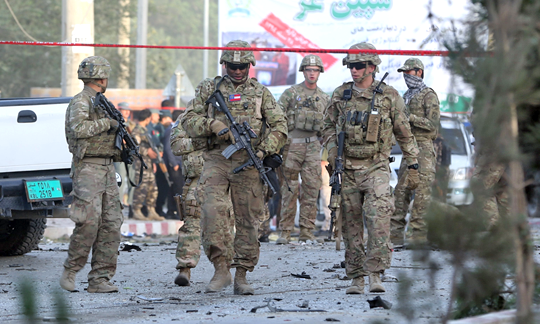
Powerful Blast Targets Foreign Forces In Kabul: At Least 8 Killed

May 3, 2017

Kabul, May 3: A powerful blast targeting a convoy of foreign forces near the US embassy in Kabul killed at least eight people and wounded 25 Wednesday, mainly civilians, officials said, the latest attack in the Afghan capital.

afghaan

Interior ministry spokesman Najib Danish confirmed the toll from the attack, which came during the busy morning rush hour, telling AFP: "Unfortunately most of (the victims) are civilians."

"We are still checking the nature of the explosion, but I confirm a convoy of foreign forces was passing by when the explosion happened," he said.

Witnesses and social media images showed the foreign troops were travelling in the armoured personnel carriers that are standard for international forces moving around Kabul.

One security source told AFP the blast came when a white Toyota Corolla exploded as the convoy drove by. It was not immediately clear if it was a car bomb or a suicide attack.

No group has yet claimed responsibility for the attack, which came days after the Taliban launched their so-called "spring offensive", in which they vowed to target international troops.

The annual offensive normally marks the start of the "fighting season", though this winter the Taliban continued to battle government forces.

Pentagon chief Jim Mattis, who visited Kabul last month as the US seeks to craft a new strategy in Afghanistan, warned of "another tough year" in the war-torn country for both foreign troops and local forces.

He would not be drawn, however, on recent calls by NATO commander in Afghanistan General John Nicholson for a "few thousand" more troops to break the "stalemate" against the insurgents.

The Afghan conflict is the longest in US history -- US-led NATO troops have been at war there since 2001, after the ousting of the Taliban regime for refusing to hand over Osama bin Laden following the 9/11 attacks in the United States.

The US has around 8,400 troops in the country with about another 5,000 from NATO allies.

A recent UN report showed that Kabul province had the highest number of civilian casualties in the first quarter of the year due to attacks in the capital.

The body had called on all groups to "take every measure possible to prevent unnecessary and unacceptable harm to Afghan civilians"

Comments

Add new comment

  • Coastaldigest.com reserves the right to delete or block any comments.
  • Coastaldigset.com is not responsible for its readers’ comments.
  • Comments that are abusive, incendiary or irrelevant are strictly prohibited.
  • Please use a genuine email ID and provide your name to avoid reject.
News Network
May 3,2020

London, May 3: The British government had a contingency plan for prime minister Boris Johnson’s death as his condition deteriorated while he battled COVID-19 last month in intensive care, Johnson said in an interview with The Sun newspaper.

Johnson returned to work on Monday, a month after testing positive for COVID-19. Johnson, 55, spent 10 days in isolation in Downing Street from late March, but was then was taken to London’s St Thomas’ Hospital where he received oxygen treatment and spent three nights in intensive care.

“They had a strategy to deal with a ‘death of Stalin’-type scenario,” Johnson, 55, was quoted as saying by The Sun. “It was a tough old moment, I won’t deny it.”

After Johnson was discharged, St Thomas’ said it was glad to have cared for the prime minister, but the hospital has given no details about the gravity of his illness beyond stating that he was treated in intensive care.

Johnson and his fiancée, Carrie Symonds, on Saturday announced the name of their newly born son as Wilfred Lawrie Nicholas, partly as a tribute to two of the intensive care doctors who they said had saved Johnson’s life.

“The doctors had all sorts of arrangements for what to do if things went badly wrong,” Johnson said of his COVID-19 battle. “The bloody indicators kept going in the wrong direction.”

He said doctors discussed invasive ventilation.

“The bad moment came when it was 50-50 whether they were going to have to put a tube down my windpipe,” he said. “That was when it got a bit . . . they were starting to think about how to handle it presentationally.”

Comments

Add new comment

  • Coastaldigest.com reserves the right to delete or block any comments.
  • Coastaldigset.com is not responsible for its readers’ comments.
  • Comments that are abusive, incendiary or irrelevant are strictly prohibited.
  • Please use a genuine email ID and provide your name to avoid reject.
News Network
July 26,2020

Seoul, Jul 26: North Korean authorities have imposed a lockdown on the border city of Kaesong after discovering what they called the country's first suspected case of the novel coronavirus, state media reported Sunday.

Leader Kim Jong Un convened an emergency politburo meeting on Saturday to implement a "maximum emergency system and issue a top-class alert" to contain the virus, official news agency KCNA said.

If confirmed, it would be the first officially recognised COVID-19 case in the North where medical infrastructure is seen as woefully inadequate for dealing with any epidemic.

KCNA said a defector who had left for the South three years ago returned on July 19 after "illegally crossing" the heavily fortified border dividing the countries.

But there have been no reports in the South of anyone leaving through what is one of the world's most secure borders, replete with minefields and guard posts.

Pyongyang has previously insisted not a single case of the coronavirus had been seen in the North despite the illness having swept the globe, and the country's borders remain closed.

The patient was found in Kaesong City, which borders the South, and "was put under strict quarantine", as would anybody who had come in close contact, state media said.

It was a "dangerous situation... that may lead to a deadly and destructive disaster", the media outlet added.

Kim was quoted as saying "the vicious virus could be said to have entered the country", and officials on Friday took the "preemptive measure of totally blocking Kaesong City".

The nuclear-armed North closed its borders in late January as the virus spread in neighbouring China and imposed tough restrictions that put thousands of its people into isolation, but analysts say the North is unlikely to have avoided the contagion.

South Korea is currently recording around 40 to 60 cases a day.

Earlier this month Kim warned against any "hasty" relaxation of anti-coronavirus measures, indicating the country will keep its borders closed for the foreseeable future.

Comments

Add new comment

  • Coastaldigest.com reserves the right to delete or block any comments.
  • Coastaldigset.com is not responsible for its readers’ comments.
  • Comments that are abusive, incendiary or irrelevant are strictly prohibited.
  • Please use a genuine email ID and provide your name to avoid reject.
News Network
April 21,2020

New York, Apr 21: Oil prices plunged below zero on Monday as demand for energy collapses amid the coronavirus pandemic and traders don't want to get stuck owning crude with nowhere to store it.

Stocks were also slipping on Wall Street in afternoon trading, with the S&P 500 down 0.9%, but the market's most dramatic action was by far in oil, where benchmark U.S. crude for May delivery plummeted to negative $3.70 per barrel, as of 2:15 pm. Eastern time.

Much of the drop into negative territory was chalked up to technical reasons — the May delivery contract is close to expiring so it was seeing less trading volume, which can exacerbate swings. But prices for deliveries even further into the future, which were seeing larger trading volumes, also plunged.

Demand for oil has collapsed so much due to the coronavirus pandemic that facilities for storing crude are nearly full.

Tanks could hit their limits within three weeks, according to Chris Midgley, head of analytics at S&P Global Platts.

Benchmark U.S. crude oil for June delivery, which shows a more ”normal” price, fell 14.8% to $21.32 per barrel, as factories and automobiles around the world remain idled. Big oil producers have announced cutbacks in production in hopes of better balancing supplies with demand, but many analysts say it's not enough.

“Basically, bears are out for blood,” analyst Naeem Aslam of Avatrade said in a report. “The steep fall in the price is because of the lack of sufficient demand and lack of storage place given the fact that the production cut has failed to address the supply glut.”

Halliburton swung between gains and sharp losses, even though it reported stronger results for the first three months of 2020 than analysts expected. The oilfield engineering company said that the pandemic has created so much turmoil in the industry that it “cannot reasonably estimate” how long the hit will last. It expects a further decline in revenue and profitability for the rest of 2020, particularly in North America.

Brent crude, the international standard, was down $1.78 to $26.30 per barrel. .

In the stock market, the mild drops ate into some of the big gains made since late March, driven lately by investors looking ahead to parts of the economy possibly reopening as infections level off in hard-hit areas.

Pessimists have called the rally overdone, pointing to the severe economic pain sweeping the world and continued uncertainty about how long it will last.

The Dow Jones Industrial Average was down 364 points, or 1.5%, to 23,887. The Nasdaq was down 0.1%..

More gains from companies that are winners in the new stay-at-home economy helped limit the market's losses Amazon rose 1.4%, and Netflix jumped 3.8% as people shut in at home buy staples and look to fill their time. Clorox likewise rose toward a new record and was up 1% as households and businesses that remain open look to stay clean.

In Tokyo the Nikkei 225 fell 1.1% after Japan reported that its exports fell nearly 12% in March from a year earlier as the pandemic hammered demand in its two biggest markets, the U.S. and China.

The Hang Seng index in Hong Kong lost 0.2%, and South Korea's Kospi fell 0.8%.

European markets were modestly higher The German DAX was up 0.5%, the French CAC 40 was up 0.7% and the FTSE 100 in London gained 0.7%.

In a sign of continued caution in the market, Treasury yields remained extremely low. The yield on the 10-year Treasury slipped to 0.64% from 0.65% late Friday. It started the year near 1.90%. Bond yields drop when their prices rise, and investors tend to buy Treasurys when they're worried about the economy.

Stocks have been on a generally upward swing recently, and the S&P 500 just closed out its first back-to-back weekly gain since the market began selling off in February. Promises of massive aid for the economy and markets by the Federal Reserve and U.S. government ignited the rally, which sent the S&P 500 up as much as 28.5% since a low on March 23.

More recently, countries around the world have tentatively eased up on business-shutdown restrictions put in place to slow the spread of the virus.

But health experts warn the pandemic is far from over and new flareups could ignite if governments rush to allow ”normal” life to return prematurely.

The S&P 500 remains about 15% below its record high in February as millions more U.S. workers file for unemployment every week amid the shutdowns.

Many analysts also warn that a significant part of the recent recovery in stocks is due to the expectation among some investors that the economy will rebound sharply once economic quarantines are lifted. They're essentially predicting that a line chart of the economy will ultimately resemble the letter “V,” with a wild ride down but then a quick pivot to a vigorous recovery.

That may be to optimistic. “We caution that a U-shaped recovery is also quite likely,” where the economy bottoms out and stays at that low level for a while before recovering, strategists at Barclays warned in a recent report.

Without strong testing programs for COVID-19, businesses likely won't feel comfortable bringing back their full workforces for a while.

”With risk assets now overbought, the chance for a correction has increased,” Morgan Stanley strategists wrote in a report.


Comments

Add new comment

  • Coastaldigest.com reserves the right to delete or block any comments.
  • Coastaldigset.com is not responsible for its readers’ comments.
  • Comments that are abusive, incendiary or irrelevant are strictly prohibited.
  • Please use a genuine email ID and provide your name to avoid reject.