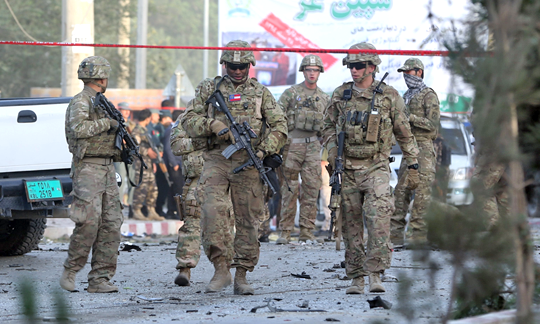
Powerful Blast Targets Foreign Forces In Kabul: At Least 8 Killed

May 3, 2017

Kabul, May 3: A powerful blast targeting a convoy of foreign forces near the US embassy in Kabul killed at least eight people and wounded 25 Wednesday, mainly civilians, officials said, the latest attack in the Afghan capital.

afghaan

Interior ministry spokesman Najib Danish confirmed the toll from the attack, which came during the busy morning rush hour, telling AFP: "Unfortunately most of (the victims) are civilians."

"We are still checking the nature of the explosion, but I confirm a convoy of foreign forces was passing by when the explosion happened," he said.

Witnesses and social media images showed the foreign troops were travelling in the armoured personnel carriers that are standard for international forces moving around Kabul.

One security source told AFP the blast came when a white Toyota Corolla exploded as the convoy drove by. It was not immediately clear if it was a car bomb or a suicide attack.

No group has yet claimed responsibility for the attack, which came days after the Taliban launched their so-called "spring offensive", in which they vowed to target international troops.

The annual offensive normally marks the start of the "fighting season", though this winter the Taliban continued to battle government forces.

Pentagon chief Jim Mattis, who visited Kabul last month as the US seeks to craft a new strategy in Afghanistan, warned of "another tough year" in the war-torn country for both foreign troops and local forces.

He would not be drawn, however, on recent calls by NATO commander in Afghanistan General John Nicholson for a "few thousand" more troops to break the "stalemate" against the insurgents.

The Afghan conflict is the longest in US history -- US-led NATO troops have been at war there since 2001, after the ousting of the Taliban regime for refusing to hand over Osama bin Laden following the 9/11 attacks in the United States.

The US has around 8,400 troops in the country with about another 5,000 from NATO allies.

A recent UN report showed that Kabul province had the highest number of civilian casualties in the first quarter of the year due to attacks in the capital.

The body had called on all groups to "take every measure possible to prevent unnecessary and unacceptable harm to Afghan civilians"

Comments

Add new comment

  • Coastaldigest.com reserves the right to delete or block any comments.
  • Coastaldigset.com is not responsible for its readers’ comments.
  • Comments that are abusive, incendiary or irrelevant are strictly prohibited.
  • Please use a genuine email ID and provide your name to avoid reject.
News Network
June 9,2020

Washington, Jun 9: When epidemiologists talked about "flattening the curve," they probably didn't mean it this way: the US hit its peak coronavirus caseload in April, but since that time the graph has been on a seemingly unending plateau.

That's unlike several other hard-hit countries which have successfully pushed down their numbers of new cases, including Spain and Italy, which now have bell-shaped curves.

Experts say the prolonged nature of the US epidemic is the result of the cumulative impact of regional outbreaks, as the virus that started out primarily on the coasts and in major cities moves inward.

Layered on top of that are the effects of lifting lockdowns in parts of the country that are experiencing rising cases, as well as a lapse in compliance with social distancing guidelines because of economic hardship, and in some cases a belief that the threat is overstated.

"The US is a large country both in geography and population, and the virus is at very different stages in different parts of the country," Tom Frieden, a former director of the Centers for Disease Control and Prevention told AFP.

The US saw more than 35,000 new cases for several days in April. While that figure has declined, it has still been exceeding 20,000 regularly in recent days.

By contrast, Italy was regularly hitting more than 5,000 cases per day in March but is currently experiencing figures in the low hundreds.

"We did not act quickly and robustly enough to stop the virus spreading initially, and data indicate that it travelled from initial hotspots along major transport routes into other urban and rural areas," added Frieden, now CEO of the non-profit Resolve to Save Lives.

To wit: the East Coast states of New York, New Jersey and Massachusetts accounted for about 50 percent of all cases until about a month or so ago -- but now the geographic footprint of the US epidemic has shifted to the Midwest and southeast, including Florida.

Another key problem, said Jennifer Nuzzo, an epidemiologist at Johns Hopkins, is that the United States is still not doing enough testing, contact tracing and isolation.

After coming late to the testing party -- for reasons ranging from technical issues to regulatory hurdles -- the US has now conducted more COVID-19 tests than any other country.

It even has one of the highest per capita rates per country of 62 per 1,000 people, according to the website ourworldindata.org -- better than Germany (52 per 1,000) and South Korea (20 per 1,000).

But according to Nuzzo, these numbers are misleading, because "the amount of testing that a country should do should be scaled to the size of its epidemic.

"The United States has the largest epidemic in the world so obviously we need to do a lot more testing than any other country."

For Johns Hopkins, the more important metric is the positivity rate -- that is, out of all tests conducted, how many came back positive for COVID-19.

As of June 7, the United States had an average daily positivity rate of 14 percent, well above the World Health Organization guideline of 5 percent over two weeks before social distancing guidelines should be relaxed.

By contrast, Germany, which has tested far fewer people in relation to its population, has a positivity rate of 5 percent.

Even if testing were scaled up, carrying out tests in of itself does very little good without the next steps -- finding out who was exposed and then asking them to isolate.

Here also, too many US states are lagging woefully behind.

Texas, which is experiencing a surge in cases after relaxing its lockdown, is a case in point. The state targeted hiring a modest 4,000 tracers by June, but according to local reports is still more than a thousand shy of even that goal.

Opt-in app based efforts have also been slow to get off the ground.

Then there is the fact that some people are growing tired of lockdowns, while others don't have the economic luxury of being able to stay home for prolonged periods.

The government sent some 160 million Americans a single stimulus check of up to $1,200 back in April but it's not clear whether more will be forthcoming.

Still others, particularly in so-called red states under Republican leadership, have chafed under restrictions and mask-wearing guidelines that they see as an affront to their personal freedom.

"The US is kind of on the extreme of the individual liberty side," Sten Vermund, dean of the Yale School of Public Health, told AFP.

Part of this has to do with mixed messaging from Republican leaders, including President Donald Trump, said Nuzzo.

"We have had at the highest political level an assertion that this is a situation that's been overblown, and that maybe certain protective behaviors are not necessary," she said.

More recently, tens of thousands of people across the country have taken to the streets to protest the killing on an unarmed black man by police, risking coronavirus infection to demonstrate against the public health threat of racialized state violence.


Comments

Add new comment

  • Coastaldigest.com reserves the right to delete or block any comments.
  • Coastaldigset.com is not responsible for its readers’ comments.
  • Comments that are abusive, incendiary or irrelevant are strictly prohibited.
  • Please use a genuine email ID and provide your name to avoid reject.
News Network
May 18,2020

Beijing, May 18: China has reported 25 new COVID-19 patients, the health authorities said on Monday, as 14 asymptomatic cases were detected in Wuhan, the first epicentre of the coronavirus where officials are doing mass testing of the city's entire 11 million population, taking the number of such cases in the city to 337, the highest in the country.

The death toll in China remained at 4,634 on Sunday with no new fatalities reported.

China's National Health Commission (NHC) reported seven new confirmed cases of COVID-19 and 18 asymptomatic cases on Sunday.

Jilin province where the government has implemented strict control measures in the last few days following reports of clusters of cases in Jilin city reported two cases on Sunday, while Shanghai city has reported one.

As of Sunday, the overall confirmed cases in China had reached 82,954, including 82 patients who are still being treated, and 78,238 people who have been discharged after recovery.

Also on Sunday, 18 new asymptomatic cases including two from abroad were reported in China, taking the total number under medical observation to 448, the NHC said.

Asymptomatic cases pose a problem as the patients are tested COVID-19 positive but develop no symptoms such as fever, cough or sore throat. However, they pose a risk of spreading the disease to others.

Wuhan which is undergoing mass testing of the city's entire over 11 million population to determine the prevalence of the virus has reported no new confirmed cases, but 14 new asymptomatic infections, taking the number of such cases in the city to 337, the highest in the country, according to the figures released by the local health commission on Sunday.

The death toll in Hubei province stood at 4,512, including 3,869 in Wuhan.

The province so far has reported 68,134 confirmed COVID-19 cases in total, including 50,339 in Wuhan, according to the officials figures.

As the cases dropped, China on Sunday exempted people in Beijing from wearing masks, signalling that the virus is under control in the national capital.

As the virus is abating in the country, China is opening up all its business including entertainment centres like Shanghai Disneyl and to show that it has managed to control the dreaded virus while the world is struggling with it with lockdowns and massive casualties.

The novel coronavirus which originated in Wuhan in December last year has claimed 315,185 lives and infected over 4.7 million people globally, according to Johns Hopkins University data.

Comments

Add new comment

  • Coastaldigest.com reserves the right to delete or block any comments.
  • Coastaldigset.com is not responsible for its readers’ comments.
  • Comments that are abusive, incendiary or irrelevant are strictly prohibited.
  • Please use a genuine email ID and provide your name to avoid reject.
News Network
January 31,2020

Wuhan, Jan 31: The World Health Organization declared a global emergency over the new coronavirus, as China reported Friday the death toll had climbed to 213 with nearly 10,000 infections.

The UN health agency based in Geneva had initially downplayed the threat posed by the disease, but revised its risk assessment after crisis talks.

suspended or reduced service to China include British Airways, German flag carrier Lufthansa, American Airlines, KLM and United.

Chinese efforts to halt the virus have included the suspension of classes nationwide and an extension of the Lunar New Year holiday.

All football matches across the country also will be postponed, the Chinese Football Association said on Thursday, including games in the top-tier Chinese Super League.

World stock markets tumbled again Thursday on fears that trouble in the "world's factory" would upset global supply chains and dent profits.

Toyota, IKEA, Starbucks, Tesla, McDonald's and tech giant Foxconn were among the corporate giants temporarily freezing production or closing large numbers of outlets in China.

Volkswagen announced Thursday its China joint-venture plants would not start production again before February 9.

US Federal Reserve Chairman Jerome Powell said the coronavirus posed a fresh risk to the world economy.

Throughout China, signs of paranoia multiplied, with residents of some Beijing residential compounds erecting makeshift barriers to their premises.

In one of many similar photos posted online, a man wearing a surgical mask and brandishing a traditional martial arts weapon squatted on a barricade outside a Chinese village, near a sign saying: "Outsiders forbidden from entering".

The crisis has caused food prices to spike, and the central government on Thursday blamed this partly on overzealous preventive measures, issuing a directive banning any roadblocks or other hindrances to food shipments.

Comments

Add new comment

  • Coastaldigest.com reserves the right to delete or block any comments.
  • Coastaldigset.com is not responsible for its readers’ comments.
  • Comments that are abusive, incendiary or irrelevant are strictly prohibited.
  • Please use a genuine email ID and provide your name to avoid reject.