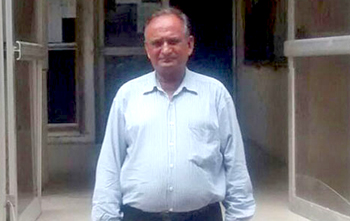
Prank video to Bajrangi Bhaijaan: Chand Nawab is a star in Pakistan

July 21, 2015

New Delhi, Jul 21: Pakistani television journalist Chand Nawab is over the moon that he inspired a character in the hit film Bajrangi Bhaijaan, which features Salman Khan as an Indian who sneaks into Pakistan to reunite a speech-impaired girl with her family.

chand nawab“I saw the film on the first day it was released in Pakistan. And I was very happy with the way Nawazuddin Siddiqui portrayed me in Bajrangi Bhaijaan,” Nawab told Hindustan Times on phone from Karachi on Monday.

“Do you know that all shows of the film have been booked in advance till July 27? People can’t get tickets for any of the four daily shows at all halls in Karachi. And so many people have been calling me to tell me they enjoyed watching the character inspired by me,” he said.

Six years ago, Nawab became an unlikely hit on YouTube after his colleagues posted a video of his flubs as a prank. It was this same video that inspired the character of Chand Nawab, the Pakistani journalist who helps Salman Khan in Bajrangi Bhaijaan.

“I want to thank (director) Kabir Khan, Salman Khan and Nawazuddin Siddiqui for the way they portrayed me and Pakistan in the film. Nawazuddin has done a good role,” said Nawab, a reporter with Karachi-based Indus News.

“I was on a TV show with Kabir Khan and he suggested I should come to Mumbai and work in films,” he added with a laugh.

Nawab said he had been receiving calls from friends and colleagues even at 3am to discuss the character in the film. “Others have been coming to my home with cakes and sweets. My colleagues and bosses have expressed their appreciation,” he said.

And thanks to the film, there have also been offers to appear in Pakistani television commercials. “There have been some offers, let’s see what happens,” said Nawab, whose mother hailed from Agra and his father from Bharatpur.

But there is also a tinge of regret. Nawab said he would have been happier if his wife Riffat, who passed away last year, could have watched Bajrangi Bhaijaan with him.

“She was a doctor and she inspired me a lot. She would always stand by me,” he said, adding that his ‘sasural’ (in-laws’ home) is at Tonk in Rajasthan.

While 52-year-old Nawab is now basking in the fame generated by Bajrangi Bhaijaan, there was a time when he was upset by the video on YouTube that started it all.

“I had once gone to Iran some years ago and I met some Indian journalists there. At the time, I told them that the YouTube video had spoiled my reputation not just in Pakistan but also in India. People would point to that video and say, ‘Look, this is the quality of Pakistani television journalism,’” he said.

But as time passed, Nawab changed his opinion about the video that features a series of flubs he made while recording a P2C or piece-to-camera, the clip that anchors a television report, for a report about people leaving Karachi to spend the Eid holidays with their families in the interiors of Sindh.

Nawab wanted the P2C to feature a train pulling out the railway station behind him but the flubs made him repeat the same sentence almost 20 times. At other times, he was interrupted by people walking up and down the stairway on which he was standing.

Perhaps the ultimate tribute is that the YouTube video inspired a complete scene in Bajrangi Bhaijaan.

Comments

Add new comment

  • Coastaldigest.com reserves the right to delete or block any comments.
  • Coastaldigset.com is not responsible for its readers’ comments.
  • Comments that are abusive, incendiary or irrelevant are strictly prohibited.
  • Please use a genuine email ID and provide your name to avoid reject.
News Network
January 23,2020

Jan 23: Calling himself an optimist who believes in the goodness of people, director Kabir Khan says everything these days is being looked at through the prism of religion but India is about more than that.

The director of blockbusters such as Bajrangi Bhaijaan and Ek Tha Tiger said he is happy he has a platform as a filmmaker to present a counterpoint to the prevailing narrative based on religious fault lines.

"I’m an optimist who believes in the goodness of the people. But yes, there is a certain level of bigotry that has crept in. Everything is being looked at through the prism of religion but India is not about that.

"It sounds like a cliché but when I was growing up, I was not aware of my religion. That was the greatness of this country,” Kabir told news agency.

He said he is a product of a mixed marriage and is pained to see the social fabric being tattered.

“I have celebrated the best that Indian secularism has to offer. But to see the greatness of this country being simplified and broken down into religious fault lines is a painful experience,” he added.

According to Kabir, it is dangerous to see history through the prism of religion, whether in cinema or society. But it is important to revisit history to know what happened and one can always find something that is relevant for the present, he said.

The director, who started as a documentary filmmaker, returns to his roots for a five-episode series on Subhas Chandra Bose's Indian National Army, The Forgotten Army: Azaadi Ke Liye, on Amazon Prime, his most expensive project yet.

Asked whether this is a difficult time for filmmakers, Kabir said he believes art thrives in the time of strife and, as a storyteller, his politics will always reflect in his work.

“Every film has its politics and every filmmaker has to reflect his or her politics. Every film of mine will reflect my politics and it will never change according to the popular mood of the audience. But a film should not be just about that. Politics should be in the layers beneath," he said.

He terms his 2015 Salman Khan-starrer Bajrangi Bhaijaan an "extremely political" film. At face value, it can also be enjoyed as the story of a mute Pakistani girl who drifts into India and is taken back to her homeland by a Hanuman devotee. But there is so much more. The "chicken song", for instance, was a sly reference to the beef ban controversy at the time, he said.

"I won’t say it is a difficult time for me as a filmmaker. It is good that I have a platform where I can talk and present a counterpoint and I refuse to believe that the entire country believes the narrative that is being sent out. There are millions and millions of people, and perhaps the majority, that does not believe. And if I present the counterpoint, they will think about it.”

Discussing his new series, the director said it has always fascinated him that the sacrifice of the men and women who comprised the INA is just a forgotten footnote in history.

“I wanted to make something that stands the test of time. It goes down in posterity,” Khan, who first explored the subject in a Doordarshan documentary 20 years ago, said.

For the documentary, he traveled with former INA officers Captain Lakshmi Sahgal and Captain Gurbaksh Singh Dhillon from Singapore to India via erstwhile Burma, retracing the route that the INA followed.

“The documentary got me a lot of attention and acclaim but the story just never left me. It's actually the first script I ever wrote and I landed up with that script in Bombay from Delhi. I realised very soon that nobody's going to give me a budget of this size to make my first film.

"And then after every film, I would pick up the script and say, ‘Okay, this is the one I want to make’, because this is the story that made me want to become a filmmaker. On the way, I ended up making eight other films but this is really the story that I wanted to make,” he said.

Kabir is happy that the story has come out as a series, not a film, as it would have required to compromise with the budget and other elements.

"Without giving any numbers, this is the most expensive project I have ever worked on… It required that kind of budget."

Kabir believes the INA was responsible for bringing down the morale of the British establishment, which realised it would be impossible to keep the country colonised without the support of the local army.

"There are a lot of debates and discussions about what happened with the INA and the controversies around it. The whole point is that, if you want to judge what the Army did, sure that's your prerogative, but at least get to know what they did. Nobody knows what happened with the Army from 1942 to 1945."

He added that 55,000 men and women of the INA fought for independence and 47,000 of them died.

"Not a single person from that Army was ever taken back into the independent Army, which is such an amazing fact... the fact that the British called them traitors became the narrative and we also started assuming that they were traitors."

"They were the only women's regiment in the whole world 70 years ago. That's what they thought about women's importance in society. I don't know whether they will be happy with what the current situation is," he said.

Comments

Add new comment

  • Coastaldigest.com reserves the right to delete or block any comments.
  • Coastaldigset.com is not responsible for its readers’ comments.
  • Comments that are abusive, incendiary or irrelevant are strictly prohibited.
  • Please use a genuine email ID and provide your name to avoid reject.
News Network
July 24,2020

New Delhi, Jul 24: With more than 50 movies under her credits and being one of the few actors from Bollywood to make a strong imprint in Hollywood, actor Priyanka Chopra started it all by winning Miss India 2000 pageant.

Chopra who is currently celebrating the completion of 20 years in the entertainment industry, on Friday looked back and reacted to the video where she was crowned as Miss India.
The' Fashion' actor shared a video on Instagram, where she is seen watching the throwback video. The 'Dostana' actor recalled winning the title and joked about her sense of style and poses back then.

Sharing the reaction video, she wrote: "Alright guys, we're doing this! I'm watching footage from my Miss India pageant in 2000! This is where it all began... If you've never seen these before, you are in for quite a treat. #20in2020 @feminamissindia."

Throughout the video, the 'Gunday' actor is seen casually commenting on her hairstyle, enacting her own movement on stage, and also recalled her luscious hair, which she now wonders where it all got lost.

However, she took a moment to appreciate the "clever and profound" answer she gave for the question that won her the crown.

While watching the winning moment, the 'Don' star noted how she never expected to win it. She explained that she had a train booked as she was to go back and take her board exams.

Going through the old photographs that run parallel to the video, she says: "These pictures are hard to look at." Pausing at a particular photograph, she laughs and says, "I don't even know how to do that pose."

"Well, this is where everything started. These are the pictures that sent me to Tinseltown," said the actor towards the end of the video.

Comments

Add new comment

  • Coastaldigest.com reserves the right to delete or block any comments.
  • Coastaldigset.com is not responsible for its readers’ comments.
  • Comments that are abusive, incendiary or irrelevant are strictly prohibited.
  • Please use a genuine email ID and provide your name to avoid reject.
News Network
June 26,2020

New Delhi, Jun 26: Actor Sushant Singh Rajput’s death has exposed the deep faultlines in the Hindi film industry with issues such as bullying, nepotism and discrimination emerging from tinsel town’s rarely discussed dark corners into the spotlight of introspection and debate.

The days since the death of the 34-year-old actor, whose body was found in his Mumbai apartment on June 14, have split the glamour industry down the middle – between ‘insiders’ and ‘outsiders’, 'us' vs 'them', and those born to fame and those who sweated for it.

That Rajput, who came from a middle class home in Patna and made his mark in mainstream Hindi cinema in what could be the classic fairytale, ended his life led to soul searching about power structures in Bollywood and also angry accusations at the biggies who call the shots.

'Outsider' Manoj Bajpayee said the structural shift that everyone in the industry wants to see will begin once the powerful abolish the "insider-outsider" divide.

"Nepotism has been in the debate for a few years now. It'll change only if each and every individual who is positioned well, who is established and powerful starts making efforts to make it healthy and democratic for all the talented people who are coming in," Bajpayee said.

“We will have to work very hard to turn this industry into a fraternity where each and everyone is welcomed," he said. Dibakar Banerjee, who directed Rajput in Detective Byomkesh Bakshy!, added that outsiders need to put in twice the amount of work as compared to star children to convince the industry, the public and the box office of their talent.

"The biggest unfairness in all this is that it takes double the talent, energy and hard work for an outsider to convince the audience and the industry that he or she is as safe a box office bet as a mediocre, unmotivated and entitled establishment elite," he told news agency.

Rajput was considered that rare actor, after Shah Rukh Khan perhaps, to have transitioned from television to Bollywood stardom and his death opened the proverbial can of worms.

Detective Byomkesh Bakshy! was produced by Yash Raj Films, which also backed Rajput’s Shuddh Desi Romance. As rumours swirled about unfair contract details, the powerful production house and other industry bigwigs and star children such as Karan Johar, Alia Bhatt and Sonam Kapoor faced ire from not just the public but even some of their colleagues.

The untimely death of the young actor had clearly not just touched a chord but triggered a rallying cry for change.

An out of context, old clip from Johar's chat show Koffee with Karan in which Bhatt is seen joking about Rajput and Kapoor confesses not knowing him fuelled the anger.

Hashtags like #BoycottKhans, #boycottnepotism and #JusticeForSushantSinghRajput started trending online a day after the actor's death with many calling for a boycott for the films made by Johar and featuring star children.

An online petition on Change.org asking fans to boycott Johar, YRF and Salman Khan has gathered almost 38 lakh signatures so far.

Reflecting the split in filmdom, Johar unfollowed everyone on Twitter except eight people, including Prime Minister Narendra Modi, Shah Rukh Khan and Amitabh Bachchan.

Hate comments also made actor Sonakshi Sinha, daughter of veteran actor-politician Shatrughan Sinha, deactivate her Twitter account last week.

Kapoor, too, disabled the comments section on her Instagram page and that of her father, veteran actor Anil Kapoor.

The public's angst found resonance in Bollywood with many in the fraternity saying the industry needs to introspect on how it treats outsiders.

Actors Gulshan Devaiah and Sushmita Sen, directors Hansal Mehta and Onir and singers Sonu Nigam and Kumar Sanu were amongst the many people who spoke out on the deeply disturbing issues that Rajput’s death had thrown up.

Mehta made a distinction between nepotism and bullying. 

He said his son Jai Mehta was an assistant director in his own film Shahid and also in Anurag Kashyap's Gang of Wasseypur series. He stepped inside the door because of his father but got ahead because he is talented.

“So when people take off on nepotism they do not really address the elephant in the room. They belittle the real battle -- the battle is between the powerful and the rising, between old and new, between rigidity and change, between secure and insecure,” Mehta said.

The director also criticised those bullying people in the guise of criticism.

“People in power (inherited/earned) have no business bullying those perceived to be less powerful or dependent on them,” he said, adding that the debate had been narrowed down to target certain people not for reform or the larger good.

According to Sen, nepotism is a truth as old as the industry.

“I think competition is a great thing but it should be a fair one for everyone… We have lived with it for many years. If it needs to change then all of us need to take responsibility, no one person,” she told PTI.

Onir said calling out nepotism does not mean denying talent just because someone belongs to the industry.

“It is about empowering all those deserving and talented denied opportunity by blatant discrimination. It’s about marginalising talent and creating a non-inclusive space,” he said.

Devaiah, known for his roles in Shaitan and A Death in the Gunj, said there is a lot of "toxicity" in showbiz because of the power structures but actors need to safeguard themselves from getting into a position where they can "lose control".

The debate was just not about actors but also the music industry.

“I have a request for music companies. Today, Sushant Singh Rajput has died. An actor has died. Tomorrow you might such news about a singer, a composer or a lyricist. The state of affairs in the music industry... there is a bigger mafia in the music industry than the film industry…,” singer Sonu Nigam said in a heartfelt video after Rajput’s death.

His colleague Kumar Sanu also uploaded a video on Facebook this week, saying he can sense a "revolution".

"Since his demise, I can see a different revolution emerging. Nepotism exists everywhere. It's a little more in our industry. You (the audience) make us who we are… Filmmakers or the top people (in the industry) cannot decide. It is in your hand to make us," he said.

As the debate intensified, Aligarh scriptwriter Apurva Asrani said some ‘woke’ friends were trying to crush the movement the actor’s death had sparked.

“Claiming to want dignity for him, they want others to suffer indignity in silence,” he tweeted, sharing a thread in which other such as Shekhar Kapur Ranvir Shorey and Abhay Deol also discussed nepotism and the camp culture in Bollywood.


Comments

Add new comment

  • Coastaldigest.com reserves the right to delete or block any comments.
  • Coastaldigset.com is not responsible for its readers’ comments.
  • Comments that are abusive, incendiary or irrelevant are strictly prohibited.
  • Please use a genuine email ID and provide your name to avoid reject.