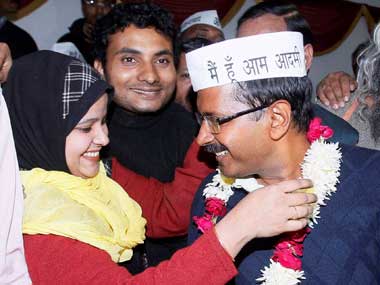
President accepts Delhi LG's proposal on AAP forming govt

December 25, 2013

Kejriwal_copyNew Delhi, Dec 25: President Pranab Mukherjee on Wednesday accepted the Delhi lieutenant governor's proposal on government formation by the Aam Admi Party.

The home ministry sent the President's communication to lieutenant governor Najeeb Jung on government formation by Arvind Kejriwal. "It is up to LG to decide date of swearing-in after holding consultation with the chief minister-designate," the home ministry said.

Earlier on Wednesday, Aam Aadmi Party said it is not in any sort of coalition or understanding with the Congress and expects "support of the majority" on the floor of the House for its 18 issues, failing which it will "move out".

"As we have always maintained, we have 18 issues and we have 28 MLAs, no more," AAP leader Yogendra Yadav told reporters here.

"We will go to the floor of the assembly and try to push each of the 18 issues which have brought us to where we are and we would expect that given the nature of these issues, and how much do they matter to the country and to the people of Delhi we would have the support of the majority on the floor of the House. If we don't have, we would move out," he said.

Trying to end speculation over some sort of understanding between the two parties, Yadav said, "I think much of the questioning and speculation is still being dictated by the old grammar of politics. Grammar of common minimum program, alliances, tie-ups, understanding, covert understanding, I wish to underline that once again that there is nothing of that kind. We have the numbers, we are going ahead to implement our agenda."

Asked about differences within Congress over supporting AAP and apprehensions that the party may try to dictate terms or affect decisions of the Kejriwal-led government, Yadav said, "It is entirely the Congress party's prerogative to take a decision about what they wish to do in the government formation scenario in Delhi."

"It is not for me to advise them, it is not for me to speculate reasons why the Congress may wish to dictate one decision or the other as we have clarified always that we do not have an alliance or a tie up, we don't have an understanding," he said.

"In the absence of that (understanding), there are no rights and obligations. It is not for me to say what they should do. Congress is an independent political party, a mature political party. It is for them to take a decision," he said.

Comments

Add new comment

  • Coastaldigest.com reserves the right to delete or block any comments.
  • Coastaldigset.com is not responsible for its readers’ comments.
  • Comments that are abusive, incendiary or irrelevant are strictly prohibited.
  • Please use a genuine email ID and provide your name to avoid reject.
Agencies
May 4,2020

Mumbai, May 4: Days after Facebook, private equity firm Silver Lake said it will invest 56.56 billion rupees ($746.74 million) in Reliance Industries's digital arm, giving it a valuation of 4.90 trillion rupees. Silver Lake on Monday agreed to pay Rs 5,655.75 crore to buy 1.15 per cent stake in the firm that houses billionaire Mukesh Ambani's telecom arm Jio.

The investment in Jio Platforms comes within days of Facebook investing USD 5.7 billion to buy a 9.99 per cent stake in Jio Platforms. The investment is at a premium of 12.5 per cent to the Facebook deal.

"This investment values Jio Platforms at an equity value of Rs 4.90 lakh crore and an enterprise value of Rs 5.15 lakh crore and represents a 12.5 per cent premium to the equity valuation of the Facebook investment announced on April 22, 2020," Reliance said in a statement.

Comments

Add new comment

  • Coastaldigest.com reserves the right to delete or block any comments.
  • Coastaldigset.com is not responsible for its readers’ comments.
  • Comments that are abusive, incendiary or irrelevant are strictly prohibited.
  • Please use a genuine email ID and provide your name to avoid reject.
News Network
February 13,2020

New Delhi, Feb 13: Arvind Kejriwal wrote to Delhi Lieutenant Governor Anil Baijal on Wednesday, staking claim to form the government in the national capital, sources said, while hinting that the AAP might not invite senior leaders and chief ministers of other parties for the oath-taking ceremony.

The sources said it was the formal process by the AAP chief, who was elected as the legislature party leader earlier in the day, to stake claim for forming the new government.

Kejriwal, who returned to power in Delhi with a stunning poll victory on Tuesday, will take oath as chief minister for the third consecutive time on February 16.

While the oath-taking ceremony will be open to the public, the Aam Aadmi Party (AAP) was considering not inviting leaders and chief ministers of other parties as it did not wish to be seen as a "confrontationist" against the BJP-led Centre, the sources said.

They, however, added that the party was yet to take a decision on it.

The AAP has planned mobilisation of people for the mega event and all the newly-elected MLAs of the party have been asked to ensure huge participation from their constituencies.

"I request the people of Delhi to attend the oath-taking ceremony of the chief minister at the Ramlila Maidan in large numbers," senior AAP leader Manish Sisodia told reporters, adding that the ceremony will start at 10 am.

The AAP won 62 seats in the 70-member Delhi Assembly, while the Bharatiya Janata Party (BJP) bagged the remaining eight seats. The Congress drew a blank for the second consecutive time in the Delhi polls.

Comments

Add new comment

  • Coastaldigest.com reserves the right to delete or block any comments.
  • Coastaldigset.com is not responsible for its readers’ comments.
  • Comments that are abusive, incendiary or irrelevant are strictly prohibited.
  • Please use a genuine email ID and provide your name to avoid reject.
Agencies
May 23,2020

New Delhi, May 23: The nationwide lockdown will no longer help India in its fight against COVID-19, and in its place community-driven containment, isolation and quarantine strategies have to be brought into play, leading virologist Shahid Jameel said.

The recipient of Shanti Swarup Bhatnagar Prize for Science and Technology also stressed that testing should be carried out vigorously to identify coronavirus hotspots and isolate those areas.

"Our current testing rate at 1,744 tests per million population is one of the lowest in the world. We should deploy both antibody tests and confirmatory PCR tests. This will tell us about pockets of ongoing infection and past (recovered) infection. This will provide data to open up gradually and let economic activity resume," Jameel told PTI in an interview.

He stressed that testing has to be dynamic to continuously monitor red, orange and green zones and change these based on that data.

About community transmission of COVID-19 in India, Jameel said the country reached that stage long ago.

"We reached community transmission a long time ago. It's just that the health authorities are not admitting it. Even ICMR's own study of SARI (severe acute respiratory illness) showed that about 40 per cent of those who tested positive for SARS-CoV-2 did not have any history of overseas travel or contact to a known case. If this is not community transmission, then what is?" he posed.

Lockdown bought India time in its fight against coronavirus, but continuing it is unlikely to yield any further dividend, Jameel said.

"Instead, community-driven local lockdowns, isolations and quarantines have to come into play. Building trust is most important so that people follow rules. A public health problem cannot be dealt with as a law-and-order problem."

The nationwide lockdown, initially imposed from March 25 to April 14, has been extended thrice and will continue at least till May 31. The virus has claimed 3,720 lives and infected over 1.25 lakh people in the country so far.

Jameel has expertise in the fields of molecular biology, infectious diseases, and biotechnology. He is the CEO of Wellcome Trust/Department of Biotechnology's India Alliance and is best known for extensive research in Hepatitis E virus and HIV.

He said COVID-19 will eventually be controlled through herd immunity, which is acquired in two ways – when a sufficient fraction of the population gets infected and recovers, and with vaccination.

"It is estimated that for SARS-CoV-2 at least 60 per cent of the population would have to be infected and recovered, or vaccinated. This will happen over the course of the next few years," Jameel said.

Herd immunity is reached when the majority of a population becomes immune to an infectious disease, either because they have become infected and recovered, or through vaccination. When that happens, the disease is less likely to spread to people who aren't immune, because there just aren't enough infectious carriers.

"India has 1.38 billion people, a population density of about 400/sq km and a healthcare system ranked at 143 in the world. If we allow 60 per cent people to get infected quickly in the hopes of herd immunity, that would mean 830 million infections," Jameel said.

"If 15 per cent need hospitalization that means about 125 million isolation beds (we have 0.3 million). If five per cent need oxygen and ventilatory support, this amounts to about 42 million oxygen support and ICU beds; we have 0.1 million oxygen support beds and 34,000 ICU beds. This would overwhelm the healthcare system causing mayhem," he said.

Jameel said if the population level mortality is 0.5 per cent that would mean 40 lakh deaths. "Are we prepared to pay this price for herd immunity in the short term? Clearly not," he said.

He said it is unlikely that a vaccine would be available by the end of the year.

"Even then, we don't know yet how long it would give protection – weeks, months, one year, a few years? I don't think we will return to pre-coronavirus days for at least the next 3-5 years. This is also a chance to evaluate if we want to return to those unsustainable, environment-damaging ways. COVID-19 is a timely warning to reform our way of living," he said.

Jameel said it is hard to predict but plausible that COVID-19 would return in second or third wave.

"Later waves come when we don't understand the disease and become lax. A comparison to Spanish Flu is not entirely valid because in 1918 no one knew what caused it. No one had seen a virus till the mid-1930s as the electron microscope needed to view those was invented in 1931," he said.

"Today we know a lot more about the pathogen, its genetic makeup, how it transmits and how to prevent it. We need to be sensible and follow expert advice," he said.

If there is any scientific evidence linking deforestation, rapid urbanisation, climate change with pandemics like COVID-19, he said zoonotic viruses -- those that jump from animals to humans -- happen so when wild animal–human contacts increase.

"Deforestation destroys animal habitats bringing them closer to humans. When you cut forests, bats come to roost on trees closer to human habitations. Their viruses in secretions/stool get transmitted to domestic animals and on to humans. This happened clearly with Nipah virus outbreak in Malaysia in 1997-98 from fruit bats to pigs to humans," he said.

"COVID-19 possibly arose in wet animal markets due to dietary habits that bring all kinds of live and dead wild animals in close contact with humans," Jameel added.


Comments

Add new comment

  • Coastaldigest.com reserves the right to delete or block any comments.
  • Coastaldigset.com is not responsible for its readers’ comments.
  • Comments that are abusive, incendiary or irrelevant are strictly prohibited.
  • Please use a genuine email ID and provide your name to avoid reject.