



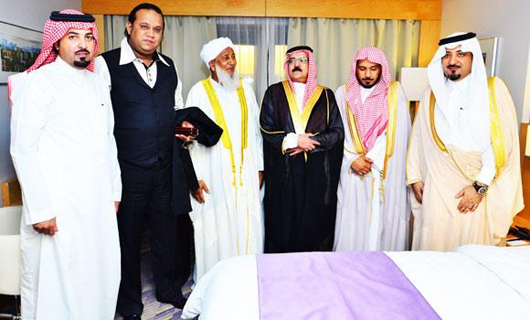
Prince Saud upbeat on Saudi-Indian ties

July 15, 2014

Prince Saud

Jeddah, Jul 15: Prince Saud bin Musaed bin Abdul Aziz, president of the Gammon Group, has highlighted the strong relationship between Saudi Arabia and India.

“We hope the Saudi-Indian relations would reach greater heights in the coming years,” he said while addressing an iftar party organized by the group.

He said many major Indian companies are interested in doing business in Saudi Arabia to make use of the growing investment opportunities in the Kingdom.

“Last year, more than 35,000 Saudis visited India for education and medical treatment,” the prince said, while commending the role played by Indian expatriate workers in boosting the Kingdom’s development in various sectors.

Shaikh Mohammed Rafik, chairman of Gammon Group, said more than 20 international companies, including those from India, Canada, Australia, Malaysia and China, have agreed to establish their plants in the new industrial city being developed by Gammon in Jazan.

“We are looking for investors in areas required by the Kingdom, including automobiles. We are in talks with a South Korean company to establish an automobile plant in Jazan,” Rafik told Arab News.

The new industrial city is expected to draw investments worth SR75 billion, the chairman said, adding that it would create about 100,000 jobs. He commended Prince Turki bin Mohammed bin Nasser, director of international trade at the Ministry of Commerce and Industry, for his efforts to speed up establishment of the industrial city.

He added that Prince Turki has been authorized by the government to develop the city by bringing in foreign investors to build the city’s entire infrastructure facilities, such as roads, bridges, commercial centers, power plants, water treatment plants, oil refinery and petrochemical plants.

“If major companies are ready to invest and transfer their technology, the government will pay them 75 percent of their project cost in soft loans for 20 years,” Rafik told Arab News.

The iftar party was attended by prominent personalities, including Indian Consul General B.S. Mubarak, British Consul General Mohammed Shaukat, South African Consul General Ebrahim Edries, Khaled Almaeena, former editor in chief of Saudi Gazette, Tariq Mishkhas, editor in chief of Urdu News and Malayalam News, Dr. Faiz Al-Abideen, CEO of Gammon Group, A.P. Abubacker Musliyar, general secretary of All-India Jameyat Al-Ulema, and Syed Bashirali Shihab Thangal.

Comments

Dorthea
 - 
Saturday, 19 Mar 2016

Right here is the right web site for everyone
who wishes to find out about this topic. You realize a whole lot its almost hard to argue with you (not that I actually will
need to…HaHa). You certainly put a new spin on a topic which has
been discussed for decades. Great stuff, just wonderful!

My web page; Lettie Bouley: http://gdzieulokowacoszczednosci.medicsen.eu

Add new comment

  • Coastaldigest.com reserves the right to delete or block any comments.
  • Coastaldigset.com is not responsible for its readers’ comments.
  • Comments that are abusive, incendiary or irrelevant are strictly prohibited.
  • Please use a genuine email ID and provide your name to avoid reject.
News Network
May 11,2020

May 11: Saudi Arabia will triple its value-added tax rate and suspend a cost of living allowance for state workers, it said on Monday, seeking to shield finances hit by low oil prices and a slump in demand for its lifeline export worsened by the new coronavirus.

Historic oil output cuts agreed by Riyadh and other major producers have given only limited support to prices after they sank on oversupply caused by a war for petroleum market share between the kingdom and its fellow oil titan Russia.

Saudi Arabia, the world's largest oil exporter, is also being hit hard by measures to fight the new coronavirus, which are likely to curb the pace and scale of economic reforms launched by Crown Prince Mohammed bin Salman.

"The cost of living allowance will be suspended as of June 1, and the value added tax will be increased to 15% from 5% as of July 1," Finance Minister Mohammed al-Jadaan said in a statement reported by the state news agency. "These measures are painful but necessary to maintain financial and economic stability over the medium to long term...and to overcome the unprecedented coronavirus crisis with the least damage possible."

The austerity measures come after the kingdom posted a $9 billion budget deficit in the first quarter.

The minister said non-oil revenues were affected by the suspension and decline in economic activity, while spending had risen due to unplanned strains on the healthcare sector and the initiatives taken to support the economy.

"All these challenges have cut state revenues, pressured public finances to a level that is hard to deal with going forward without affecting the overall economy in the medium to long term, which requires more spending cuts and measures to support non-oil revenues stability," he added.

The government has cancelled and put on hold some operating and capital expenditures for some government agencies, and cut allocations for some reform initiatives and projects worth a total 100 billion riyals ($26.6 billion), the statement said.

Central bank foreign reserves fell in March at their fastest rate in at least 20 years and to their lowest since 2011, while oil revenues in the first three months of the year fell 24% from a year earlier to $34 billion, pulling total revenues down 22%.

"The reforms are positive from a fiscal side as greater adjustment is essential. However, the tripling of VAT is unlikely to help that much in 2020 revenue wise with the expected fall in consumption," said Monica Malik, chief economist at Abu Dhabi Commercial Bank.

She said she kept unchanged her deficit forecast of 16.3% of GDP for this year, which already factors in a greater than previously announced spending cut.

About 1.5 million Saudis are employed in the government sector, according to official figures released in December.

In 2018, Saudi Arabia's King Salman ordered a monthly payment of 1,000 riyals ($267) to every state employee to compensate them for the rising living costs after the government hiked domestic gas prices and introduced value-added tax.

DIFFICULT TIMES

A committee has been formed to study all financial benefits paid to public sector employees and contractors, and will submit recommendations within 30 days, the statement said.

In late 2015, when oil prices fell from record highs, the kingdom slashed lavish bonuses, overtime payments and other benefits once considered routine perks in the public sector.

In a country without elections and with political legitimacy resting partly on distribution of oil revenue, the ability of citizens to adapt to such reforms is crucial for stability.

"Tripling the VAT will test the limits of the balance between revenues and consumption as the economy dives into a deep recession. The move will impact consumption and could also lower the expected revenues," said John Sfakianakis, a Gulf expert at the University of Cambridge.

"These are pro-austerity and pro-revenue moves rather than pro-growth ones," he said.

Hasnain Malik, head of equity strategy at Tellimer, said the VAT rise could bring about $24-$26.5 billion in additional non-oil fiscal revenue. The rise would hit consumer spending further but was a needed step towards fiscal sustainability, he said.

Comments

Add new comment

  • Coastaldigest.com reserves the right to delete or block any comments.
  • Coastaldigset.com is not responsible for its readers’ comments.
  • Comments that are abusive, incendiary or irrelevant are strictly prohibited.
  • Please use a genuine email ID and provide your name to avoid reject.
Agencies
March 15,2020

Riyadh, Mar 15: Saudi Aramco on Sunday reported a 20.6 percent drop in its net profit for 2019 due to low oil prices and production levels, the company said in a statement.

These are the first annual results to be announced by the energy giant after its historical $29.4 billion initial public offering and listing on the Saudi Tadawul market last December.

Aramco posted net profits of $88.2 billion last year compared to $111.1 billion in 2018, Monday's statement said.

"The decrease was primarily due to lower crude oil prices and production volumes, coupled with declining refining and chemical margins," it said.

The company also made $1.6 billion of impairment provisions for losses associated with Sadara Chemical Company, an Aramco subsidiary.

"2019 was an exceptional year for Saudi Aramco. Through a variety of circumstances -- some planned and some not -- the world was offered unprecedented insight into Saudi Aramco's agility and resilience," CEO Amin Nasser said.

"Our unique scale, low costs, and resilience came together to deliver both growth and world-leading returns, while also maintaining our position as one of the world's most reliable energy companies," Nasser said.

The earnings for last year are not affected by the coronavirus outbreak or the ongoing price war between Saudi Arabia and Russia that has sent oil prices crashing.

Aramco said it will distribute dividends worth $73.2 billion for 2019 but based on its commitments under the IPO, its dividends for the next five years starting this year will be at least $75 billion.

It said its capital spending last year dropped to $32.8 billion from $35.1 billion in 2018.

The company expects capital spending, which is expenditure on projects, to be between $25 billion and $30 billion this year "in light of current market conditions and recent commodity price volatility."

But it said that capital expenditure for 2021 and beyond is currently under review.

The results were announced amid a price war between Saudi Arabia and Russia after they failed to agree on additional output cuts to support prices dented by the outbreak of the coronavirus pandemic.

"The recent COVID-19 outbreak and its rapid spread illustrate the importance of agility and adaptability in an ever-changing global landscape," Nasser said.

The kingdom said last week Aramco will pump 12.3 million barrels of oil per day, boosting output by at least 2.5 million bpd.

It also announced plans to raise production capacity from 12 million bpd to 13 million bpd.

Forecasts for future crude prices and demand are also bleak.

In its latest monthly report, the Organization of Petroleum Exporting Countries lowered its forecast for global average daily demand by 0.92 million barrels to 99.73 million barrels.

Saudi Arabia is also in the midst of a royal purge that saw King Salman's brother and nephew detained after sources said they were accused of plotting a palace coup to unseat the crown prince, heir to the Saudi throne.

Aramco shares rallied immediately after the listing on December 11, rising by 19 percent to 38 riyals ($10.1) and temporarily lifting the company's valuation above the $2 trillion mark, which was sought by Crown Prince Mohammed bin Salman, Saudi Arabia's de facto ruler.

But as oil prices tumble, Aramco shares have lost 29 percent from its highest point, slipping below the listing price.

On Thursday, Aramco's market value dropped to around $1.55 trillion, but it still remains the world's largest publicly listed company.

Comments

Add new comment

  • Coastaldigest.com reserves the right to delete or block any comments.
  • Coastaldigset.com is not responsible for its readers’ comments.
  • Comments that are abusive, incendiary or irrelevant are strictly prohibited.
  • Please use a genuine email ID and provide your name to avoid reject.
News Network
January 16,2020

Dubai, Jan 16: The UAE Ministry of Climate Change and Environment on Wednesday announced that it has banned the import of birds, some eggs and meat products from Hungary and Slovakia.

The ministry said the decision was taken following a notification from the World Organization for Animal Health (OIE) on the outbreak of a highly pathogenic strain of bird flu, H5N2, in the two countries.

Accordingly, the ministry has banned "the import of all species of domestic and wild live birds, ornamental birds, chicks, hatching eggs, meats and meat products and non-heat-treated wastes from Hungary and Slovakia".

It has also regulated the import of poultry meat and non-heat-treated products, requiring a health certificate for the export of meat and meat products from the two countries to release consignments into the UAE.

A health certificate will be needed for the import of eggs, the ministry added.

However, thermally-treated poultry products (meat and eggs) have been cleared for import from all parts of Hungary and Slovakia.

Kaltham Ali Kayaf, Acting Director, Animal Development & Health Department at the ministry, said: "These measures reiterate the ministry's keenness in achieving its strategic objectives including enhancing bio-security levels and eliminating pathogens before they enter the country. In doing so, the ministry prevents the bird flu virus and related risks and impacts on the country's poultry health and safety, in addition to protecting public health and well-being."

Comments

Add new comment

  • Coastaldigest.com reserves the right to delete or block any comments.
  • Coastaldigset.com is not responsible for its readers’ comments.
  • Comments that are abusive, incendiary or irrelevant are strictly prohibited.
  • Please use a genuine email ID and provide your name to avoid reject.