



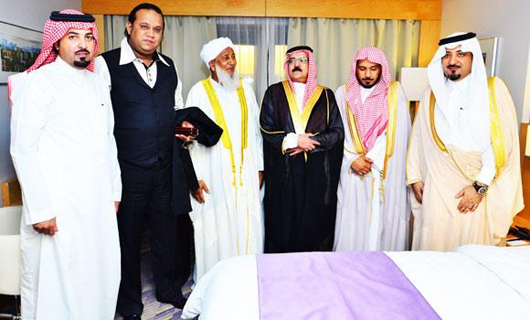
Prince Saud upbeat on Saudi-Indian ties

July 15, 2014

Prince Saud

Jeddah, Jul 15: Prince Saud bin Musaed bin Abdul Aziz, president of the Gammon Group, has highlighted the strong relationship between Saudi Arabia and India.

“We hope the Saudi-Indian relations would reach greater heights in the coming years,” he said while addressing an iftar party organized by the group.

He said many major Indian companies are interested in doing business in Saudi Arabia to make use of the growing investment opportunities in the Kingdom.

“Last year, more than 35,000 Saudis visited India for education and medical treatment,” the prince said, while commending the role played by Indian expatriate workers in boosting the Kingdom’s development in various sectors.

Shaikh Mohammed Rafik, chairman of Gammon Group, said more than 20 international companies, including those from India, Canada, Australia, Malaysia and China, have agreed to establish their plants in the new industrial city being developed by Gammon in Jazan.

“We are looking for investors in areas required by the Kingdom, including automobiles. We are in talks with a South Korean company to establish an automobile plant in Jazan,” Rafik told Arab News.

The new industrial city is expected to draw investments worth SR75 billion, the chairman said, adding that it would create about 100,000 jobs. He commended Prince Turki bin Mohammed bin Nasser, director of international trade at the Ministry of Commerce and Industry, for his efforts to speed up establishment of the industrial city.

He added that Prince Turki has been authorized by the government to develop the city by bringing in foreign investors to build the city’s entire infrastructure facilities, such as roads, bridges, commercial centers, power plants, water treatment plants, oil refinery and petrochemical plants.

“If major companies are ready to invest and transfer their technology, the government will pay them 75 percent of their project cost in soft loans for 20 years,” Rafik told Arab News.

The iftar party was attended by prominent personalities, including Indian Consul General B.S. Mubarak, British Consul General Mohammed Shaukat, South African Consul General Ebrahim Edries, Khaled Almaeena, former editor in chief of Saudi Gazette, Tariq Mishkhas, editor in chief of Urdu News and Malayalam News, Dr. Faiz Al-Abideen, CEO of Gammon Group, A.P. Abubacker Musliyar, general secretary of All-India Jameyat Al-Ulema, and Syed Bashirali Shihab Thangal.

Comments

Dorthea
 - 
Saturday, 19 Mar 2016

Right here is the right web site for everyone
who wishes to find out about this topic. You realize a whole lot its almost hard to argue with you (not that I actually will
need to…HaHa). You certainly put a new spin on a topic which has
been discussed for decades. Great stuff, just wonderful!

My web page; Lettie Bouley: http://gdzieulokowacoszczednosci.medicsen.eu

Add new comment

  • Coastaldigest.com reserves the right to delete or block any comments.
  • Coastaldigset.com is not responsible for its readers’ comments.
  • Comments that are abusive, incendiary or irrelevant are strictly prohibited.
  • Please use a genuine email ID and provide your name to avoid reject.
News Network
June 23,2020

Riyadh, Jun 23: Authorities in Saudi Arabia have decided to allow a limited number of citizens and residents who are already in the Kingdom to do this year’s Haj.

In a statement on Monday, the Ministry of Haj and Umrah said that in light of the continuation of the coronavirus pandemic and the risks of infections spreading in crowded spaces and large gatherings, it has been decided that Haj for this year (1441 H/ 2020 AD) will be held whereby a very limited number of pilgrims from various nationalities who already reside in Saudi Arabia, would be able to perform it.

“The decision was taken to ensure Haj is performed in a safe manner from a public health perspective while observing all preventative measures and the necessary social distancing protocols to protect human beings from the risks associated with this pandemic and in accordance with the teachings of Islam in preserving the lives of human beings, the statement added.

“The government of the Custodian of the Two Holy Mosques is honored to serve millions of Haj and Umrah pilgrims annually and it confirms that this decision stems from the top priority it accords maintaining the safety of pilgrims on its land until they depart to their home countries.”

“We ask Allah the Almighty to protect all countries from this pandemic and keep all humans protected and safe, the statement said.

Saudi Arabia’s top priority is to always enable Muslim pilgrims to perform Haj and Umrah rites safely and securely and the Kingdom has been keen since the beginning of the pandemic to take all necessary precautionary measures to protect pilgrims, including by suspending the entry of Umrah pilgrims while ensuring the safety of the pilgrims already present at the holy sites, the statement further added.

Commenting on the Haj decision, the Saudi Human Rights Commission said that Saudi Arabia believes in the universal right to health. Limiting Haj not only protects the Kingdom but also many pilgrims and the communities they call home around the world.

Comments

Add new comment

  • Coastaldigest.com reserves the right to delete or block any comments.
  • Coastaldigset.com is not responsible for its readers’ comments.
  • Comments that are abusive, incendiary or irrelevant are strictly prohibited.
  • Please use a genuine email ID and provide your name to avoid reject.
News Network
May 5,2020

Dubai, May 5: Saudi Arabian prosecutors have ordered the arrest of a Saudi citizen for insulting an Asian expatriate and abusing him for not embracing Islam.

A video went viral online showing the expat, apparently with little knowledge of the Arabic language, being insulated by an Arabic-speaking man who does not appear in the clip, for having not embraced Islam and for not fasting.

A monitoring centre affiliated with the public prosecution examined the video the content of which “shows the citizen’s use of abusive words against the Asian resident on the pretext of inviting him to Islam,” the prosecution source said.

“The public prosecution closely follows up whatever infringes rights of citizens and residents including harm to their dignity and legal rights regardless of pretexts of such infringement,” the source added.

Comments

Add new comment

  • Coastaldigest.com reserves the right to delete or block any comments.
  • Coastaldigset.com is not responsible for its readers’ comments.
  • Comments that are abusive, incendiary or irrelevant are strictly prohibited.
  • Please use a genuine email ID and provide your name to avoid reject.
News Network
May 11,2020

May 11: Saudi Arabia will triple its value-added tax rate and suspend a cost of living allowance for state workers, it said on Monday, seeking to shield finances hit by low oil prices and a slump in demand for its lifeline export worsened by the new coronavirus.

Historic oil output cuts agreed by Riyadh and other major producers have given only limited support to prices after they sank on oversupply caused by a war for petroleum market share between the kingdom and its fellow oil titan Russia.

Saudi Arabia, the world's largest oil exporter, is also being hit hard by measures to fight the new coronavirus, which are likely to curb the pace and scale of economic reforms launched by Crown Prince Mohammed bin Salman.

"The cost of living allowance will be suspended as of June 1, and the value added tax will be increased to 15% from 5% as of July 1," Finance Minister Mohammed al-Jadaan said in a statement reported by the state news agency. "These measures are painful but necessary to maintain financial and economic stability over the medium to long term...and to overcome the unprecedented coronavirus crisis with the least damage possible."

The austerity measures come after the kingdom posted a $9 billion budget deficit in the first quarter.

The minister said non-oil revenues were affected by the suspension and decline in economic activity, while spending had risen due to unplanned strains on the healthcare sector and the initiatives taken to support the economy.

"All these challenges have cut state revenues, pressured public finances to a level that is hard to deal with going forward without affecting the overall economy in the medium to long term, which requires more spending cuts and measures to support non-oil revenues stability," he added.

The government has cancelled and put on hold some operating and capital expenditures for some government agencies, and cut allocations for some reform initiatives and projects worth a total 100 billion riyals ($26.6 billion), the statement said.

Central bank foreign reserves fell in March at their fastest rate in at least 20 years and to their lowest since 2011, while oil revenues in the first three months of the year fell 24% from a year earlier to $34 billion, pulling total revenues down 22%.

"The reforms are positive from a fiscal side as greater adjustment is essential. However, the tripling of VAT is unlikely to help that much in 2020 revenue wise with the expected fall in consumption," said Monica Malik, chief economist at Abu Dhabi Commercial Bank.

She said she kept unchanged her deficit forecast of 16.3% of GDP for this year, which already factors in a greater than previously announced spending cut.

About 1.5 million Saudis are employed in the government sector, according to official figures released in December.

In 2018, Saudi Arabia's King Salman ordered a monthly payment of 1,000 riyals ($267) to every state employee to compensate them for the rising living costs after the government hiked domestic gas prices and introduced value-added tax.

DIFFICULT TIMES

A committee has been formed to study all financial benefits paid to public sector employees and contractors, and will submit recommendations within 30 days, the statement said.

In late 2015, when oil prices fell from record highs, the kingdom slashed lavish bonuses, overtime payments and other benefits once considered routine perks in the public sector.

In a country without elections and with political legitimacy resting partly on distribution of oil revenue, the ability of citizens to adapt to such reforms is crucial for stability.

"Tripling the VAT will test the limits of the balance between revenues and consumption as the economy dives into a deep recession. The move will impact consumption and could also lower the expected revenues," said John Sfakianakis, a Gulf expert at the University of Cambridge.

"These are pro-austerity and pro-revenue moves rather than pro-growth ones," he said.

Hasnain Malik, head of equity strategy at Tellimer, said the VAT rise could bring about $24-$26.5 billion in additional non-oil fiscal revenue. The rise would hit consumer spending further but was a needed step towards fiscal sustainability, he said.

Comments

Add new comment

  • Coastaldigest.com reserves the right to delete or block any comments.
  • Coastaldigset.com is not responsible for its readers’ comments.
  • Comments that are abusive, incendiary or irrelevant are strictly prohibited.
  • Please use a genuine email ID and provide your name to avoid reject.