



Processing US visa applications in Saudi Arabia resumes as travel ban lifted

February 8, 2017

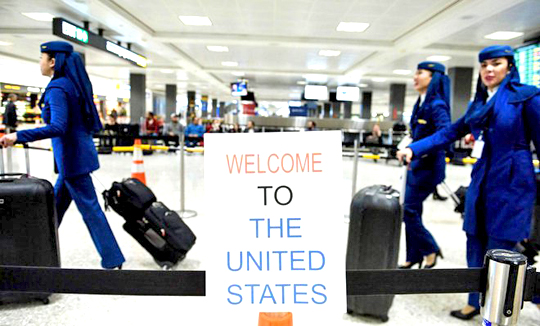
Riyadh, Feb 8: The US diplomatic missions in Saudi Arabia announced that they have resumed processing existing visa applications and schedule appointments for new ones after a US federal court order effectively suspending the travel ban for citizens of Muslim-majority countries imposed by President Trump.
USvisa

“The US Department of State had, under the executive order, provisionally revoked all valid visas of nationals of those seven countries, with limited exceptions. That provisional revocation is now lifted, and those visas are now valid for travel to the United States if the holder is otherwise eligible,” said Johann Schmonsees, a spokesman for the US embassy here, on Tuesday.

Schmonsees said that “individuals whose visas are expired, or were canceled, must apply for a new visa at a US embassy or consulate, absent a Customs and Border Patrol (CBP) decision to grant parole or waive the visa requirement at the port of entry.”

The applicants can submit their applications at the Riyadh-based US embassy or at the Jeddah-based US Consulate.

A statement posted by the US embassy on its website said that “we are working closely with the Departments of Justice and Homeland Security and we will provide further updates as soon as information is available”.

“On Jan. 27, 2017, President Trump signed the ‘Executive Order 13769 on Protecting the Nation from Terrorist Attacks by Foreign Nationals,’ which directs us to review current screening procedures,” the statement added.

The statement further said that the US government’s screening and vetting procedures for visitors are constantly reviewed and refined to improve security and more effectively identify individuals who could pose a threat to the US.

“We welcome every opportunity to continue to review and improve our systems and procedures,” said the statement.

The US embassy, located in Riyadh in the Diplomatic Quarter, and the Jeddah consulate offer visa services from Sunday through Thursday.

The US diplomatic missions will be closed on Feb. 19, a holiday in the US, according to the US embassy website.

Trump’s order applied to Iraq, Syria, Iran, Sudan, Libya, Somalia and Yemen, all Muslim-majority countries that the administration said raise terrorism concerns.

The US State Department said last week that as many as 60,000 foreigners from those seven countries had had their visas canceled.

Comments

Add new comment

  • Coastaldigest.com reserves the right to delete or block any comments.
  • Coastaldigset.com is not responsible for its readers’ comments.
  • Comments that are abusive, incendiary or irrelevant are strictly prohibited.
  • Please use a genuine email ID and provide your name to avoid reject.
Agencies
April 27,2020

Riyad, Apr 27: The Saudi-led Arab Coalition supporting Yemen’s UN-recognized government on Monday urged all parties to end any escalation of hostilities and return to the status that existed before the Southern Transitional Council (STC) declared self-rule.

In a statement carried by the Saudi Press Agency (SPA), the coalition emphasized “the need to cancel any step that violates the Riyadh agreement and work to accelerate its implementation.” 

On Sunday, the United Arab Emirates-backed STC scrapped a peace deal with the internationally recognized government of President Abed Rabbo Mansour Hadi.

Accusing the government of corruption and mismanagement, the separatists said they would “self-govern” the key southern port city of Aden and other southern provinces.

Yemen’s Foreign Minister Mohammed Al-Hadhrami described the move as a “resumption of its (STC’s) armed insurgency and rejection and complete withdrawal from the Riyadh agreement.” 

Authorities in Yemen’s southern provinces of Hadramawt, Abyan, Shabwa, Al-Mahra and the remote island of Socotra also rejected the separatist group’s claim to self-rule.

The government said local and security authorities in the five provinces dismissed the move as a “clear and definite coup.” 

Some of the provinces issued their own statements condemning it.

The coalition appealed to all parties to “give priority to the interests of the Yemeni people over any other interests”. 

It also urged the parties involved not to lose their focus on working to achieve the goal of restoring the state, ending the Houthi “coup” and “countering terrorist organizations”.

“The Coalition has and will continue to undertake practical and systematic steps to implement the Riyadh Agreement between the parties to unite Yemeni ranks, restore state institutions and combat the scourge of terrorism,” the statement said. “The responsibility rests with the signatories to the Agreement to undertake national steps toward implementing its provisions, which were signed and agreed upon with a time matrix for implementation.”

The STC has been part of the coalition-backed forces fighting the Iran-backed Houthi militia, which seized control of the Yemeni capital Sanaa and other provinces in 2014.

The Houthi “coup” has led to the formation of the Saudi-led coalition, which had since driven away the Houthis from the south and other provinces. President Hadi’s government has made Aden as its temporary seat.

Comments

Add new comment

  • Coastaldigest.com reserves the right to delete or block any comments.
  • Coastaldigset.com is not responsible for its readers’ comments.
  • Comments that are abusive, incendiary or irrelevant are strictly prohibited.
  • Please use a genuine email ID and provide your name to avoid reject.
News Network
March 18,2020

Riyadh, Mar 18: Private-sector businesses in Saudi Arabia on Wednesday were ordered to introduce enforced remote working for all employees for 15 days in an attempt to prevent the spread of the coronavirus.

Businesses that require staff to be physically present to ensure they continue to operate — including those in vital or sensitive sectors such as electricity, water and communications — must reduce the number of workers in their offices to the bare minimum. This can be no more than 40 percent of the total number of staff.

In such cases precautionary measures set by the Ministry of Health must be followed. At offices, and staff accommodation, with more than 50 workers, an area at the entrance must be provided where temperatures can be taken and symptoms checked.

Employers must also set up a mechanism for workers to report any symptoms, such as high temperature, coughing or shortness of breath, or contact they have had with infected individuals or people who recently returned from other countries without following proper Ministry of Health quarantine procedures.

Inside offices, a safe amount of space between employees must be maintained at all times. In addition, all health clubs and nurseries provided by employers must close.

Pregnant women and new mothers, people suffering from respiratory diseases, those with immune-system problems or chronic conditions, cancer patients and employees above the age of 55 are to be given 14 days compulsory paid leave, which will not be deducted from their annual entitlement.

Businesses that are excluded from the new measures include pharmacies and supermarkets, and their suppliers. Private-sector organizations that provide services to government agencies must contact them before suspending workplace attendance. Any other business that considers it impossible to operate with only 40 percent of staff in the workplace must submit an exemption request to the authority that supervises it.

Comments

Add new comment

  • Coastaldigest.com reserves the right to delete or block any comments.
  • Coastaldigset.com is not responsible for its readers’ comments.
  • Comments that are abusive, incendiary or irrelevant are strictly prohibited.
  • Please use a genuine email ID and provide your name to avoid reject.
Arab News
March 9,2020

Dubai, Mar 9: The eyes of the world will be on the oil markets when the big trading hubs in Europe and North America open following the end of the deal between Saudi Arabia and Russia that has helped to sustain crude at relatively high levels for the past three years.

There were big falls on Friday when ministers from the Organization of the Petroleum Exporting Countries (OPEC) failed to get a deal with non-OPEC members — the so-called OPEC+ — to extend output agreements. Brent oil was down nearly 10 percent at $45.27 going into the western weekend.

Saudi Aramco took immediate action to cut prices after the OPEC+ collapse, offering big discounts for crude deliveries from next month, when the current output restrictions end.

According to a notification sent to customers by Saudi Aramco, seen by Arab News, the Kingdom’s oil giant will cut between $4 and $8 per barrel, with the biggest discounts being offered to buyers in northwest Europe and the US.

Roger Diwan, an oil analyst at consultancy IHS Market, said: “We are likely to see the lowest oil prices of the past 20 years in the next quarter.”

West Texas Intermediate, the US oil benchmark, fell to $28.27 in November 2001.

The move raises the possibility of a “crude war” between the three biggest oil blocs — the US, Russia and the Arabian Gulf. Some analysts believe the American shale industry is more vulnerable to low prices than either the Russians or the Saudis.

Robin Mills, head of the Qamar consultancy, told Arab News: “I don’t think this was premeditated but Saudi Arabia has clearly swung quickly into action to put the Russians under pressure. But the Russians, with low debt and a flexible exchange rate, can cope with a few months of low prices.”

The boom in US shale has made the country the biggest oil producer in the world, but with high financing costs. Lower global prices would put a lot of shale companies out of business.

On the other hand, American motorists, and President Donald Trump, would be pleased to see lower fuel prices in an election year.

In Moscow, one prominent financier with ties to the Kingdom played down the long-term significance of the Vienna fallout.

Kirill Dmitriev, chief executive of the Russian Direct Investment Fund, told Arab News: “Saudi Arabia is our strategic partner, and cooperation between our two countries will continue in all areas. We will also continue to work within the framework of the Russia-Saudi Economic Council.”

One Russian official, who asked not to be named, added: “There is a good relationship between Alexander Novak, Russian energy minister, and his Saudi counterpart Prince Abdul Aziz bin Salman, and I am sure they will continue talking to each other less formally.”

Comments

Add new comment

  • Coastaldigest.com reserves the right to delete or block any comments.
  • Coastaldigset.com is not responsible for its readers’ comments.
  • Comments that are abusive, incendiary or irrelevant are strictly prohibited.
  • Please use a genuine email ID and provide your name to avoid reject.