



Public health in India is a disaster: Amartya Sen

October 17, 2014

New Delhi, Oct 17: The ancient Nalanda University, renowned across southeast Asia and beyond, had a school of public health and a Chinese student who studied there around the 6th century AD had a lot of admiration for the state of public health in India, which today is in a state of "disaster", said Nobel laureate and renowned economist Amartya Sen.
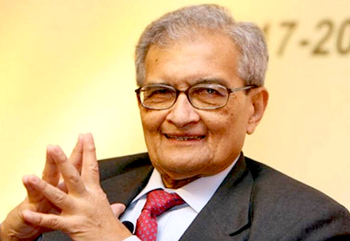
Amartya SenSen, who is vice chancellor of the revived Nalanda University that has begun classes from Sep 1 this year, said the Chinese scholar Yi Jing who studied public health for many years in Nalanda University in the 6th century "had fond admiration for the state of public health in India" and he found that it was comparable to China and "praised public health in India" which is now "a disaster".

Delivering a talk on "The Relevance of Nalanda in the Contemporary World" as part of the Nalanda Distinguished Lecture series, the economist said the revived university had plans to start a school of public health and also one on Buddhism and on linguistics.

Later, in answer to a question, Sen said that in India the government spends about one percent of the GDP on public health in comparison to China's three percent.

"We need to go beyond" to provide good public health to the people, he added.

He said that in many parts of the world that are poor, international lending agencies like the World Bank and IMF "discouraged" such countries from spending on healthcare until a decade ago "and instead wanted them to send on developmental expenditure".

He said that "one of the reasons why an epidemic like Ebola has become so difficult to control is that many of the healthcare establishments that could have come up did not come up in order to qualify for aid from international organizations, though that is not the position now".

Sen has earlier too deplored the state of public health in India.

The revived Nalanda University was inaugurated by External Affairs Minister Sushma Swaraj last month.

Classes started with two schools - School of Ecology and Environment Studies and School of Historical Studies - Sep 1 with 15 students and half-a-dozen faculty members.

The university is to come up in Rajgir, 12 km from where the ancient Nalanda University stood till the 12th century when it was razed by Muslim invaders.

Sen said there were some attempts to see the ancient Nalanda University as part of the Silk Route, through which trade and commerce was carried out between the East and West between the 3rd century before Christ and the 3rd century AD.

He also said that the "gigantic influence of the Nalanda trail" was still not grasped by the world and that the UN had not given it the recognition it deserved.

To a question on why Indian universities failed to make the mark among the top universities in the world, he said "we should not lose our heads" over the matter but focus on "raising quality".

He said while the IITs were very good, they lacked teaching in humanities subjects that was counted by the rating bodies.


Comments

Add new comment

  • Coastaldigest.com reserves the right to delete or block any comments.
  • Coastaldigset.com is not responsible for its readers’ comments.
  • Comments that are abusive, incendiary or irrelevant are strictly prohibited.
  • Please use a genuine email ID and provide your name to avoid reject.
Agencies
July 30,2020

Mumbai, Jul 30: Counterfeiting incidents have increased 24 per cent in the country in 2019 over the previous year, creating an over Rs 1 lakh crore hole in the economy, according to a report.

The report also said counterfeiters are having a free run due to the pandemic-driven disruptions to organised supply chains and the resultant spike in consumer demand.

According to the report by ASPA, a self-regulated industry body of anti-counterfeiting and traceability solutions providers, counterfeiting has risen steadily in the last few years, and exploiting the pandemic as a cover for their activities.

Between February and April 2020, over 150 incidents of counterfeiting cases were reported, mostly about fake PPE kits, sanitisers and masks taking advantage of the high demand for these products, it noted.

"There was a 24 per cent increase in counterfeiting in 2019 over 2018, leading to the loss of more than Rs 1 lakh crore to the overall economy," said Nakul Pasricha, president of Authentication Solution Providers Association.

The association works with global authorities like the International Hologram Manufacturers Association, Counterfeit Intelligence Bureau of the Interpol, and domestic industry lobbies like Ficci, he said.

Counterfeiting is a universal issue and is 3.3 per cent of global trade, according to the OECD data, impacting social and economic development across the world.

The report lists the currency, FMCG, alcohol, pharma, documents, agriculture, infrastructure, automotive, tobacco, lifestyle and apparel, as the 10 sectors impacted most by counterfeiting.

Among these, currency, alcohol and FMCG continue to be the top three sectors with the highest counterfeiting in the last two years. The FMCG sector is most vulnerable, as counterfeit incidents rose 63 per cent between 2018 (79) and 2019 when the reported cases jumped to 129.

Within the states, the fakers have a free run in Uttar Pradesh, Bihar, Rajasthan, Madhya Pradesh, Bengal, Punjab, Jharkhand, Delhi, Gujarat, and Uttarakhand, calling for urgent actions to frame anti-counterfeiting policy measures.

According to the report, UP continues to be on top followed by Bihar, Rajasthan, and together these three states represent almost 45 per cent of all counterfeiting reported in the last two years.

What is more alarming is that counterfeiting is not limited to high-end luxury items today, as common everyday items as fake cumin seeds, mustard cooking oil, ghee, hair oils, soaps, baby care vaccines and medicines are aplenty in the markets.

"There is an urgent need for building and nurturing authentication ecosystems in the country with the active involvement and active participation of all stakeholders," said Pasricha.

Comments

Add new comment

  • Coastaldigest.com reserves the right to delete or block any comments.
  • Coastaldigset.com is not responsible for its readers’ comments.
  • Comments that are abusive, incendiary or irrelevant are strictly prohibited.
  • Please use a genuine email ID and provide your name to avoid reject.
Agencies
January 12,2020

New Delhi, Jan 12: A fact-finding committee of the Congress on the JNU violence on Sunday said the January 5 attack inside the university campus was "state-sponsored" and recommended Vice Chancellor M Jagadesh Kumar be dismissed and criminal investigation initiated against him.

The Congress had appointed a four-member fact-finding committee to carry out a detailed inquiry into the violence at the Jawaharlal Nehru University (JNU).

Sushmita Dev, member of the committee, said the committee recommended that Kumar should be dismissed immediately and all the appointments in faculty should be probed and independent inquiry should take place.

"Criminal investigation must take place against the VC and faculty members and the security company," the Mahila Congress chief said.

"It is clear that the attack on JNU campus was state-sponsored," Dev said.

She also demanded a complete rollback of the JNU fee hike.

The other members of the fact-finding committee are Hibi Eden, MP and former NSUI president, Syed Naseer Hussain, MP and former president of JNU NSUI and Amrita Dhawan, a former NSUI president and ex-DUSU president.

On January 5 night, masked people armed with rods and sticks stormed the JNU campus and assaulted students and faculty members, and vandalised property, leaving several people injured.

Leftist outfits and the RSS-affiliated Akhil Bharatiya Vidyarthi Parishad (ABVP) blamed each other for the violence.

Comments

Add new comment

  • Coastaldigest.com reserves the right to delete or block any comments.
  • Coastaldigset.com is not responsible for its readers’ comments.
  • Comments that are abusive, incendiary or irrelevant are strictly prohibited.
  • Please use a genuine email ID and provide your name to avoid reject.
Agencies
July 29,2020

Ambala, Jul 29: The five French Rafale fighter jets touched down at Haryana's Ambala after covering a distance of nearly 7,000 km to join the Indian Air Force.

The jets were given a customary water salute upon their arrival at the airbase, some 220-km from the India-Pakistan border.

The formal induction ceremony of the aircraft would be held later. The aircraft would move out soon to another operational base for operational sorties.

After taking off from France on Monday, the aircraft made their first stopover at a French base in the United Arab Emirates on their way to India and were refuelled by the French Air Force tanker aircraft somewhere around Greece or Israel over the sea before landing there.

The five were flown by pilots of the 17 Golden Arrows led by Commanding Officer Group Captain Harkirat Singh along with other pilots, Wing Commanders MK Singh, R Kataria, Sidhu and Arun.

The five Rafale fighter aircraft took off on Monday for India from an airbase in France. The weather in Ambala was cloudy with one or two spells of rain or thundershowers being forecasted.

India had signed a Rs 59,000-crore deal on September 23, 2016 for 36 Rafale jets from French aerospace major Dassault Aviation.

In view of Rafale fighter jets landing in the city on Wednesday, Section 144 is being imposed in four villages close to Ambala airbase. Munish Sehgal, DSP Traffic, Ambala, said the administration is on a high alert and the gathering of people on roofs and photography during landing has been strictly prohibited.

The five Rafale fighter jets had entered the Indian Airspace earlier in the day. "The Birds have entered the Indian airspace..Happy Landing in Ambala!" tweeted the Defence Minister's Office earlier on Wednesday.

The Defence Minister's Office further informed that the five Rafales were escorted by 02 SU30 MKIs as they enter the Indian airspace.

Here are the key Highlights of Rafale:

It's an Omni role aircraft.
4th Generation Fighter Jet.
It's a two-engine aircraft.
It's top speed is 2,222 Km/Hr.
It can go up to 50,000 Ft.
It's Rate of Climb is 60,000 Ft/Min.
It's Operational Range is 3,700 Km.
Ground Support.
In-depth Strike.
Anti-Ship Strike.

Reach and combat radius is 1600-1700 Kms.
Capable for Long Range standoff Mission.
Equipped with Air-to-Ground Missile System.

Specifically designed to take off from an extremely cold high altitude region.

It will also be fitted with the air-to-air beyond visual range interception combat and self-defence missile.

It can also carry the best long range air-to-land missile.

It has multi-directional radar system which can detect 40 targets at the same time in a range of over 100 Kms.

It has advance radar warning receiver to identify hostile tracking system a towed decoy system to thwart incoming missile attacks.

Rafale will ensure that our pilots will not have to cross the border to strike the target, that is about 600 Km in enemy territory.

It will get French industrial support for 50 years. 

Comments

Add new comment

  • Coastaldigest.com reserves the right to delete or block any comments.
  • Coastaldigset.com is not responsible for its readers’ comments.
  • Comments that are abusive, incendiary or irrelevant are strictly prohibited.
  • Please use a genuine email ID and provide your name to avoid reject.